Accepting US car standards would risk European lives
(etsc.eu)666 points by saubeidl 4 hours ago
666 points by saubeidl 4 hours ago
> Every EU politician who tries to subvert car safety should be dismissed and tried for endangering public safety.
The problem is coming from the other side, the Americans are threatening to start a new trade war if the EU doesn't permit their murdermobiles on the European roads.
IMO pedestrian safety should still come above all else, but this is not an initiative coming from some EU representatives who want to own a Cybertruck. Blocking these cars can have impact on the war against Ukraine and the prices of fuel and other import products on the short term.
As an European, I'd rather have a trade war, than bend 90 degrees.
But the EU commission will bend and sell us out, the same way it's selling european privacy to security and data companies lobbying it (just check how many times Thorn, Palantir et al have met with EU officials, lobbying is recorded and publicly accessible).
It's a tactic, agree to the deal, the US ignores us. Allow the deal to get destroyed in parliament and the courts and it has no effect. The deal was a means by which to get enough time to figure out the correct response. We've been doing this kind of thing for decades.
The problem with accepting yet another blackmail (or else trade war, or else NATO doesn't really exist anymore) is just a slippery slope. Not the first request that was made like this, not the last.
>lobbying is recorded and publicly accessible
As in the meeting dates or the actual talks? Mind dropping a link?
I mean, the commission said it "intends to accept". Given the EC's legendary lightning-fast speed, that presumably puts the timeline long after ol' minihands is out of office, and thus irrelevant.
Even when the EC actually _wants_ to do something, it typically struggles to get it done in under a decade.
Trade wars work both ways. So far the US export market is not doing so great. All those tariffs are raising the cost of exported goods as well. And those were already too expensive before the tariffs. If the US wants more US cars on EU roads, it needs to start making better cars. It's that simple. But in the EU, cars have to compete with domestic cheap cars and imported Korean and Chinese cars. It's a level playing field. Hence not a lot of US cars on the roads. A few Teslas (made in the EU mostly), a few Fords (some made on the VW platform), and a sprinkling of niche imports for things like muscle cars and pickup trucks. They are quite rare but you see one or two once in a while.
Maybe the legislation allowing their import should take their special status in to account.
I would suggest mandatory semi (or full) trailer truck drivers' license required for anyone who operates these. In addition, they should be indicated as a new category of "recreational trucks", with harsh penalties specific to them especially regarding road accidents.
For example, if found guilty of reckless driving, or causing accidents, the vehicle would be permanently confiscated. (On top of personal fines, loss of license etc as already sentenced by law.) Perhaps the law enforcement could then be given access to such confiscated vehicles, creating also some incentive to enforce the law.
> threatening to start a new trade war if the EU doesn't permit their murdermobiles on the European roads
The strange part is that those car can be sold in the EU markets already. They just have to comply with the same pollution and safety standards as other cars. What would justify an exception?
Fuck it. Let the Americans start another trade war then. This nonsense has been going on long enough, if times need to get tough so be it then, start earlier rather than in 5 years when these misery machines are everywhere and the car arms race is in full effect.
It’s tough when there’s a war going on and the EU countries don’t really want to pay the true cost for their defense.
Decisions are still made by our local polititians, not by Americans, who should take responsibility for those, especially in such a serious situation as this.
Pressure from Americans - who have no say in how we live in Europe -, remote or suspected, transient consequences on costs and conflics, all have lower, much lower priorities than keeping the population safe and healthy. Dead people need no cheap fuel, need no prompt conflict resolution, need no short term tariff settlements, and do not care what Americans think. Dead people are just dead! EU polititians should let people stay alive foremost of all! The rest come aftre that.
And all because these stupid huge trucks. Not even close in importance! Does not worth it.
As an American, I have plenty of disappointment in government right now with my own. But it's also incredibly disappointing how many other world leaders are letting Trump roll over them.
The trade wars go both ways. Certainly it can be a bit of a collective action problem when it comes to individual countries that are smaller than the US, but the EU as a whole should be able to negotiate on even-enough footing with the US on these kinds of issues.
Any war goes both ways, but that's not the point. The point is: can you win a war against your adversary? Can the UK win a trade war against the US for example?
The thing is, nobody else wants trade wars. Both sides of a trade war lose in a system of otherwise free commerce, the "winning" party is the party that is willing to sacrifice the most to make a point. Everyone but maybe the super wealthy are worse off. Americans are paying the price for their government's idiotic tariff game, but the real cost will come over the following years, and in some cases decades.
The EU is trying to minimize the damage for its constituents, they're not interested in a stupid power play. Threats of reciprocating in trade wars are meaningless if the leadership you're threatening doesn't care if their people starve.
Playing tough doesn't matter anyway, the American voting public will just blame the EU for all the bad things that happen if the EU's actions do have an impact, laugh at the EU if a diplomatic solution is found, and the American leadership will repeat whatever the last guy to verbally jerk off Trump said for at least the coming three years.
In a way, it's kind of impressive. The EU was not ready for America to devolve into this level of clown politics this fast, and that left them unprepared.
> with pedestrian deaths up 80% and cyclist deaths up 50%
https://www.youtube.com/watch?v=LC9a3GR1HJY&t=371s
> I said there was no way this truck would pass a pedestrian impact safety standard. Now, I wasn't wrong that the truck won't pass a pedestrian impact safety standard, it won't! And that's why they can't sell it in Europe. [...] But I didn't realise that America has no pedestrian impact standards. [...] America actually allows companies to self-certify a variety of aspects of safety.
See also: Boeing. It is the exact same kind of fuck-up. Regulators should not be in bed with the industries they regulate. That's a hard problem to solve, because where if not in industry would you get the expertise. But these kind of revolving door arrangements are extremely problematic.
And that is not counting in the fact that there far more pedestrians on the street in EU than in the USA. If there were the same amount of pedestrians in the USA as in the EU the statistics would be even worse.
When there are more obstacles and hazards on the road drivers tend to slow down and pay attention. Pedestrian deaths in my city peaked in 2025, but they didn't happen in the walkable central areas of the city where pedestrians are common, they happened out in the 'burbs where the roads are wide and pedestrians are few.
The general problem is the US are a bully and Europe just caves, always. We should put up a serious fight. Block all US imports, starting with tech, and see what happens. Who cares if we sell less champagne??!?
It’s not about champagne. It’s about us not making anything like the Patriot air defense system. Or us not having the capabilities to command our disparate militaries cohesively without US involvement in NATO. The whole Western order has been built on the premise of US being the corner stone that ties everything together.
Thank God the French have always been suspicious about it since the Suez crisis, hence we _do_ have at least some independent capabilities.
For those who don't know, the French (and British) instigated the Suez crisis. It was a highly illegal attempt at regime change in Egypt and the US along with the USSR and United Nations rightfully pressured the French to stop. Bizarre example to illustrate the need for military independence.
The US is underwriting European security (and by extension various European welfare states).
Do you really want to block the import of arms and financial aid to Ukraine?
If Europeans were serious about their sovereignty they’d have made very different choices up until now.
It isn’t right that America has so much power in this circumstance, but going back decades the US has been asking for Europe to take defense seriously.
> It isn’t right that America has so much power in this circumstance, but going back decades the US has been asking for Europe to take defense seriously.
Funny because the last time I believe that it was the US that requested help in Iraq and Afghanistan and not the other way around.
Europe should certainly increase its defense spending (and actual capabilities). But the reason NATO exists isn't just to please Europe. The US have a direct interest in containing Russia; I don't think they can afford to simply stop caring about the rest of the world. And I'd be willing to test that theory.
> I don't think they can afford to simply stop caring about the rest of the world.
It seems that the policy of the current US government is to split the world between themselves, Russia and China. And I guess that's a legitimate policy, even though I think it's both impossible and incredibly misguided.
> Do you really want to block the import of arms and financial aid to Ukraine?
Umm... yes? Since this whole debacle started, the EU has been shooting itself in the foot with all the sanctions that hurts its industries.
On the other hand, the US did the smart thing and did not give out weapons for free, it charged for them.
In the end, the US will be the winner of this war and Europe will come out of it incredibly weak economically. And it will have to turn to the US for help. Again.
> I didn't know this, but it is absolutely crazy.
It's crazy because the numbers don't line up with the theory. If you look at US traffic deaths by year, they were basically flat in terms of vehicle miles traveled between 2010 and 2019 and then took a big jump from COVID which is only now starting to come back down.
Meanwhile in Europe road fatalities were also fairly flat up until 2019, and then went down significantly from COVID.
Now we have to guess why the responses to COVID had the opposite effect in each place, but it's pretty obvious that the difference was a primarily result of COVID rather than differences in vehicle safety regulations, unless the vehicle safety regulations all changed in 2020 and everyone immediately replaced the installed base of cars everywhere overnight.
2020 wasn't just the start of Covid, but also the start of BLM. The narrative I always see from the American right is that BLM caused many police forces across the US to radically reduce traffic enforcement, since: 1. traffic offenders are disproportionately black, 2. stops for minor traffic offences can sometimes spiral into violence in various ways, and some viral ones have involved absurdly bad use of force decisions by officers involved, and 3. no force wants to take the blame for another George Floyd
Per this narrative, a significant antisocial tranche of the public has responded to the effective suspension of traffic law in the way that you would expect them to, and that is why road deaths are up.
COVID happened in the year of the discontinuity and caused major changes to commuting behavior as a result of remote work, people afraid of infection avoided mass transit, many people moved out of cities or lost their jobs, people bought cars who didn't used to drive and now there are more new/inexperienced drivers with cars (and it's easier to get a license in the US than Europe), etc.
Also, the numbers for at least the US are apparently just wrong:
https://en.wikipedia.org/wiki/Motor_vehicle_fatality_rate_in...
1.27 fatalities per 100M VMT in 2023 (the latest year with data), 1.11 in 2010, that's a difference of 14%, not 30%. Even the peak during COVID was only 24% above 2010. The only way I can see to get 30% is to use the during-COVID number for only the total number of motor vehicle fatalities without accounting for population growth or vehicle miles traveled, which is not a great metric for making comparisons.
Keep in mind that the US stats are derived from cities that are designed around personal automobile transportation, so they're likely muted.
Europe on the other hand has a much higher level of intermingling between pedestrians and vehicles. This puts pedestrians more often in harms way, and likely will lead to out-sized dangers that aren't seen as frequently in the USA. Pedestrian safety is a key requirement for European car safety.
If the EU is politically forced into accepting the US standards: The slack will need to be picked up by European insurance companies, who should charge extreme premiums for unsafe designs, effectively blocking the sale of the vehicles from dangerous, young, or casual drivers and limiting those designs to those who truly need them (which I suspect is very few.)
This should also go a long way in addressing inexpensive Chinese vehicles that ape the American designs. Since that is more likely going to be what is on the roads.
I'm with you regarding the argument, but want to nitpick:
"dismissing" a politician sounds like an easy fix but we probably don't want hyper-polarized dismissal wars where politicians are "shot down" immediately after being elected. That's why there are other mechanisms such as not re-electing, public shaming, transparency fora etc. ... we need to work on strengthening those, the accountability and transparency.
They need to prop up dying German car companies, and are OK with using European lives as collateral.
>They need to prop up dying German car companies
Germany isn't the only economy dependent on the legacy auto sector. France, Italy, Romania, Czechia, Slovakia and Belgium also have a lot of jobs, or had, in the auto industry, before the mass layoff of the last 2-3 years.
True, France does too of course, but Germany has been particularly stubborn. There's infighting within Europe, for that matter - note Polestar opposing Merz's attempts to weaken Europe's phase out of combustion vehicles. https://www.msn.com/en-gb/news/newsbirmingham/volvo-and-pole...
Yes, but in France Renault just made a new Twingo, to be electric, for 20,000 euro, and they're starting to make electric sports cars (A290, future electric A110), so I wouldn't call that 'legacy auto'.
As much as German car companies suck it's not them that are road killers
Among other issues, Volkswagen killed roughly 1200 people by cheating on their emissions tests.
https://lae.mit.edu/2024/06/28/study-quantifies-premature-de...
Besides the whataboutism, this is 1200 premature deaths (of mostly frail people). As much as I'm sensible to the topic of air pollution, putting that number closer to the number of, I dunno, premature deaths attributable to Coal power plants will give a more realistic view of the problem
You can't really compare the two. Vehicle safety regulations might not be able to make up for the USA having stroads and in general bad design. For the same reasons trying to move safety standards over could make things even worse than the USA due to them not fitting the conditions.
Whether they like it or not, American cars have become a lot more European over the years. I wish I had figures to back it up but from my own anecdotal experience when we traveled to the US when I was young almost every car was different and, for me at least, this made it feel strange and exciting.
Taking my own kids back there this year, most of the normal cars were common, or at most variations of the ones from Europe. Even many of the vans and work vehicles are now common European shapes, occasionally with a different badge. Trucks and full size SUVs were the last hold outs of US specific models.
Which makes me wonder, are the pedestrian deaths really heavily weighted towards these models?
For what it's worth we hired a full sized SUV. There was one point where I was about to drive out of our Villa's driveway when my partner shouted "wait!" There was a 8ish year old kid walking down the sidewalk towards where I was about to cross it who was completely invisible from the driving position. It was actually safer to forward park that thing because the visibility in the reversing camera was much better than driving forward.
At the risk of sounding contrarian, do we have any idea what the drivers of this are? Is this actually about car design, or is it other bits?
Just as a starter for ten, is that 30% increase distributed around the US or concentrated in certain states? I can't imagine we've seen the same increase in New York than in rural Alabama (and if that's the case, how much of it is really attributable to car designs)?
> Every EU politician who tries to subvert car safety should be dismissed and tried for endangering public safety.
Yeah, so that would be rampantly anti-Democratic authoritarianism... Peaceful transfer of power is pretty much at the core of why democracy works in the first place, and once you start engaging in political persecution because you don't like some trade-off involving safety ... yeah, that's no longer a democracy but something else.
Yes, and? Are they tried for making politician decisions someone (e.g. the next people in power) didn't like? This doesn't engage at all with what I talked about, and I already explicitly acknowledged that peaceful transition of power is important. What is the point of this comment? Why rebuke something I never even remotely said?
> Every EU politician who tries to subvert car safety should be dismissed and tried for endangering public safety.
No. Every EU politician who doesn't support BANNING all cars should be dismissed and tried and executed! Look, I'm even tougher on pedestrian safety than you are!
I think it's hard to say for sure that it's only the safety regulations on the car that that have resulted in these reductions, and by contrast those increases in the US. There are so many other things not related to the regulations on the car. My guess for example is that us have a lot less bike roads than europe does and traffic rules are not affected by the regulations on the cars and so on. for sure European European car regulations are probably better than American ones from a safety perspective. but I think it's hard to to say that without them we would have an increase, it would have a smaller reduction.
I kind of agree but this is missing a big part in my opinion. How can we quantify the penalty faced by consumers in EU with to increased costs due to regulation?
There might be certain number of deaths we can accept for increased cost but how is it so obvious that this tradeoff was worth it?
What if cars got 2x costlier in EU due to the regulations to give you a .01% increased chance in safety?
Edit: here are some back of envelope numbers from chatgpt
A single, ordinary car ride carries an extremely small chance of death:
USA: ~1 in 7.7 million
EU: ~1 in 20 million
Its not super clear that optimising these numbers is obviously worth the increased costs.
Edit2: people can make the choice to buy Volvo cars that are ~40% safer. Why isn't every car buyer buying only Volvo?
The assumption you have to make is that regulation would make it much cheaper to buy a safe car than just buying Volvo. It is somewhat true but not sure on the extent.
I think that's a little bit of a weird way to look at the probabilities. Sure, for a one-off activity I might look at 1 in 7,700,000 and decide that's an acceptable risk. But many people in the US take several car rides per day.
At, say, 4 rides per day, that's about a 1 in 5300 chance of death over a single year. That's still small, but not that small. Someone in a decent-sized town or city could expect to lose someone they know once every few years with those odds.
We know what the rate of deaths are: 1 in 8000; roughly 40,000 over 320,000,000.
Slightly less than the rate of suicide; and slightly more than half the number of fentanyl deaths. And a smaller fraction of medical mistake deaths. (Of course, none of the risk is evenly distributed.)
As a systemic problem, I’m not convinced that cars are the worst. Or outside what we accept in several areas.
The non-even distribution is a key part of it. Fentanyl deaths don’t affect me if I don’t drug, and if 80% (made up number as example) of car fatalities involve drunk driving, it also factors out for most people.
If cars had a random chance to simply explode equivalent to the mortality rate in crashes, people would treat them Very Differently.
I think if you want to make this argument you can go look at the stats. Look at the relative cost of vehicles in the EU over the past 25 years, compare to the cost of vehicles in the US over the past 25 years.
Obviously the lack of difference there wouldn't prove much (if I had to bet I'd bet cars in the US have gotten way more expensive faster than in the EU, just from labor costs), but the lack of a major difference would complicate the theory that new regulations in the past 15 years have massively improved costs, absent a theory that some other thing the EU is doing but the US is not doing is also kicking in to similarly counteract that.
The numbers exist, this isn't in the abstract. Just a question of doing the legwork
I think we should not compare EU vs US costs but rather predict what would be the decrease in costs (relative to EU itself) due to reduced regulations in EU.
Huh, but this is a terrible comparison.. the cars in both unions have been made the same, of course they cost similarly. In other words the US buyers partially pay for the R&D cost to keep to EU standards. And the US population also get the EU regulated-safety requirements (although only partially, since the US also allows Cybertrucks to drive around).
A comparison would be comparing a car that can ensure the survival of their passengers, proven with test crashes, vs e.g. Chinese-made cara for the local market that have terrible crumpling when crash-tested..
Zero pedestrian or cyclist deaths are acceptable just for someone to get a cheaper (or much worse, larger) car. Zero.
There is a vast number of reasons why we need and must reduce private car modality share as much as possible. Making cars more expensive is a feature, not a bug.
And how exactly fixes that pedestrian deaths? But I know your answer; put people not driving a car into jail too, right? Eliminate sidewalks too, use the space for an additional lane. Exiting your car anywhere except in parking lots and private property should be prohibited!
Sounds like a lovely place for sure.
To get to zero you must eliminate cars completely and I don't buy into that kind of logic.
Is it ever acceptable to have pedestrian or cyclist deaths to have buses, trains, ambulances, fire trucks?
The specific regulations here
> EU officials must revisit the hastily agreed trade deal with the US, where the EU stated that it “intends to accept” lower US vehicle standards, say cities – including Paris, Brussels and Amsterdam, and more than 75 civil society organisations. In a letter to European lawmakers, the signatories warn that aligning European standards with laxer rules in the US would undermine the EU’s global leadership in road safety, public health, climate policy and competitiveness.
They point to many things and not only the size of cars - like fewer approvals, lower pollution controls, fewer safety measures.
Some of them increase utility (like people might prefer bigger cars) and others decrease cost.
The problem with these sorts of things is that they discriminate against lower-income folks. In cities with good public transit and affordable housing (such that people can live near their jobs) this is maybe not such a problem, but that unfortunately describes precious little of the US. I bet it could work in many places in the EU, though.
With the huge hoods these things have the driver has a hard time seeing what is right in front of them, and when they hit a pedestrian (kid or adult) they are much more likely to die.
https://www.carscoops.com/2024/12/suvs-and-pickup-trucks-2-3...
> How can we quantify the penalty faced by consumers in EU with to increased costs due to regulation?
I really hate that everything has to be seen from the consumers' lens, especially the consumer of luxury goods (I'm talking SUVs and the like, cheap cars exist in Europe).
What if we didn't just look at it from the POV from people who buy or want cars? I don't own a car, nor do I plan to. I have to pay for roads, which I understand to an extent. But why should my life be at risk from people wanting to buy SUVs cheaper?
Edit: Also, looking at "cars" without distinction really just obfuscates the real issue. The most dangerous cars (for pedestrians) are the biggest (and sometimes the fastest) ones. Plus most pedestrians die in cities, not on a Highway. So yeah, if you want to drive an SUV in a dense city, then I'm all for making it 10x more expensive for you, because it makes no sense (to me) and puts me in danger :)
I agree with everything you said but
> But why should my life be at risk from people wanting to buy SUVs cheaper?
What if the risk is not that much greater? That's what I'm questioning.
Why isn't everyone buying Volvo cars if they are 40% more safe?
Volvo cars are 40% safer. Then why don't people buy only those cars and choose to buy more unsafe cars at the same price?
Numbers of km driven in the US has increased by circa 10% [1] over that period while decreased in the EU by circa 10% [2]. Add to that in european cities the multiplication of bike lanes, and the permanent manufactured congestion of certain cities. There are many reasons that can explain the movement, and car design is probably a small factor among many small factors.
[1] https://www.bts.gov/content/us-vehicle-kilometers-0
[2] https://www.odyssee-mure.eu/publications/efficiency-by-secto...
> car design is probably a small factor
That probably is doing a lot of work here. A truck with a driver sitting so high above the street they can't physically see a child or bicycle in front of them is just an inherent risk to pedestrians and cyclists, no matter how you twist it. And don't even get me started on Cybertrucks, which are pretty much designed to cause accidents with casualties.
Even if the causal link is more complex than the numbers make it seem, acting like putting heavier and bigger vehicles with less restrictions on streets won't cause accidents is just plain dishonest.
I once rented a small Kia (cheapest car I could get), drove from Houston to New Orleans and back. Apart from my eye balls popping at the sight of all the weapons on people and in shops, seeing some of the most obese people ever in my life (even in commercials it's ok to be obese), the 3x portions of all the food, and the variety of [drive-through-x for x in [ATM, pharmacy, funeral, etc]], I was in constant fear of someone not noticing my tiny Kia and driving over me.
I was stopped by police while taking a walk and shouted at and treated like a criminal when walking in to a Wendy's drive through (even though only the drive through was open at that hour!) But, other than that, the people were incredibly kind! The culture shock though... It is very hard to imagine if you've never been there. I think as someone from western Europe I have more in common with people from Thailand.
Cars are really a must-have in the US, biking is just a hobby. It's more the other way around here. Everybody is a "cyclist" (not even a word we use here) some of the time. It means "carists" have respect and understanding of how it is on a bike, and drive carefully around people on bikes (in general, there are always exceptions). Our infrastructure and law demands it (ie, a car-owner is always financially responsible in an accident with a pedestrian or person on a bike here, insurance for this is mandatory).
Here people in massive US sized cars are really seen as anti-social, in general I'd say. Hope it stays that way. For now I think some of those cars can't even fit into city-center parking garages here (ie [0], btw if you look around there you see separated bike lanes, crossings where pedestrians always have priority (ignoring that is instant fine), very narrow lanes for cars. Go forward in time and you see they added "statues" that look like they are about to cross the street to make drivers aware of this.)
> as someone from western Europe I have more in common with people from Thailand
As someone with experience in the US, Europe and Thailand, I feel qualified to say: nope, you most definitely do not, at least not on that basis.
Actually, truck culture is one of the points on which Thailand and the USA share a lot of values. That notwithstanding, I’m afraid you’re stuck with your New World cousins just as they are stuck with you, there’s nobody closer.
> I was stopped by police while taking a walk and shouted at and treated like a criminal when walking in to a Wendy's drive through
I live in a very bike friendly country, so culturally closer to Europe in terms of transport, but if you walked into a drive through you may well be stopped by police.
Drive throughs have long since stopped serving pedestrians.
Generally anyone trying this is inebriated.
I worked at the local McD as a teenager and it was always funny to see a horse ordering something (the camera does not pick up the rider). Ours was near the end of a trail often used by people on horseback.
And since horse riders are legally equivalent to vehicles it's pretty much a "fine as long as you don't shit in the driveway" situation.
It's odd, on one side the USA is very car-centric, and western Europe is very bike centric, and then stuck in-between is the UK which has no idea which one it is.
Local governments here try to encourage cycling by putting in as many dedicated bike lanes as they can, but they never seem to get much use (where I live they're used almost exclusively by bike delivery people and a few people like myself).
The roads can be lethal and many drivers have a great deal of animosity towards cyclists (probably helped to no good degree by the likes of people like Jeremy Clarkson / Top Gear which spent a decade joking about and belittling cyclists).
> Local governments here try to encourage cycling by putting in as many dedicated bike lanes as they can, but they never seem to get much use
Might be a regional or urban/rural thing? In Ireland bike lanes in central and near-central Dublin are often very heavily used these days, especially since covid (to the point that I think they're going to have to rethink traffic control for some of them), but bike lanes in outer suburbs seem to be mostly empty.
I have to leave early or late to beat the bike traffic in East London these days
> western Europe is very bike centric
Bike usage is relatively low, hardly comparable to the amount of cars. Maybe more popular than USA, but definitely far from it being bike-centric. Just a handful of cities (such as Amsterdam) have more people commuting via bicycles than cars.
"The roads can be lethal and many drivers have a great deal of animosity towards cyclists" --- which is why bike lanes don't get much use: sooner or later you will have to share the road with cars for a while, and I personally don't feel safe at all doing that.
It varies massively from place to place.
Where I live in London, and in many other cities, cycling to get around is massively popular and growing fast.
But other towns and cities are much more like you describe.
Anecdotally this seems like somewhat of a demographic thing and places that skew younger, university educated[/ing], and dare I say left wing tend toward much higher rates of cycling vs other forms of transport.
Perhaps. But I also found it of note that while traveling Vietnam, many hotels had bikes for rent (about 2 usd a day [2010 so ymmv] or sometimes for free) to go places. And it would generally be a nice way to get around. Although the situation is very different there I have to admit.
US car regulations are weirdly inconsistent. Sometimes they are incredibly strict. You can't have a convex left side mirror and the right one has to carry a stupid warning label. Importing non-antique foreign cars is practically impossible. But then, some obviously unsafe features, such as indicators in the same color as the rear lights, are perfectly legal.
such as indicators in the same color as the rear lights, are perfectly legal.
Less lights is less cost. On European streets the easiest way to detect an American-designed car is that they only have one reverse light, the bare minimum. Only suitable as an indicator to the driver behind you. Ever considered trying to reverse into a parking spot without any streetlight nearby? Reversing blind is awesome!
In any European car you get two lights, not in the center but in the corners so you can actually see stuff in your side mirrors while parking.
This is correct, though wat probably is meant is that US cars (or dual designed cars) have two spots with only the right one filled in the EU and a separate fog light with only the left one filled. I had a Ford Fiesta with only one reverse light and put in another to get a bit more light when reversing and my assumption is this is more common on US designed vehicles (though the Fiesta was designed in either the UK or Germany but you get the jist).
These regulations are very odd as the third/center break-light is a US thing that come into Europe.
I think the indicator color laxness is dumb, but I don't really get when people are so up in arms about it (and yes, I've heard Alec from Technology Connections rant about this many times, and usually agree with the things he says). I have literally never been confused by this. A blinking red light is very different from a solid red light, at least to my eyes.
It's got to be a nightmare to drive these large American cars in Europe. The streets really aren't the most accommodating for them. I rented a Mercedes V-class minivan for my family and friends to drive to a wedding in the UK and that was such a pain in London. I've never driven such a large vehicle in London before and I probably never will again. Should've just taken the train out to some far off spot before renting the car.
We also had a wedding to go to in France where we drove a Citroen C4. To be honest, if these weddings weren't so far from railway stations and we didn't have to transport so many people together I'd never have done it. And both these cars were tiny compared to the GMC Sierras or Cadillac Escalades you see on San Francisco streets.
I can only conclude that anyone who drives an American-size vehicle in these places is a masochist. It cannot be fun. No, not even to ride in while someone else drives.
The way these imported cars are parked and driven don't really seem to indicate any masochism. The drivers mostly seem to make their oversized car everyone else's problem, not taking lanes too seriously, double parking by default, and of course blocking both the road and the sidewalk with the overhang of their trucks.
This is not masochism. This is rectified pure egoism and dominance. Usurping the public space and pushing others aside, making one's ego everyone's problem.
> I can only conclude that anyone who drives an American-size vehicle in these places is a masochist. It cannot be fun.
US soldiers/DOD etc PCS'd to EU manage (not always well).
And, us EUians get the advantage of seeing just how disgracefully oversized US cars and trucks are.
Aside: No yellow indicators? I'd rather US red ones than the 1"x3" mini-yellow-indicators that are becoming more common.
"Yet, EU vehicle safety regulations have supported a 36% reduction in European road deaths since 2010. By contrast, road deaths in the US over the same period increased 30%, with pedestrian deaths up 80% and cyclist deaths up 50%." They seem to think that the two are correlated, they are definitely not. The US is like the wild west compared to the EU, especially as it pertains to traffic. Americans take laws as mere suggestions, where in Europe the law is the law and you follow the rules, especially in Germany / Austria / Switzerland. We also allow people to drive on the roads with super old, broke down, and unserviced cars with missing bumpers or things clearly falling off, like its no big deal. Again, they are grasping at straws suggesting their auto build quality has lowered their death rate while increasing ours, its ridiculous.
Europeans need to just stall for may be 1 or 2 years. The current admin is honestly going to collapse when the rather ill president won't be able to govern anymore, which given recent reporting, is rather soon.
"Yet, EU vehicle safety regulations have supported a 36% reduction in European road deaths since 2010. By contrast, road deaths in the US over the same period increased 30%"
I thought this stark difference might be partially explained by US population increasing more quickly than EU. However it turns out in the 2010-2024 period, US population increased by +10% while EU27 pop increased +2%. So although there is a minor 8% difference, this is far, very far, from explaining the stark difference even if we compared per capita. The EU is certainly doing something right here.
There's a lot going on there, and it's not just vehicle design. Many countries have brought in reduced speed limits in urban areas, usually 30km/h, for instance. Your chances of dying if hit by a car at 30km/h are dramatically lower than 60km/h. Many countries also took the opportunity of COVID (roads not busy, construction industries in need of life-support) to improve cycling infrastructure. And rush-hour traffic is usually not as bad as it was, due to WFH.
In Ireland, public transport usage now is also much bigger share of commutes than pre-covid, particularly in Dublin, though I'm not sure if that's due to local factors or if it's replicated across Europe.
Minor nitpick, it seems the report is dealing mainly with the period up until 2020, not 2024. Not sure if it makes a significant difference for your numbers, but maybe adjust them?
See page 12 on https://etsc.eu/wp-content/uploads/15-PIN-annual-report-FINA...
Having visited the US recently I was shocked how tall the cars could be. They were essentially trucks/lorries with civilian drivers. There should be a special category of licence for those who want to do it. Or just bundle them in with the class of driver that drives a high/heavy load.
Dutch car taxes are based on CO2 emissions and weight, these 'cars' from the US will be pricing themselves out of market anyway.
> Yet, EU vehicle safety regulations have supported a 36% reduction in European road deaths since 2010. By contrast, road deaths in the US over the same period increased 30%, with pedestrian deaths up 80% and cyclist deaths up 50%.
WOW! That's massive
The F150 has an EV variant that will probably be affordable by Dutch road standards, given the general price of the average EV.
It's time to also take into account area when it comes to vehicle tax in my opinion, even European "cars" (SUVs) are bulging out of normal parking spaces these days.
> Dutch car taxes are based on CO2 emissions and weight, these 'cars' from the US will be pricing themselves out of market anyway.
Look at the license plates of these "tokkie tanks": they all start with a "V" (https://www.anwb.nl/auto/autokosten/grijs-kenteken) meaning the owner pays reduced tax.
For reference: A RAM 1500 would pay 383 Euro in Utrecht as a person and 183 as a business (quarterly). And as a bonus you pay no BPM (aquisition tax) as a business, which is in the 12000-15000 (15k) range. The BPM hole has been fixed as of 2025 but there are enough already on the road.
I personally like the wanktank since it's more internationial.
You cannot use a "grijs" plate as a personal vehicle unless you pay "bijtelling" which starts at 500km yearly for private usage, but I guess the milage administration will be on the same order as the driving style.
Compelling arguments, particularly regarding the proliferation of oversized American trucks - such as the Tesla Cybertruck monstrosity - which are predominantly used in urban areas and designed less for practicality and more to assert dominance on the road, at the expense of other users.
Adopting such standards in Europe risks accelerating the "bulkinzation" and "truckification" of our roads. This would not only strain already limited space for essential transportation and parking, but also severely increase risks to pedestrian and standard vehicle safety, and in general bring a more hostile road/societal environment a la American "predator capitalism" exemplified.
Agree with your points. Trucks are a tragedy of the commons kindof thing. I just dislike that you’re singling out Cybertruck. It’s not bigger than the Doge Ram, F150 or a Hummer.
Big trucks happen to be a popular market in the US. If you build cars in the US, you’ll have to serve that market. Even more so if your goal is to prove that an EV can be anything that an ICE can be, and more.
I used to have no worries about my kids playing in the street here (Norway), but I've noticed a few of these big trucks lately – I cannot understand how their drivers can be able to see a five year old running around it?
The five year old just needs to stay at least 2.5m [1] away from the driver and there aren't any problems!
[1]: Based on the chart in this old meme https://old.reddit.com/r/fuckcars/comments/140dgn8/many_popu...
They don't. In the US, most children killed by cars had even been run over in the family's own driveway — because the SUV/truck had poor visibility.
Obviously. Have you seen the Cybertruck? But I guess this is the price of the US remaining in NATO.
I would guess it is a tariff thing rather than NATO. Is anyone in Europe really believing the USA still has our back?
The US has been like that for a long time. But Western European and American interests were well aligned for a couple decades. First the whole WW2 business. Then Western Europe needed funds for rebuilding and a strong deterance against further expansion of the Soviet Union, while the US felt threatened by the idea of communism. Then in the early 90s we had a couple years where we had common ground in commercializing and integrating post-Soviet states.
During the Bush and Obama eras Europe was at least important as a staging ground for war in the Middle East, but the US wants to get away from putting boots on the ground there.
But now most of the common ground is gone, and the gloves are coming off
You talk about Europe as it were a single country. I live in Switzerland and basically nothing of what you say is or was true here. What you describe is losing the few allies you had here, not "Europe". Trump is using these words so wrongly it hurts. There never was a common Europe on Americas side to begin with.
Wow. Shocking.
Quick question: where you are from, what percentage of GDP did you spend on the military in the last 10 years?
Why isn't Switzerland, the very rich and developed and human-rights-protecting country, fighting Russia right now? Oh, right, your country loves profiting off of misery.
Not even a fifth. However other than the cold trading war with the US we haven't been in any war situation for a while.
And we don't exactly need military against you guys. We attack with rolex and suited super rich
Edit:// if Russia is such an easy problem? How comes orange man did nothing so far even thought he spends days talking about how he did?
We are also actually the main sponsor for America by capita. (As in owning state papers and your dept) So essentially we finance you guys to do the dirty stuff!?
It is a tariff thing.
Nobody's under any illusion that this was a good decision, including the people that made this decision. It was just a means to an end, the end being lowering tarrifs on the EU.
There's still quite a few steps between the current state and the dominance of US cars on European streets. It's still an empty promise from the EU side.
> Is anyone in Europe really believing the USA still has our back?
Pretty much every government unfortunately.
Are you German by change? There is barely any America positive sentiment in our media anymore as far as I can tell, since the last time orange man won (which been a while).
From the media I can see it's only Germany who has a really weird relationship with the US. Switzerland, Italy, France, .. are pretty clear in what they think and how they will act.
No I'm French, and we always had mixed feelings with the Americans. But for anyone following the topic, it's pretty clear that most other European governments are still pretty convinced that they just need to brace for the next three years and appease Trump.
See the debates about how the European funds (ReArm Europe) should be spent, and whether or not it should be allowed to be used to buy US equipment. Or the recent procurement of additional F35 (at least Belgium, Netherlands, Italy and Germany have ordered more).
Also, none of the re-arming plans seem to consider the assumption that the US logistics (airlift & tankers) could not be relied on.
Guaranteed new deaths everyday instead of possibly, maybe, USA president will not back out from a conflict on a whim or by getting offended and go full sulky kid due to some remarks on his patheticly idiotic personality (I hope he will never get here, I do not want to be carpet bombed because of a comment).
I'd say keep everyday life better and buy some stupid US military airplanes instead, to keep this deteriorated stupid smug child satisfied!
The EU representatives shall remain adults!!
The article says road deaths in USA are up 30% over last 15 years and links to https://www.transportation.gov/sites/dot.gov/files/2024-02/2.... That doc talks a lot about initiatives but what is the normal American's sense of what's going on on the street?
European living in the US here. Around my mostly suburban area, I see mainly SUVs and crossovers with a few vans and pickups sprinkled in. Outside the urban areas, pickups and other monsters like nine seaters seem more common.
I also see a lot - and I mean a lot - of people holding a phone while driving, even in dense city traffic. Add to that non-walkable streets in some places and unsafe rules like legal right turns on a red light. Cyclists often have to squeeze into a narrow bike lane that is level with the car lanes instead of raised onto the sidewalk. That adds up to a much higher amount of latent dangers than in Europe.
There's something you can learn from the broad scale, but SF has pretty decent tracking and perhaps there's something you can learn from looking at one city too. SF has a Collisions Report[0] and also traffic citations data is open data[1] so you can see how enforcement has changed. Subjectively, I notice a lot more red-light running, and objectively the red-light camera near my apartment illuminates the ceiling of my home office every day.
I'm now a father so one cannot discount the amount to which my tolerance of bad actors has changed, but my experience has been that the lack of enforcement for violations (right-turn red lights in SF are rarely obeyed) is definitely taken advantage of by many drivers. However, the collisions report does make it somewhat clear that a non-trivial amount of the new fatalities are due to new traffic modalities: people now have the stand up OneWheels, and there are many more food delivery drivers on e-bikes.
But one gratifying thing is that the newer parts of town where people are having children have a lot more safety construction. I was walking home from the gym here in Mission Bay when I saw a group of kids between 6 and 12 on their little scooters.
[0] https://www.visionzerosf.org/wp-content/uploads/2023/05/San-...
[1] https://www.sfchronicle.com/bayarea/article/car-traffic-pede...
I dunno about the last 15 years, but my sense is there is a fairly widespread perception that drivers have become more reckless and oblivious since COVID. This isn't just about car standards (although there is probably a connection terms of things like touchscreens becoming more and more prevalent in cars) but it's a thing.
I'm an American that doesn't drive. I've lived across multiple states across multiple coasts, so I can speak a bit to the issues here as someone that is primarily a pedestrian. There's a bunch of different things that add up into an absolute mess.
The first thing and the most obvious is that for 99% of people, you need a car to live. I've been able to work around that issue, but you simply cannot exist anywhere without a car. Our public transit networks are terrible, our roads are terrible and our commutes are even worse. Half-hour to an hour commutes are normalized among a lot of people. I don't see a need to hammer this point any further as I'm sure almost everyone who has tangential knowledge of the US knows.
The more insidious problem is that Americans are also incredibly afraid and incredibly self-serving, and our law system is set up to benefit that. Drivers can very easily get away with vehicular manslaughter because our system is tilted in favor of drivers. This is why we see larger and larger cars, because people want to protect themselves at the cost of everyone else. And if they do hit a kid or murder a pedestrian it was an accident and not their fault. This is also why Americans drive like absolute maniacs. Our police also rarely enforce traffic laws and drivers have only gotten worse as a result.
So we have a bunch of people that should not be allowed to drive on the road because they have to drive, where they rarely get punished for breaking the law and where the law is set up to benefit them when they do break it. This has been a universal constant across every state I've lived in, though notably Virginia was worse than both Texas and Washington in terms of drivers.
People driving "Brodozers(tm)" can't see shit near the vehicle due to both the big hood and being super high up, while the gigantic, flat front grille kills people rather than crumpling them over the hood.
And while I call them "Brodozers" to be derogatory, a significant number of really tiny females are driving them as well in the name of "safety". And they REALLY can't see anything over the hood.
The combination of gigantic blind spots and complete energy transfer is good at killing unarmored people.
I hope large cars will get good safety systems. Powerful image of a very tragic case from 2023 (Actually European car in Europe):
https://images.sanoma-sndp.fi/98ad49728452bf5d3e1c9d1d90d899...
The answer you get will depend on how much a person has to travel or has traveled in the US. If someone lives, works, and never travels outside (for example) a 100 KM radius then what they do every day will play a big part. Frequent road travel for work, family, or other reasons probably will look towards the smallest or most efficiant car that can fit their need.
The average weather pattern of the region a person lives in plays a part, the amount of public transportation avaliable plays a part, how densely packed cities near you are plays a part. What car is avaliable is obviously a big part. All that stuff will be probably be considered before the "overall safety" of the car you want (and can afford) to get.
The people who can afford to think about safety will most likely be considering "passanger safety" rather than at the societial level. The more big cars around them the more someone concerned about safety will feel the need to own and drive in a big car. Sometimes you need the bigger car for the larger range a bigger gas tank allows. There are still places where you can find around 400 km between gas stations, especially if you are driving outside normal buisness hours.
One topic for the American car market has been how the "mid-sized" or "mid-range value" car space has been vanishing. That the options are increasingly moving towards either minimal passanger/storage Eco-Cars or the larger Trucks and SUVs. That plays a part, the used car market plays a part, and other world events play a part.
So at least from one point of view here all that leads to a lot of topics like this where there are people who have only lived in the US (and often not even moved around to other parts of the US) pushing their world view on others. You also have people who "have been to the US" claiming qualified expertiese based off their point(s) of reference, valid or not. The "US needs better public transportation" crowd will usually come out as well with sometimes more militant views against car use and ownership.
But all this circles back to the idea that the "normal American" has time to think about this or try to act on any of this. Some do, some don't, most won't really think about this unless a headline prompts something from their brain. The hard thing for the "normal European" to understand is the economics of distance and scale at play in the US given just how much space between cities and towns there can be.
People can blame the "American Dream" or the auto-industry, or whatever else you might want to imagine has contributed to the damage done in the last century of road construction and sprawl. The end result is that most Americans don't have a choice but to own a car, and may be far too tired to be trusted at the wheel of a vehicle. Multiple people driving less than a few miles to work may be involved in an accident with someone who had driven hundreds. Miles driven in a year is part of insurance calculations for a reason.
This was much more comment than I intended to give.
Americans want big cars.
American regulations created a dichotomy where there's no middle ground. Big car or sour cream dollop with no space and no power.
Americans want big because big means "safety". An SUV feels safer next to the semi than a Smart car. They also want big to haul the occasional furniture between moves, go on the occasional road trip, bring all the gear when camping, or bring back a massive shopping haul.
American housing is way less dense outside the cities. There's no reason for a compact car if you live in the burbs apart from gas mileage.
At the same time, more and more people want to build bike lanes and people infra near roads. "Strong Towns" movement, etc.
We're putting more bicyclists on the roads next to big cars now.
That is not the only reason for a big car. You have to find special forward facing child seats to put 3 wide in a Tesla model 3 rear row, then do yoga to try to insert the children into them. To run the child seats facing backwards as long as possible, you need to be something like 5’4” or less to be comfortable with 2 seats in the back. That’s pretty standard in the “normal” sized car market, having a SUV or a minivan makes sense considering that.
I know. Sold my Tesla, now drive a Land Cruiser. A small car is just an exercise in pain when you have kids and need a car to get everywhere. If I had safe bike lanes to get the kids to school and practice and the grocery store, I’d just have an urban arrow… but I’m not contending with the aforementioned kindercrushers that aren’t looking for cyclists and risking my kids with the way our streets are designed. I would happily support changes that fix this, but this is the world we’re in as parents.
I once had a Volvo wagon with a rear-facing third row, but I don't think anything like that has been made for over 30 years.
You're right though, if we hadn't moved to the Netherlands, we'd have bought something like that too, to make sure we'd win in any crash. Luckily we do, indeed, use an Urban Arrow instead.
Ironically I can hold more kids on the Urban Arrow than I could in my last car - 4 small kids can ride on the bike (3 in bucket, one on a seat on the back), plus the rider of course.
I think this is just not true. You can already easily import, register and drive all of these cars in the EU.
There’s simply approximately zero demand for F150s in the EU regardless of if Ford sells them directly or not.
"When Congress passes new emission standards, [Honda] hires 50 more engineers and GM hires 50 more lawyers."
The quote is attributed to Soichiro Honda, in the book Driving Honda: Inside the World's Most Innovative Car Company by Jeffrey Rothfeder
Why solve hard problems when you can just lobby your way out of it?
This whole discussion is weird. The ETSC-linked sources do not make any statements regarding vehicle size or US American car standards. It just claims that European standards 'supported' fewer deaths.
I am European, I don't think big trucks are particularly well supported by our road systems but I don't think we need to look at American car standards to get the next 10x reduction in traffic-related deaths.
IMHO it is not explainable how in 2025 there are still cars sold without LIDAR-based anti-collision systems, how are these still extra? Systems to warn of objects in the blind spot areas are available yet not mandatory.
This reads like the classic western world strawman to me. Instead of looking at how to improve things we just make sure things are not getting worse. By burning a strawman, in this case trucks from the US. Which are best described as a niche market over here, but now that we have a newly defined enemy, we do not have to confront our shitty carmakers about technological advancements.
These people do not care about human lives, they care about politics.
What rhymes with US is boycott, not adopt. Ah, but what else can a vassal state and "freeloaders" do, right? Gunboat diplomacy works, albeit in a different way.
Regarding the giant trucks specific: one pragmatic lever we could pull here is just m parking enforcement. The EU says we have to allow sale of dangerous vehicles to keep Trump happy. But cities can just say "you can't park there mate" (where "there" means, for example, the Paris metropolitan area). They are already too big for existing parking spaces. We can forbid construction of larger spaces and require privately-owned car parks to enforce size limits.
Anyone seen the recent Mercedes SUVs? They are just huge, so European manufacturers are to blame as well.
Yeah the GLS is almost the size of an Escalade now. I honestly don't understand why SUVs are outselling wagons at such an insane rate. Heavier, uglier, worse aerodynamics with the same practicality and a worse ride because they need to make up for the higher center of gravity with a stiffer suspension. I see no positives, other than better ground clearance, which, let's be honest, most people never need because they only ever drive on paved roads. Easier to run over children and bikes though, if that's your thing.
Even Volvo has made the newer XC models have a much more obstructive, flat, high bonnet. I drove one as a rental and it was disconcerting how little you could see. You can't see anything in front of the car, whereas the old style was still a (stupid, IMO) crossover, but the front was basically like a normal car-shaped car with a down-sloped front.
I don't know why anyone who isn't a complete psycho would actually prefer being more limited in forward vision (though I imagine it allowed more space for dual-motor engines).
Honestly if I were the government, I'd require a downward sightline such that you can see, with your own two eyes, a child of a certain height standing against the front bumper. No visibility, no sales, no imports, no excuses. Let the car manufacturers figure out how to build a car that meets it or settle for "only" being able to sell car-shaped estate cars.
I drive a 2014 Ford Fiesta. Every car feels huge in comparison. I had a Nissan Qashqai parked next to my car, it looked like a tank. I had a look inside, it didn't seem particularly spacious.
Same when I flew to Bilbao. I booked late, the only rentals left were in the luxury segment. I drove off in a mild-hybrid Lexus NX, where I struggled to fit the luggage that fit reasonably well in the boot of my car on the way to Schiphol.
Despite all the bs you’ll read here, Europeans also want bigger cars. For me the proof is that poor people car brands like Dacia no longer sell sedans.
I think the reason you don’t see many big cars is that we are generally so poor that we can’t afford what we would like to buy. At least where I live… Also our streets are old and narrow which makes it impractical.
A topical piece from the BBC… https://www.bbc.co.uk/news/articles/cy7vdvl2531o
Has anyone found petitions against this that we can sign?
Who is the beneficiary from this?
I don't think its EU citizens, because:
    * roads will be damaged faster
    * risk of hitting and killing more people
    * because roads damaged more tax money spent on fixing them
    * more CO2
Just come to Amsterdam and see if you can drive those cars in the middle of Amsterdam. Even trams from 2 opposite direction share same line in some areas.
> I think EU should go back to build good relationships with Russia
This is horribly naïve at best. You're suggesting building good relationships with a country waging a war of aggression with a neighbour it shares with the EU. A country that's committing genocide against that neighbour. A country that has been rather consistently stepping up its attacks against European infrastructure over the past several years.
I'm not saying that you are an idiot. But I am saying that you would have to be an idiot to sincerely believe what you just said.
You think EU should go back to building good relationships with Russia when there is an ongoing war of aggression started by them? If you really believe that and you're an EU citizen I can't help viewing you as traitorous to very foundational values the EU was created for. Absolutely disgusting.
Every point you mentioned is just parroting the Russian narrative.
There's no such thing as "good trade relationships with Russia", as those that were there existed only thanks to planted agents like Gerhard Schröder.
What most likely triggered this war was Putin's ambition to stay in power, as Russia never actually recovered from the 2008 crisis, so he let Medvedev handle the popularity hit associated with the first years post that.
Russian agents are sabotaging European businesses as we speak - there's no getting back to whatever level of friendly relations there were before the invasion.
"EU vehicle safety regulations have supported a 36% reduction in European road deaths since 2010. By contrast, road deaths in the US over the same period increased 30%, with pedestrian deaths up 80% and cyclist deaths up 50%."
Everyone rightfully highlights this striking statistic. But I notice a sleight of hand ("have supported" = correlation) and would like to see a breakdown of the factors that may have contributed to this divergence.
>European consumers want livable cities with smaller (and more affordable) cars. Thanks.
Provably false.
https://www.acea.auto/figure/new-passenger-cars-by-segment-i...
Retract your statement. Thanks.
Honestly US standards can go to hell. I absolutely abhor these monstrosities. They should be outright banned except if specific need can be shown. They are dangerous, take up way too much space, and excessively damage the road.
Your freedom to do stuff stops where my freedom to walk & cycle around without undue fear of death begins.
Attributing "monstrosities" only to the US as a "US standards" doesn't make sense since the consumer trend towards bigger cars is global. It's a consumer trend, not a standard.
In NL, for example, I see plenty of large EU cars driving around with only a very occasional US "monstrosity" like a pickup truck, and I don't even live in the city.
I think it's more of a comfort thing than a safety thing in many cases. Definitely in my case.
If you've never experienced it, I think you should at least understand what you are up against. Most people aren't buying these things to be evil to each other in some big dick safety war. Go visit an FCA dealership and see for yourself. Have a sales guy drive you down the freeway in that Ram 1500 Lonestar Edition. Observe how quiet your conversation can be at 80mph. It might change your perspective a bit.
Yes, it's infuriating.
The extra dumb thing about it is that I don't believe the numbers in the US really even strongly support that preference. Yes, you're less likely to die in a big SUV than in a sedan if you get into a crash, but the difference isn't that large, and the risk of death in general is low enough that it's not worth worrying about.
I drive a sedan, but I'm only really worried about getting killed by one of these monster vehicles when I'm out walking, as a pedestrian, or while I'm on a bicycle.
US pedestrian deaths increased almost 100% the last decade or so... and the Cybertruck is the most hilarious car, a representation of bad US car standards.
With its pointy edges, even in a very slow accident hitting a pedestrian, the outcome will make any Tarantino movie look soft, in terms of blood being spilled around.
Don't even get me started on those huge American cars, they are the absolute terror in terms of pedestrian safety.
This has got to be propaganda from big auto. No one would benefit from more regulation as much as they would
"EU vehicle safety regulations have supported a 36% reduction in European road deaths since 2010. By contrast, road deaths in the US over the same period increased 30%, with pedestrian deaths up 80% and cyclist deaths up 50%."
Of course, we are talking about two completely different sets of traffic cultures here (urban design, laws etc.) but I wouldn't be surprised if this gets accepted fully as part of a trade deal. EU isn't a strong negotiator, caves easily under American pressure and Trump has a firm hand and knows how to get the best deal for himself.
The only place on the entire continent where I've seen American cars being driven is the Netherlands and they stick out like a sore thumb. They are too big, too loud, too heavy, emit massively more CO2, usually don't have good acceleration (which you need into/out of roundabouts). Just not a good fit for European roads and streets. God forbid you crash into a pedestrian or a cyclists, you kill them instantly. They are built like a tank whereas European cars will self-destroy to preserve pedestrian life.
"Since 2010, EU cardeaths decreased with -36%, US cardeaths increased by +30%"
Well not for long, if the US pressures Europe to go back on these
If Paris, Brussels and Amsterdam don’t like it they can probably do something about it
Every euro city seems to be able to set their own regulation on car exhausts
So why not limit the sizes of cars or prohibit specific cars into the city?
I’m frankly surprised Amsterdam didn’t ban some of these huge machines yet
I detest how each city has different rules on exhausts but it might be the only way
All the cities you listed end up using the common EU standards for deciding emissions requirements, they just draw a different line as to what is allowed and from when. So maybe in one European city you need at least Euro 4 Petrol since 2024 and in another it was Euro 3 by 2025, but all you need to know as an owner or driver is that you're driving say a Euro 6 Petrol car or that the second hand car you just bought your teenage daughter is only Euro 4.
France has a layer where they translate from the Euro standards to their own system, but that's no different from having to mentally translate temperature units or distances.
It's not protectionism when all you require is that products which compete should be held to the same standards. Or do you mean that it's fine for US companies to undercut other companies by lowering standards and costs, and only enforcing the standards on said competing companies?
EU legislation requires a number of design considerations for pedestrian and cyclist collisions, like specific energy absorption requirements for front-impact and side-impact protection, restrictions on sharp corners/steep angles that could concentrate impact forces, minimum clearance around hard internal structures, mandatory ADAS (automated emergency braking, lane departure warnings) etc. Not saying that US cars are "not safe" in a binary fashion but for the most part these things are either optional or unregulated in the US.
Sure you can. I'm not even sure why I need to support this statement. You can have any kind of trade you want.
In the longer term, these sorts of things are governed more by demand than anything else. Sure, some governments might sometimes enact protectionist policies, but if most people in a country think the cars made by their domestic car companies are garbage, they're going to end up with a government that allows cars from other countries in.
Because of safety standards? It’s the whole point of the article.
You can absolutely have unidirectional trade, countries produce a different array of goods and these are not bartering deals.
If the EU cars aren't "safe enough" for the US then sure. Some of it is political silly buggers and protectionism but at the end of the day countries (or unions of countries) can set their own rules.
If the US wants to sell cars to the EU, they can. Plenty of countries export cars to the EU just fine. It's not the EU's fault that American car manufacturers make dangerous vehicles. It's also not American car manufacturer's fault that European cities and roads are often smaller and Europeans have less appetite for road deaths. But it is their fault if they want to export to that market without making any effort to design suitable cars for it. American exporters aren't granted a God-given right to inflict American standards in the rest of the world.
If they don't meet EU safety standards, they are, by definition, legally unsafe for sale in the EU.
Front sightlines are a common example given for larger pickups and SUVs. Pedestrian outcomes in collisions are also given more weight in the EU standards (which is why you can't buy a Cybertruck).
American semi trucks are also generally considered unsafe for that reason plus overall length - nearly all EU and UK HGVs are cabover models.
There's no rule againt US-made vehicles. It's just that many vehicle models that happen to be made and sold in the US don't meet safety requirements in other places.
You can well argue that EU vehicle standards are excessively strict (many EU residents may agree or disagree on various aspects), but coming at it from "very unfair trade, it's a huge deficit, sad!" angle seems more like simping for car manufacturers then reasonable public safety policy tuning.
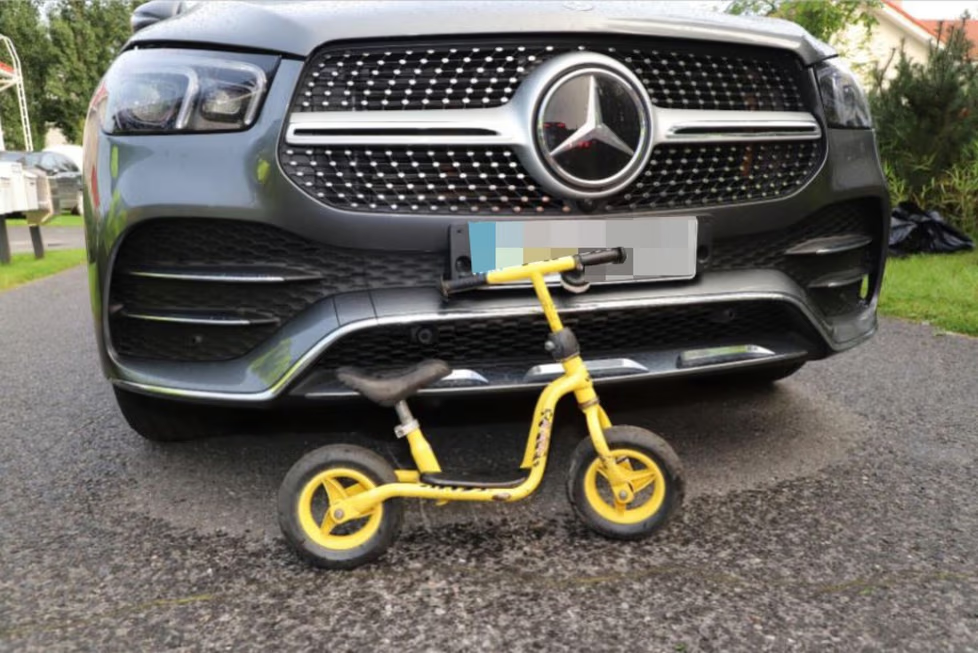
>EU vehicle safety regulations have supported a 36% reduction in European road deaths since 2010. By contrast, road deaths in the US over the same period increased 30%, with pedestrian deaths up 80% and cyclist deaths up 50%
I didn't know this, but it is absolutely crazy. Every EU politician who tries to subvert car safety should be dismissed and tried for endangering public safety.