Accepting US car standards would risk European lives
(etsc.eu)748 points by saubeidl 6 hours ago
748 points by saubeidl 6 hours ago
> "Individual Vehicle Approval" rules, exempting them from type safety requirements
These rules need to start discriminating between "safe for the passenger who bought it" and "safe for everyone else sharing the public space". Let people easily import some old Model T or a cute kei truck but not something that will kill someone else's kids who they can't see.
I'll always catch hate for saying this, but the quickest way to get people into small more efficient vehicles is to eliminate public roads and make the fuckers pay whatever the market rate is for their super-sized diesel coal rolling environmental destruction machine to be on a road.
They'd quickly find out when they're not being subsidized by the general public and people actually have to pay their way to use their vehicles through tolls to people amortizing their road maintenance costs, that the smaller more pedestrian safe cars are the ones that make sense to operate.
Would be great if that was the case in the UK. Currently road tax, or Vehicle Excise Duty is related to CO2 emissions. Road upkeep is from general taxation. Road tax was abolished in 1937, I like to remind motorists of this fact when they say "cyclist should pay road tax". Although EVs now have to pay 3p per mile from 2028, which is a big change. Yeah the super-sized vehicles might pay more in fuel tax and have a higher VED rate, but nowhere near enough.
Where I presently live in the U.S., the fuel taxes and registration fees pay both for the roads and produce excess revenue used to pay for public transit.
Larger vehicles use more fuel; they’re more often diesels which attract a higher tax; and they pay increased registration fees and tolls.
Total tax on diesel fuel is about 71¢ a gallon (about .16€/L). When they fill up their F-350s, which get around 12mpg (20L/100km), they’re paying $21 in road tax, or about 6¢ per mile (.3€/km).
In larger cities, there are often even more tolls/fees like in NYC which are raised whenever they need more money to pay for public transit.
Part of me has also been thinking "let people drive their imported huge trucks but with the understanding that if they kill someone in an accident its not just an accident, its a murder charge for willingly driving such a dangerous vehicle on public roads".
1. I'm not a driver, much less in a country with toll roads. But is it common to have per-vehicle customized toll prices? I would expect to pay a fixed per-car, per-use fee.
2. How is this dependent on privatization? Every car is registered. So it seems pretty easy to enforce taxes on cars. And to do so based on model, weight, whatever you want.
In other words, from what I can tell, making people pay their fair share seems simpler in a public system, if anything. It certainly doesn't require privatization.
FWIW I have little skin in the game, as I said, not a driver, so I would probably benefit both by having to pay less tax and by reducing overall car usage.
What I've commonly seen in the US is that the lowest toll is for passenger cars, and then it goes up by the number of axles that the vehicle has.
I share your feeling. However
> pay whatever the market rate
would only work if there is a market. And infrastructures like roads are a natural monopoly[0], so there could be no market.
Doesn't work in France with its huge number of toll roads, and in the UK where fuel duty is the largest single part of the price of fuel, it more than covers the cost of public roads, yet people still drive everywhere in increasingly large vehicles. It's not gonna reduce driving, though I do agree it should not be subsidized.
You're getting downvoted because good enough quality roads are so cheap that market rate wouldn't really do anything. The government needs to be in the road business so it can stick its thumb on the scale.
The roads where I live are paid for with a plate fee of $10 a year for cars and a higher one for trucks.
The state also sends a certain amount of fuel taxes to local governments in accordance with how many miles are travelled in an area.
New construction must privately pay to build the roads and then transfer ownership to the government. So the cost really is private. By far the most expensive part of maintaining roads is replacing bridges. Hence why so many bridges have rules about weight limits for trucks.
I suppose if you really wanted a user fee on roads you could have a system of tolls on bridges, intersections and interchanges, but that would be really unpopular.
There are many easier ways to effect this social change, if you’re willing to do basic legislation around the vehicle itself.
The easiest way to decrease unnecessary oversized vehicles, frankly, is to require them be painted pink and flowery. Many men in America pick big vehicles as they're perceived as masculine, and a basic paint job to attack this psychological would probably work.
Less jokingly, add mechanical speed limits to them. Big heavy vehicles are extremely dangerous, but that danger is closely related to speed.
Other options include adding excessive cameras and radar equipment, so the front of the vehicle isn’t a blind spot. Cars have plenty of cameras and mirrors already, so it’s not novel to drivers. It’s a missed opportunity already since this could really be implemented by major manufacturers within a year.
Why do they need to do this? Is this a real problem in Europe? Are lots of people being killed by these imported trucks?
The question seems legit to me.. Otherwise worded it's essentially whether there's correlation between both. Without evidence it's more difficult to justify regulation. At the end of the day a pickup is adjacent to a midsize van. To me, both seem like you're essentially getting hit by a wall...
Probably safer actually since you can’t go as fast and have to pay far more attention.
> I moved here to get away from American kindercrushers (among other reasons) and I am profoundly concerned that Europe is being invaded by these machines.
I'm European and I'll go one step further: I'm profoundly concerned that the majority of people in Europe seem happy to imitate all the bad things that the US has, but fiercly reject all the good things that the US has.
Afaik the payout is determined by your insurance, not the opposing party if you are not the cause. They will usually just stick to the standards set by the companies and not argue.
They are all business vehicles as the premiums would be so insane no person would pay it (which is a hint why they should not be in the road). The problem comes when the crash out costs the business and then you get nothing due to type of insurance (pretty much we pay nothing you pay everything yourself), or the ability of companies to fight endless court battles which your insurance likely does not cover.
My way of middle fingering them is reporting them every time they are either on the curb when there is a parking spot (not legal, blocking pedestrian access is only partially legal when there is no parking pace nearby and you leave enough space), or when they overextend onto the road which is a judgement call and up to the enforcing officer.
You also need to keep notice of people trying to get the municipality to widen parking spots and block that.
As far as I'm aware, having any wheel on the footpath is illegal except in areas specifically signposted for it, but my experience has been that handhaving just didn't care
https://www.parkeerbord.nl/wetgeving/is-parkeren-op-de-stoep...
This spot used to drive me absolutely insane when walking to school with my kids - the gemeente even added marked parking spots and drivers just stole the footpath anyway, so we had to walk in the street, and the gemeente straight refused to issue tickets. The guy on the phone told me "it's not causing any trouble" because hey, it's not like _he's_ ever had to push a pram in the street.
I have - or rather had, died - an uncle who had a very effective way of dealing with this. He just walked over the cars.
RIP Cor H., one of a kind. I'm pretty sure the fact that in that neighborhood even now people are religiously parking on the street and never on the sidewalk is a remnant of his presence in this world.
I might have it wrong in the inside/outside city limits with respect to parking on the curb as there are differences. There are also municipal rules but in general they are only for very specific locations afaik.
If you get injured because the municipality refused to act they are on the hook. Thell them you want it on paper they say they will do nothing to prevent this and you want them telling you specifically you have to walk on the street because they do not act on illegally parked cars.
Edit: where I live I have the option of specifically reporting a dangerous situation which in your case I would: near school zones with children involved it always is in my opinion but who am I to judge. It also helps if more people complain. We have a load of parking tourists here since the municipality mode the payed zones so more traffic and more annoyances. My first messages got impolitely unanswered but after a year of complaining by pretty much everyone they finally start doing things.
The issue you're running into is that you're a crazy extremist and so the parking ticket people who are accountable to a government that has to at least pretend to care about public opinion aren't going to enforce the rules the way crazy extremists like you want, they're gonna enforce the rules in the way some approximation of the general public wants.
To be fair, parking illegally and/or disrespectfully is not a problem with the vehicle type but with the driver and lack of local enforcement. People also block footpaths, roads and parking spots in Polos and similar smaller vehicles, and plenty of workers cause issues with their regular european cans and pickup trucks. A favorite of mine being small roads with perpendicular parking spots, with an extended Mercedes Sprinter parked so that both footpath and road is restricted.
> he problem comes when the crash out costs the business and then you get nothing due to type of insurance (pretty much we pay nothing you pay everything yourself), or the ability of companies to fight endless court battles which your insurance likely does not cover.
Business automobile insurance doesn't work any differently than consumer automobile insurance. Liability payouts don't usually (ever?) have deductibles. I was recently sideswiped by a guy driving a massive pickup truck for work and their insurance paid me promptly and fairly without any fuss at all. At least the state liability insurance laws I am familiar with do not change just because you're a business.
Absolutely the same with RAMs in Germany. Big toys for rich guys to compensate something small. Takes at least 2 parking spots and doesn’t fit anyway.
On other hand the RAMs are not relevant for the average citizen. Crazy fuel consumption is a showstopper. And the ones with some extra cash will continue to import with German „Individual Vehicle Approval“ equivalent. In my eyes it’s another useless European regulation. Let poor people import cheap Toyotas from overseas.
They're relevant for the average citizen because they're killing average citizens.
A Ram was certainly relevant for this dead woman - https://www.rtl.nl/nieuws/binnenland/artikel/5521908/rouveen...
Would be the end different if it was another oversized car like X7, G-Klasse or Cayenne?
Edit: I am really curious why there is no real vehicle physical size tax in Germany. Let’s take reference as VW Golf. Smaller cars cost less, bigger more. I agree to pay more, but current insanity with RAMs and vans should be somehow regulated.
This seems to be concerning but as a Dutch person who has lived in the UK for a long time the relatively recent home-grown 'fatbike' issue seems to be a much more pressing problem for Dutch road safety than this and isn't being dealt with effectively as far as I understand.
Having said that I think these American pick-ups (and large SUV's, they are part of the same problem) are a common sight here as well and should not be allowed on the road (unless maybe you can show you need one for work or business).
> This seems to be concerning but as a Dutch person who has lived in the UK for a long time the relatively recent home-grown 'fatbike' issue seems to be a much more pressing problem for Dutch road safety than this and isn't being dealt with effectively as far as I understand.
This is the appeal to worse problems fallacy. Both are problems, both need to be addressed.
What's wrong with fatbikes? They look stupid for sure, but otherwise?
They are routinely modified to exceed legal speed limits and owned by 10 year old or younger kids. Going nearly 30mph on a footpath whilst holding a mobile phone. I think they are also unregistered.
This morning in Amsterdam a dog got struck and was killed by one of these vehicles, happend right in front of me. Poor doggo
What idiot would drive one of these in Amsterdam to begin with? It just doesn't fit the way traffic is organized there.
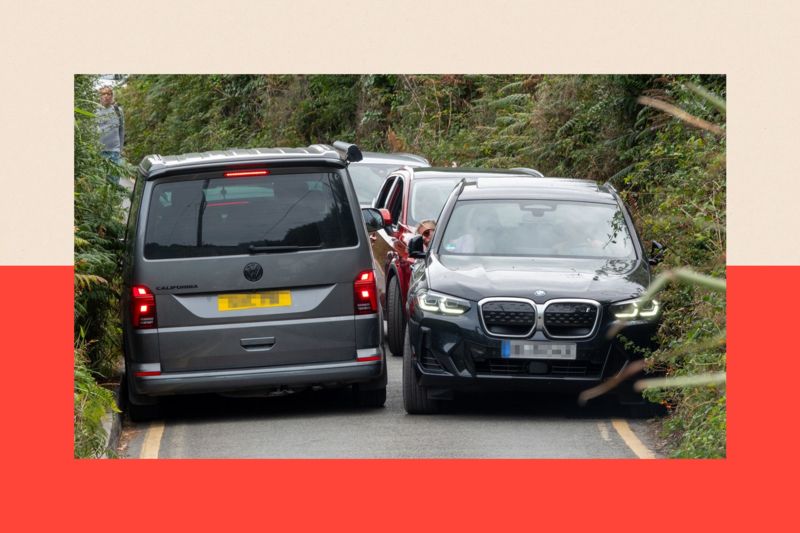
Here's an example of driving "standard" historic UK rural roads:
https://ichef.bbci.co.uk/news/800/cpsprodpb/b2ad/live/a20a6d...
from: 'Carspreading' is on the rise - and not everyone is happy about it - https://www.bbc.com/news/articles/cy7vdvl2531o
Throws in the term "Chelsea Tractor", in Australia in the 1980's they were called Toorak Tractors or simply Yank Tanks.
It doesn't, but people do it.
Here's one in Utrecht https://urbanists.social/@Fuzzbizz/109608802470660144
They're starting to become more common in Spain too, even in villages/towns where they definitely don't fit. Through the years I've seen two of them stuck because they tried to fit into small village roads where hardly normal passenger cars can fit.
I saw a Ferrari trying to navigate speed bumps and a roundabout once.
People are strange.
That is a lot of Dodge Rams. It's a ponderous trend, it'd be interesting to see what is the driver. Is it a particular demographic, or subculture?
My mom who is originally from Bergschenhoek claims her elder brother taught her to drive, in a Dodge truck, probably post WW2 in a model like this one: https://en.wikipedia.org/wiki/Dodge_T-,_V-,_W-Series
I don't know whether there are hordes of bejaarden buying Dodges for nostalgic reasons, but that would mean the Dodge brand has some insane staying power. My guess would be that is absurd and unlikely.
I really dig your deadpan sprinkling of Nederlands. Some words have that etymological acuity that makes them irresistible to just deploy. I was always amazed by how many Yiddish and French words there are in Hollands.
Germanic languages share a massive amount of crossover. Just knowing English and a small amount of Afrikaans I saw cognates all over Western Europe from Netherlands, to Denmark, Sweden, Germany.
> […] and on top of that are almost always registered as "business vehicles" (you can tell from the V plate) which means they pay an absolute pittance in tax.
In Ontario, Canada, (AIUI) you have to get a commercial car plate for pickup trucks.
* https://en.wikipedia.org/wiki/Vehicle_registration_plates_of...
If you want personal / non-commercial plates you have to get inspections done:
Honestly, local governments should just grow a pair and say no to this kind of shit.
If the US government wants to give its soldiers perks, they can rent or loan them a local car. Probably cheaper all round than flying/shipping in their financed Dodge RAM anyway.
Then again, American personnel being arseholes to the locals is well established from Okinawa to Croughton so it's probably endorsed as a power thing.
Luckily I haven't seen a single Cybertruck in the north/north-east of Spain. Pretty sure I'd call the police if I saw one as they're clearly illegal here.
Modern US trucks are an absolute atrocity. I am the demographic that thinks they look cool and might one day have bought one should I end up with more money than I knew what to do with if I hadn't learned that they're death traps.
The tall grill means impact to pedestrians, bicyclists and motorcycles is basically instant death as their head - the only thing above the grill - gets whiplashed onto the rigid tip of the hood. On a normal vehicle you get your legs swiped and rotate your whole body onto an intentionally flexible area of the hood for a much gentler impact.
The visibility from the driver seat is not only much worse than our actual semis, but also worse than actual tanks. You could have half a kindergarten and a small vehicle in front of your car without knowing.
As for the tax, eh - tbf these vehicles are mostly used for business purposes by sole proprietors and the likes, and while they're stupid vehicles they do still do the job. A fully decked Iveco Daily or Mercedes Sprinter is also expensive with little registration tax. Registration tax is a weird (and arguably stupid) system, this isn't really an outlier in that regard.
I roll my eyes more when I see a sports car attempted registered as a van.
Living in the US, what I find even more wild is just how many people purchase them here who have zero need to own a truck that size. It's got to be the most absurd parts of our modern cultural identity.
Even if the owner is using it as a rugged machine for hauling tools and supplies back and forth, they make for terrible work vehicles. A bed that's advertised as 6 foot actually measures about 5' 7" if you're lucky and the wheel wells eat into it so much that loading anything wider than maybe 4' just feels stupid. Nothing about it feels convenient or helpful when compared to a proper work van or a small flatbed. It's basically just a comfy exoskeleton for the driver to pickup groceries.
Meanwhile, I'm driving from site to site with a 4-cylinder hatchback full of tools in custom boxes I made getting twice the gas mileage. It gets some funny looks, but it gets the job done, which is more than I can say for most of the not-a-scratch-on-them trucks I see on the road, here.
I do empathize with those picking the vehicle not on practicality but cool factor - considering how common and accepted gadget cravings are in other areas, I would find it unfair to attack that aspect. I'm currently using ~5GB out of my laptops 64GB of RAM, pretty sure I could start a small fire with my flashlight, and my motorcycle has off-road suspension in a country where the most demanding obstacle is a curb. Other things would objectively fit my needs better while costing less, but be less fun - and fun can be hard to find these days.
As you say, they are absolutely terrible for work use as well - Japanese kei trucks famously have larger beds than some common US pickup trucks, and the size of the custom beds we use in the EU makes the US ones look like absolute kids toys - but that too I wouldn't mind too much if they were just forced to be safe and with decent emissions so the idiocy mainly affected the driver and their wallets.
I'm not too impressed with your vehicle only getting twice the gas mileage though. I'd expect more than that. :P
> I'm not too impressed with your vehicle only getting twice the gas mileage though. I'd expect more than that. :P
I'm going to blame the ham radio antennas and bike rack ;)
But in all seriousness, I was getting slightly better mileage when the car was new 6 years ago. It has declined a bit, despite my regular maintenance, but I'm still very pleased with it. It might be more than twice the mileage of the average truck on the road, to be honest, but I find it hard to get a clear number. I think some truck owners embellish the mileage they actually get, as does the dealer sticker on the new vehicles for sale since those numbers assume perfect terrain with no traffic, last I checked. Then I hop into a co-worker's 2020 truck and realize he's getting 12mpg on a good day and nearly have a heart attack.
My vehicle gets between 45 and 55mpg on average, depending if I'm on the highway a lot or more urban environments.
It's almost impossible to navigate parking garages if two such trucks park opposite each other. Or if one parks on an end that people need to navigate around.
People spend insane amounts of money buying these monstrosities too. It seems as a society we've normalized spending a year's salary on a vehicle, or rather getting a 7-year loan and making crazy monthly payments. I don't understand it. My then normal-sized, now smallish, 13-year old car, that I paid off 11 years ago, still runs great and I can park it easily.
> People spend insane amounts of money buying these monstrosities too
This is also another part of the whole truck-craze in the US that I do not understand. An F150, for example, starts around $40,000 USD for base models, not including taxes and hidden fees. I purchased my car (an HEV, mind you) back in 2019 for just over half that price, spend about $500 annually on regular maintenance that I'm not able to do myself to keep things tip top, and spend about half as much in fuel as my coworkers who travel about the same amount as me for our jobs. Accounting regularly double-checks that I turned in all my fuel receipts because they still don't quite grasp that my car gets far, far better gas mileage.
All that said, these guys make about the same money I do, some a little less since they're newbies, which is to say we are all very underpaid for what we do, wealthy by no standards. And yet, they made these massive purchases while struggling to pay bills or complaining that fuel is too expensive at the pump, etc. These are the same people who buy two paychecks worth of fireworks every July 4th just to watch it all burn in 15 minutes.
Makes me think part of our cultural identity includes regularly acting against our own interests.
> Modern US trucks are an absolute atrocity
This.
I'm living in EU, thinking about getting some pickup. Just want to try this kind of vehicle (and I would love to transport my motorcycle, building materials etc). But I want something small - it looks like almost non-existent market here (there are cars like older f150, s10, etc - but very, very limited offers). Everyone gets the big modern trucks, that are unusable in our tight spaces.
Loading a motorcycle in a pickup bed is always a delicate task unless you have dedicated equipment.
Even when I had a pickup truck, I ended up getting a trailer for my motorcycle. In the end, I've got tired of having my luggage getting wet (no such thing as a fail proof bed cover) and replaced the truck with a more sensible minivan.
> The visibility from the driver seat is not only much worse than our actual semis, but also worse than actual tanks. You could have half a kindergarten and a small vehicle in front of your car without knowing.
Yeah, mentioned in a comment, driving a Ford Expedition on holiday in the US I almost hit a hit walking down the sidewalk.
It literally had better visibility going backwards in the rear view camera than it did going forwards.
You have clearly never sat in the cab of a semi let alone a tank.
The pass side blind spot is massive, even in a day cab with no trailer attached. You can hide an entire minivan in there. Even something like a modern F550 is worlds better.
This isn't to say that modern pickups don't have huge blind spots, they very obviously do, only that your comparison is hyperbolic and unserious.
> The tall grill means impact to pedestrians, bicyclists and motorcycles is basically instant death as their head - the only thing above the grill - gets whiplashed onto the rigid tip of the hood. On a normal vehicle you get your legs swiped and rotate your whole body onto an intentionally flexible area of the hood for a much gentler impact.
What's infuriating is the EuroNCAP safety tests refuse to acknowledge this. SUVs get the same bonnet impact test as small cars do and end up scoring highly due to have a large bonnet surface area despite the fact that actual impacts with pedestrians does not happen like that with SUVs.
And then (wrong) smug wanks on the internet talk about how much safer their SUVs are for pedestrians than small cars based on quoting NCAP scores.
tax should be applied to things we want less of:
- low visibility of little people directly in front of the car: huge tax
- low visibility in the rear: tax (yes, rear camera = no tax)
- too big to comfortably fit a standard parking space: tax
- too big to fit a standard parking space at all: huge tax
- too heavy: tax
- way too heavy: huge tax
- not fuel efficient: tax
- emits lots of dark/smelly/toxic smoke: tax/tax more/huge tax
etc.
Aren’t “bad fuel efficiency” and “can’t park in town” already their own priced-in disadvantages?
Fuel consumption itself is already taxed at the pump.
And I think “too heavy” already means higher tax in NL.
The weird thing is that the EU is really not shy about banning things, and yet here we are in a thread about American Monster Trucks taking over Amsterdam.
> Aren’t “bad fuel efficiency” and “can’t park in town” already their own priced-in disadvantages?
> Fuel consumption itself is already taxed at the pump.
yes to both, but that doesn't mean that extra incentives for high efficiency and extra discouragement nudges for low efficiency shouldn't be present. they're orthogonal features of the economy.
> And I think “too heavy” already means higher tax in NL.
looks like not high enough, judging by this whole thread :)
> The weird thing is that the EU is really not shy about banning things
yes, but it's also known for not moving fast, as all large committees are - and when they finally move, the policy response can be deployed for a market which doesn't exist anymore.
These American trucks are driven by Dutch or by eastern Europeans (e.g. from construction industry)? The Dutch cycling culture and urban planning are adorable, but we are terrible selfish assholes especially regarding the cars.
It isn't algorithmically generated. I used to spend a lot of time in cyclist circles both IRL and online and there is a very vocal minority of cyclists that basically hate cars and motorists. The stereotype exists for a reason.
The reasoning is these trucks make no practical or economic sense in Europe. They are not allowed to be sold, because they are dangerous to bystanders, are polluting and oversized. Only through some loophole quite a few have been imported, which is very frustrating to all of us that are intimidated and appalled by seeing these on our roads.
These trucs signal that the driver does not care about other people, environment, climate, etc. Because they are dangerous, obnoxious and polluting. And instead of calling these things trucks, I think Kindercrusher is a perfectly apt description.
> Okay. But you've posted 12 times already in this thread that isn't even an hour old, mostly emotions and hyperbolics as quoted above. Kindercrushers?
FWIW, I am not him but I could have written exactly the same, just changing the location. Yes, we do tend to care when selfish arseholes ruin it for everyone, and put other people’s lives at risk for no good reason. And kindercrusher is a perfectly good description of these things.
So tired of current trend in Europe, the Goverment should solve every issue & every day everyone wants a new rule.
We have now so many rules either they are not enforced or they are making everythingn slow or expensive.
Now to solve those issues, they will call for new legislations, but again they will be enforced only for the first 2 weeks. And then again a call for new rules will be made.
Take for instance FAT bikes in Netherlands, these are e-bikes with big wheel that young kids like. They drive like madman, harrass women in parks & everybody wants to ban them. But there is already enough legislation to take care of these kids, they are just not enforcing them. And probably rightly so, because they have bigger issues to deal with.
Not everything can be solved with a pill.
Opening that video, American-style pickup trucks are about 40% more likely to kill a pedestrian 100% more likely to kill a child (the video argues that this mostly stems from the shape of the front). These cars also get into more crashes
Honestly, banning these things seems sensible when the only thing going for them for most buyers is seemingly an appreciation of their style
Yeah there is always a reason for a rule that makes sense, but there is also a price for making a new rule everytime something doesnt work.
A fat bike is a bike with >3.8" tires and is not necessarily an e-bike nor an issue. Some people use them in the snow, sand or trail without issues to anyone and I have occasionally also used mine in the city because it was more comfortable to ride at slow speed than my road bike and stops on a dime thanks to the available grip.
There are a number of trendy aliexpress quality e-bikes that are also using fat tires and are ridden by idiots but the problem is not fat bikes per se. The problem is idiots on unrestricted/modded e-bikes. Ban fat bikes and they will use unrestricted e-bikes with different tires and the problem will be the same.
Yeah that's kind of the point, new rules will often not solve things, but will just move the issue. The underlying issue with certain groups in society & not enforcing will remain.
> We have now so many rules either they are not enforced or they are making everythingn slow or expensive.
What exactly is so slow or expensive that you're prevented to do because of some regulation or law?
In theory many laws are based on good ideas, but in practice they dont or only partially accomplish what they set out to do. Few examples:
- Bureaucracy around clinical trials The old Clinical Trials Directive (2001/20/EC) was meant to harmonise standards, but in practice it led to lots of extra admin and different interpretations in each country, which made multi-country trials slow and expensive. EUR-Lex You can see the effect in the numbers: Europe’s share of commercial clinical trials fell from ~22% in 2013 to about 12% in 2023, even while global trial numbers increased by ~38%.
- Medical Device Regulation (MDR & IVDR) bottleneck Meant for safety, but has meant delays and uncertainty for new devices and even risks of shortages of older ones, which clearly affects innovation. * https://www.meddeviceonline.com/doc/we-re-heading-toward-a-b...
- Data protection (GDPR) and health/science data Complexity and fragmentation of implementation can definitely slow things down, especially for big pan-European projects or AI/“big data” medicine. In theory it's good, but researcher or not being helped on how they can compete worldwide while being GDPR compliant, meaning EU will get behind & certain research is done elsewhere
Many more examples in other fields then medicine. And there are clearly a lot of good laws, but our idea of running a country is just adding lots of new rules every year is just faulty.
<facepalm>. This sort of breathless rhetoric from people like you are is exactly why it's a difficult to solve social/political problem rather than a mundane technical optimization issue. They basically banned flip up headlights without any fanfare 30yr ago and it garnered a little complaining from the aesthetics crowd. Those sorts of things can't be done anymore because your ilk has poisoned the well of public policy and discourse.
The common man hears your sort of rhetoric, knows he can't reasonably be an expert in the subject matter and the nuances of the statistics, but he can pattern match on how you're saying what you're saying and it matches up with a whole bunch of crap that's been bad for him.
I really hate the modern high hood truck styling. But I hate it a little less knowing it's followed the problem people to Europe.
NotJustBikes just put out a video about this issue - https://www.youtube.com/watch?v=--832LV9a3I
A couple years ago he also made a video about these trucks more broadly - https://www.youtube.com/watch?v=jN7mSXMruEo
What's truly maddening is how many of these vehicles which _do not_ meet European safety standards are _already_ in Europe. Walk around Hilversum in the Netherlands and you will see plenty of Dodge Rams (mostly 1500's, but there's even a 2500 Dually usually parked on the sidewalk ("pavement "for Brits) where my kids used to go to school). They're imported under "Individual Vehicle Approval" rules, exempting them from type safety requirements, and on top of that are almost always registered as "business vehicles" (you can tell from the V plate) which means they pay an absolute pittance in tax.
I moved here to get away from American kindercrushers (among other reasons) and I am profoundly concerned that Europe is being invaded by these machines.
(Edit) Worth noting is that a lot of Dutch street design is based on the idea that people _can_ share space with cars in dense, low speed environments, but that assumption flies out the window when the vehicles are so large you can't even see a kid walking or biking to school.
Further edit - source - https://www.motorfinanceonline.com/news/dodge-ram-registrati... 5,000 Dodge Rams imported in to Europe in 2023 alone.