Accepting US car standards would risk European lives
(etsc.eu)545 points by saubeidl 3 hours ago
545 points by saubeidl 3 hours ago
> "Individual Vehicle Approval" rules, exempting them from type safety requirements
These rules need to start discriminating between "safe for the passenger who bought it" and "safe for everyone else sharing the public space". Let people easily import some old Model T or a cute kei truck but not something that will kill someone else's kids who they can't see.
I'll always catch hate for saying this, but the quickest way to get people into small more efficient vehicles is to eliminate public roads and make the fuckers pay whatever the market rate is for their super-sized diesel coal rolling environmental destruction machine to be on a road.
They'd quickly find out when they're not being subsidized by the general public and people actually have to pay their way to use their vehicles through tolls to people amortizing their road maintenance costs, that the smaller more pedestrian safe cars are the ones that make sense to operate.
Would be great if that was the case in the UK. Currently road tax, or Vehicle Excise Duty is related to CO2 emissions. Road upkeep is from general taxation. Road tax was abolished in 1937, I like to remind motorists of this fact when they say "cyclist should pay road tax". Although EVs now have to pay 3p per mile from 2028, which is a big change. Yeah the super-sized vehicles might pay more in fuel tax and have a higher VED rate, but nowhere near enough.
I share your feeling. However
> pay whatever the market rate
would only work if there is a market. And infrastructures like roads are a natural monopoly[0], so there could be no market.
That's weird because there's no public road near me for miles and I can get 90% of the way to "town" without them.
I've also connected my private roads to a couple other private roads so no one has a monopoly on my way to town.
As for the "barriers to entry" mentioned in that article, is absolutely wild. My road and most the ones in our grid network were made with little more than a dude and a tractor (I think you can get suitable one for $10k off craigslist). I initially made mine with an axe, a light truck, and a rope (to rip out small trees) and there's nothing stopping anyone adjacent from doing the same if I'd block the road.
Part of me has also been thinking "let people drive their imported huge trucks but with the understanding that if they kill someone in an accident its not just an accident, its a murder charge for willingly driving such a dangerous vehicle on public roads".
Doesn't work in France with its huge number of toll roads, and in the UK where fuel duty is the largest single part of the price of fuel, it more than covers the cost of public roads, yet people still drive everywhere in increasingly large vehicles. It's not gonna reduce driving, though I do agree it should not be subsidized.
There are many easier ways to effect this social change, if you’re willing to do basic legislation around the vehicle itself.
The easiest way to decrease unnecessary oversized vehicles, frankly, is to require them be painted pink and flowery. Many men in America pick big vehicles as they're perceived as masculine, and a basic paint job to attack this psychological would probably work.
Less jokingly, add mechanical speed limits to them. Big heavy vehicles are extremely dangerous, but that danger is closely related to speed.
Other options include adding excessive cameras and radar equipment, so the front of the vehicle isn’t a blind spot. Cars have plenty of cameras and mirrors already, so it’s not novel to drivers. It’s a missed opportunity already since this could really be implemented by major manufacturers within a year.
Why do they need to do this? Is this a real problem in Europe? Are lots of people being killed by these imported trucks?
Afaik the payout is determined by your insurance, not the opposing party if you are not the cause. They will usually just stick to the standards set by the companies and not argue.
They are all business vehicles as the premiums would be so insane no person would pay it (which is a hint why they should not be in the road). The problem comes when the crash out costs the business and then you get nothing due to type of insurance (pretty much we pay nothing you pay everything yourself), or the ability of companies to fight endless court battles which your insurance likely does not cover.
My way of middle fingering them is reporting them every time they are either on the curb when there is a parking spot (not legal, blocking pedestrian access is only partially legal when there is no parking pace nearby and you leave enough space), or when they overextend onto the road which is a judgement call and up to the enforcing officer.
You also need to keep notice of people trying to get the municipality to widen parking spots and block that.
As far as I'm aware, having any wheel on the footpath is illegal except in areas specifically signposted for it, but my experience has been that handhaving just didn't care
https://www.parkeerbord.nl/wetgeving/is-parkeren-op-de-stoep...
This spot used to drive me absolutely insane when walking to school with my kids - the gemeente even added marked parking spots and drivers just stole the footpath anyway, so we had to walk in the street, and the gemeente straight refused to issue tickets. The guy on the phone told me "it's not causing any trouble" because hey, it's not like _he's_ ever had to push a pram in the street.
I might have it wrong in the inside/outside city limits with respect to parking on the curb as there are differences. There are also municipal rules but in general they are only for very specific locations afaik.
If you get injured because the municipality refused to act they are on the hook. Thell them you want it on paper they say they will do nothing to prevent this and you want them telling you specifically you have to walk on the street because they do not act on illegally parked cars.
Edit: where I live I have the option of specifically reporting a dangerous situation which in your case I would: near school zones with children involved it always is in my opinion but who am I to judge. It also helps if more people complain. We have a load of parking tourists here since the municipality mode the payed zones so more traffic and more annoyances. My first messages got impolitely unanswered but after a year of complaining by pretty much everyone they finally start doing things.
I have - or rather had, died - an uncle who had a very effective way of dealing with this. He just walked over the cars.
RIP Cor H., one of a kind. I'm pretty sure the fact that in that neighborhood even now people are religiously parking on the street and never on the sidewalk is a remnant of his presence in this world.
To be fair, parking illegally and/or disrespectfully is not a problem with the vehicle type but with the driver and lack of local enforcement. People also block footpaths, roads and parking spots in Polos and similar smaller vehicles, and plenty of workers cause issues with their regular european cans and pickup trucks. A favorite of mine being small roads with perpendicular parking spots, with an extended Mercedes Sprinter parked so that both footpath and road is restricted.
> he problem comes when the crash out costs the business and then you get nothing due to type of insurance (pretty much we pay nothing you pay everything yourself), or the ability of companies to fight endless court battles which your insurance likely does not cover.
Business automobile insurance doesn't work any differently than consumer automobile insurance. Liability payouts don't usually (ever?) have deductibles. I was recently sideswiped by a guy driving a massive pickup truck for work and their insurance paid me promptly and fairly without any fuss at all. At least the state liability insurance laws I am familiar with do not change just because you're a business.
Absolutely the same with RAMs in Germany. Big toys for rich guys to compensate something small. Takes at least 2 parking spots and doesn’t fit anyway.
On other hand the RAMs are not relevant for the average citizen. Crazy fuel consumption is a showstopper. And the ones with some extra cash will continue to import with German „Individual Vehicle Approval“ equivalent. In my eyes it’s another useless European regulation. Let poor people import cheap Toyotas from overseas.
They're relevant for the average citizen because they're killing average citizens.
A Ram was certainly relevant for this dead woman - https://www.rtl.nl/nieuws/binnenland/artikel/5521908/rouveen...
Would be the end different if it was another oversized car like X7, G-Klasse or Cayenne?
Edit: I am really curious why there is no real vehicle physical size tax in Germany. Let’s take reference as VW Golf. Smaller cars cost less, bigger more. I agree to pay more, but current insanity with RAMs and vans should be somehow regulated.
This seems to be concerning but as a Dutch person who has lived in the UK for a long time the relatively recent home-grown 'fatbike' issue seems to be a much more pressing problem for Dutch road safety than this and isn't being dealt with effectively as far as I understand.
Having said that I think these American pick-ups (and large SUV's, they are part of the same problem) are a common sight here as well and should not be allowed on the road (unless maybe you can show you need one for work or business).
This morning in Amsterdam a dog got struck and was killed by one of these vehicles, happend right in front of me. Poor doggo
What idiot would drive one of these in Amsterdam to begin with? It just doesn't fit the way traffic is organized there.
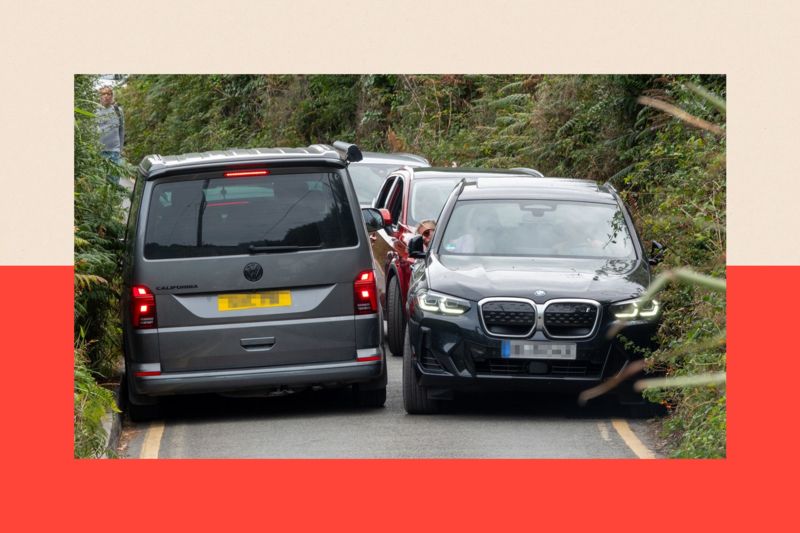
Here's an example of driving "standard" historic UK rural roads:
https://ichef.bbci.co.uk/news/800/cpsprodpb/b2ad/live/a20a6d...
from: 'Carspreading' is on the rise - and not everyone is happy about it - https://www.bbc.com/news/articles/cy7vdvl2531o
Throws in the term "Chelsea Tractor", in Australia in the 1980's they were called Toorak Tractors or simply Yank Tanks.
It doesn't, but people do it.
Here's one in Utrecht https://urbanists.social/@Fuzzbizz/109608802470660144
That is a lot of Dodge Rams. It's a ponderous trend, it'd be interesting to see what is the driver. Is it a particular demographic, or subculture?
My mom who is originally from Bergschenhoek claims her elder brother taught her to drive, in a Dodge truck, probably post WW2 in a model like this one: https://en.wikipedia.org/wiki/Dodge_T-,_V-,_W-Series
I don't know whether there are hordes of bejaarden buying Dodges for nostalgic reasons, but that would mean the Dodge brand has some insane staying power. My guess would be that is absurd and unlikely.
I really dig your deadpan sprinkling of Nederlands. Some words have that etymological acuity that makes them irresistible to just deploy. I was always amazed by how many Yiddish and French words there are in Hollands.
Honestly, local governments should just grow a pair and say no to this kind of shit.
If the US government wants to give its soldiers perks, they can rent or loan them a local car. Probably cheaper all round than flying/shipping in their financed Dodge RAM anyway.
Then again, American personnel being arseholes to the locals is well established from Okinawa to Croughton so it's probably endorsed as a power thing.
Modern US trucks are an absolute atrocity. I am the demographic that thinks they look cool and might one day have bought one should I end up with more money than I knew what to do with if I hadn't learned that they're death traps.
The tall grill means impact to pedestrians, bicyclists and motorcycles is basically instant death as their head - the only thing above the grill - gets whiplashed onto the rigid tip of the hood. On a normal vehicle you get your legs swiped and rotate your whole body onto an intentionally flexible area of the hood for a much gentler impact.
The visibility from the driver seat is not only much worse than our actual semis, but also worse than actual tanks. You could have half a kindergarten and a small vehicle in front of your car without knowing.
As for the tax, eh - tbf these vehicles are mostly used for business purposes by sole proprietors and the likes, and while they're stupid vehicles they do still do the job. A fully decked Iveco Daily or Mercedes Sprinter is also expensive with little registration tax. Registration tax is a weird (and arguably stupid) system, this isn't really an outlier in that regard.
I roll my eyes more when I see a sports car attempted registered as a van.
Living in the US, what I find even more wild is just how many people purchase them here who have zero need to own a truck that size. It's got to be the most absurd parts of our modern cultural identity.
Even if the owner is using it as a rugged machine for hauling tools and supplies back and forth, they make for terrible work vehicles. A bed that's advertised as 6 foot actually measures about 5' 7" if you're lucky and the wheel wells eat into it so much that loading anything wider than maybe 4' just feels stupid. Nothing about it feels convenient or helpful when compared to a proper work van or a small flatbed. It's basically just a comfy exoskeleton for the driver to pickup groceries.
Meanwhile, I'm driving from site to site with a 4-cylinder hatchback full of tools in custom boxes I made getting twice the gas mileage. It gets some funny looks, but it gets the job done, which is more than I can say for most of the not-a-scratch-on-them trucks I see on the road, here.
I do empathize with those picking the vehicle not on practicality but cool factor - considering how common and accepted gadget cravings are in other areas, I would find it unfair to attack that aspect. I'm currently using ~5GB out of my laptops 64GB of RAM, pretty sure I could start a small fire with my flashlight, and my motorcycle has off-road suspension in a country where the most demanding obstacle is a curb. Other things would objectively fit my needs better while costing less, but be less fun - and fun can be hard to find these days.
As you say, they are absolutely terrible for work use as well - Japanese kei trucks famously have larger beds than some common US pickup trucks, and the size of the custom beds we use in the EU makes the US ones look like absolute kids toys - but that too I wouldn't mind too much if they were just forced to be safe and with decent emissions so the idiocy mainly affected the driver and their wallets.
I'm not too impressed with your vehicle only getting twice the gas mileage though. I'd expect more than that. :P
It's almost impossible to navigate parking garages if two such trucks park opposite each other. Or if one parks on an end that people need to navigate around.
People spend insane amounts of money buying these monstrosities too. It seems as a society we've normalized spending a year's salary on a vehicle, or rather getting a 7-year loan and making crazy monthly payments. I don't understand it. My then normal-sized, now smallish, 13-year old car, that I paid off 11 years ago, still runs great and I can park it easily.
> Modern US trucks are an absolute atrocity
This.
I'm living in EU, thinking about getting some pickup. Just want to try this kind of vehicle (and I would love to transport my motorcycle, building materials etc). But I want something small - it looks like almost non-existent market here (there are cars like older f150, s10, etc - but very, very limited offers). Everyone gets the big modern trucks, that are unusable in our tight spaces.
> The visibility from the driver seat is not only much worse than our actual semis, but also worse than actual tanks. You could have half a kindergarten and a small vehicle in front of your car without knowing.
Yeah, mentioned in a comment, driving a Ford Expedition on holiday in the US I almost hit a hit walking down the sidewalk.
It literally had better visibility going backwards in the rear view camera than it did going forwards.
These American trucks are driven by Dutch or by eastern Europeans (e.g. from construction industry)? The Dutch cycling culture and urban planning are adorable, but we are terrible selfish assholes especially regarding the cars.
It isn't algorithmically generated. I used to spend a lot of time in cyclist circles both IRL and online and there is a very vocal minority of cyclists that basically hate cars and motorists. The stereotype exists for a reason.
> I moved here to get away from American kindercrushers (among other reasons) and I am profoundly concerned that Europe is being invaded by these machines.
Okay. But you've posted 12 times already in this thread that isn't even an hour old, mostly emotions and hyperbolics as quoted above. Kindercrushers?
Please don't yell at any truck-driving strangers in the parking lot ("car park" for Brits) because I'm getting that vibe.
The article is equally light on actual details to support its case (ADAS is mandatory in the US, even on econoboxes), and for all we know the life saving equipment never mentioned but used to bolster their case could be... rear fog lights... or removal of the ability to shut off DRL, a largely useless feature that shortens the life of your headlamps.
The reasoning is these trucks make no practical or economic sense in Europe. They are not allowed to be sold, because they are dangerous to bystanders, are polluting and oversized. Only through some loophole quite a few have been imported, which is very frustrating to all of us that are intimidated and appalled by seeing these on our roads.
These trucs signal that the driver does not care about other people, environment, climate, etc. Because they are dangerous, obnoxious and polluting. And instead of calling these things trucks, I think Kindercrusher is a perfectly apt description.
>EU vehicle safety regulations have supported a 36% reduction in European road deaths since 2010. By contrast, road deaths in the US over the same period increased 30%, with pedestrian deaths up 80% and cyclist deaths up 50%
I didn't know this, but it is absolutely crazy. Every EU politician who tries to subvert car safety should be dismissed and tried for endangering public safety.
> Every EU politician who tries to subvert car safety should be dismissed and tried for endangering public safety.
The problem is coming from the other side, the Americans are threatening to start a new trade war if the EU doesn't permit their murdermobiles on the European roads.
IMO pedestrian safety should still come above all else, but this is not an initiative coming from some EU representatives who want to own a Cybertruck. Blocking these cars can have impact on the war against Ukraine and the prices of fuel and other import products on the short term.
As an European, I'd rather have a trade war, than bend 90 degrees.
But the EU commission will bend and sell us out, the same way it's selling european privacy to security and data companies lobbying it (just check how many times Thorn, Palantir et al have met with EU officials, lobbying is recorded and publicly accessible).
It's a tactic, agree to the deal, the US ignores us. Allow the deal to get destroyed in parliament and the courts and it has no effect. The deal was a means by which to get enough time to figure out the correct response. We've been doing this kind of thing for decades.
I mean, the commission said it "intends to accept". Given the EC's legendary lightning-fast speed, that presumably puts the timeline long after ol' minihands is out of office, and thus irrelevant.
Even when the EC actually _wants_ to do something, it typically struggles to get it done in under a decade.
> long after ol' minihands is out of office
The EC is not that slow when it comes to the American trade wars. The timeline suddenly shrinks to months instead of years because this stuff could majorly disrupt the economy (and safety) across the European continent.
The EC may not fear the (mostly disinterested) European citizen body, but it does fear immediate actions by world powers.
Trade wars work both ways. So far the US export market is not doing so great. All those tariffs are raising the cost of exported goods as well. And those were already too expensive before the tariffs. If the US wants more US cars on EU roads, it needs to start making better cars. It's that simple. But in the EU, cars have to compete with domestic cheap cars and imported Korean and Chinese cars. It's a level playing field. Hence not a lot of US cars on the roads. A few Teslas (made in the EU mostly), a few Fords (some made on the VW platform), and a sprinkling of niche imports for things like muscle cars and pickup trucks. They are quite rare but you see one or two once in a while.
Maybe the legislation allowing their import should take their special status in to account.
I would suggest mandatory semi (or full) trailer truck drivers' license required for anyone who operates these. In addition, they should be indicated as a new category of "recreational trucks", with harsh penalties specific to them especially regarding road accidents.
For example, if found guilty of reckless driving, or causing accidents, the vehicle would be permanently confiscated. (On top of personal fines, loss of license etc as already sentenced by law.) Perhaps the law enforcement could then be given access to such confiscated vehicles, creating also some incentive to enforce the law.
Fuck it. Let the Americans start another trade war then. This nonsense has been going on long enough, if times need to get tough so be it then, start earlier rather than in 5 years when these misery machines are everywhere and the car arms race is in full effect.
It’s tough when there’s a war going on and the EU countries don’t really want to pay the true cost for their defense.
As an American, I have plenty of disappointment in government right now with my own. But it's also incredibly disappointing how many other world leaders are letting Trump roll over them.
The trade wars go both ways. Certainly it can be a bit of a collective action problem when it comes to individual countries that are smaller than the US, but the EU as a whole should be able to negotiate on even-enough footing with the US on these kinds of issues.
The thing is, nobody else wants trade wars. Both sides of a trade war lose in a system of otherwise free commerce, the "winning" party is the party that is willing to sacrifice the most to make a point. Everyone but maybe the super wealthy are worse off. Americans are paying the price for their government's idiotic tariff game, but the real cost will come over the following years, and in some cases decades.
The EU is trying to minimize the damage for its constituents, they're not interested in a stupid power play. Threats of reciprocating in trade wars are meaningless if the leadership you're threatening doesn't care if their people starve.
Playing tough doesn't matter anyway, the American voting public will just blame the EU for all the bad things that happen if the EU's actions do have an impact, laugh at the EU if a diplomatic solution is found, and the American leadership will repeat whatever the last guy to verbally jerk off Trump said for at least the coming three years.
In a way, it's kind of impressive. The EU was not ready for America to devolve into this level of clown politics this fast, and that left them unprepared.
Any war goes both ways, but that's not the point. The point is: can you win a war against your adversary? Can the UK win a trade war against the US for example?
> with pedestrian deaths up 80% and cyclist deaths up 50%
https://www.youtube.com/watch?v=LC9a3GR1HJY&t=371s
> I said there was no way this truck would pass a pedestrian impact safety standard. Now, I wasn't wrong that the truck won't pass a pedestrian impact safety standard, it won't! And that's why they can't sell it in Europe. [...] But I didn't realise that America has no pedestrian impact standards. [...] America actually allows companies to self-certify a variety of aspects of safety.
See also: Boeing. It is the exact same kind of fuck-up. Regulators should not be in bed with the industries they regulate. That's a hard problem to solve, because where if not in industry would you get the expertise. But these kind of revolving door arrangements are extremely problematic.
> I didn't know this, but it is absolutely crazy.
It's crazy because the numbers don't line up with the theory. If you look at US traffic deaths by year, they were basically flat in terms of vehicle miles traveled between 2010 and 2019 and then took a big jump from COVID which is only now starting to come back down.
Meanwhile in Europe road fatalities were also fairly flat up until 2019, and then went down significantly from COVID.
Now we have to guess why the responses to COVID had the opposite effect in each place, but it's pretty obvious that the difference was a primarily result of COVID rather than differences in vehicle safety regulations, unless the vehicle safety regulations all changed in 2020 and everyone immediately replaced the installed base of cars everywhere overnight.
2020 wasn't just the start of Covid, but also the start of BLM. The narrative I always see from the American right is that BLM caused many police forces across the US to radically reduce traffic enforcement, since: 1. traffic offenders are disproportionately black, 2. stops for minor traffic offences can sometimes spiral into violence in various ways, and some viral ones have involved absurdly bad use of force decisions by officers involved, and 3. no force wants to take the blame for another George Floyd
Per this narrative, a significant antisocial tranche of the public has responded to the effective suspension of traffic law in the way that you would expect them to, and that is why road deaths are up.
COVID happened in the year of the discontinuity and caused major changes to commuting behavior as a result of remote work, people afraid of infection avoided mass transit, many people moved out of cities or lost their jobs, people bought cars who didn't used to drive and now there are more new/inexperienced drivers with cars (and it's easier to get a license in the US than Europe), etc.
Also, the numbers for at least the US are apparently just wrong:
https://en.wikipedia.org/wiki/Motor_vehicle_fatality_rate_in...
1.27 fatalities per 100M VMT in 2023 (the latest year with data), 1.11 in 2010, that's a difference of 14%, not 30%. Even the peak during COVID was only 24% above 2010. The only way I can see to get 30% is to use the during-COVID number for only the total number of motor vehicle fatalities without accounting for population growth or vehicle miles traveled, which is not a great metric for making comparisons.
And that is not counting in the fact that there far more pedestrians on the street in EU than in the USA. If there were the same amount of pedestrians in the USA as in the EU the statistics would be even worse.
When there are more obstacles and hazards on the road drivers tend to slow down and pay attention. Pedestrian deaths in my city peaked in 2025, but they didn't happen in the walkable central areas of the city where pedestrians are common, they happened out in the 'burbs where the roads are wide and pedestrians are few.
It’s not about champagne. It’s about us not making anything like the Patriot air defense system. Or us not having the capabilities to command our disparate militaries cohesively without US involvement in NATO. The whole Western order has been built on the premise of US being the corner stone that ties everything together.
Thank God the French have always been suspicious about it since the Suez crisis, hence we _do_ have at least some independent capabilities.
For those who don't know, the French (and British) instigated the Suez crisis. It was a highly illegal attempt at regime change in Egypt and the US along with the USSR and United Nations rightfully pressured the French to stop. Bizarre example to illustrate the need for military independence.
The US is underwriting European security (and by extension various European welfare states).
Do you really want to block the import of arms and financial aid to Ukraine?
If Europeans were serious about their sovereignty they’d have made very different choices up until now.
It isn’t right that America has so much power in this circumstance, but going back decades the US has been asking for Europe to take defense seriously.
Europe should certainly increase its defense spending (and actual capabilities). But the reason NATO exists isn't just to please Europe. The US have a direct interest in containing Russia; I don't think they can afford to simply stop caring about the rest of the world. And I'd be willing to test that theory.
> It isn’t right that America has so much power in this circumstance, but going back decades the US has been asking for Europe to take defense seriously.
Funny because the last time I believe that it was the US that requested help in Iraq and Afghanistan and not the other way around.
> Do you really want to block the import of arms and financial aid to Ukraine?
Umm... yes? Since this whole debacle started, the EU has been shooting itself in the foot with all the sanctions that hurts its industries.
On the other hand, the US did the smart thing and did not give out weapons for free, it charged for them.
In the end, the US will be the winner of this war and Europe will come out of it incredibly weak economically. And it will have to turn to the US for help. Again.
Keep in mind that the US stats are derived from cities that are designed around personal automobile transportation, so they're likely muted.
Europe on the other hand has a much higher level of intermingling between pedestrians and vehicles. This puts pedestrians more often in harms way, and likely will lead to out-sized dangers that aren't seen as frequently in the USA. Pedestrian safety is a key requirement for European car safety.
If the EU is politically forced into accepting the US standards: The slack will need to be picked up by European insurance companies, who should charge extreme premiums for unsafe designs, effectively blocking the sale of the vehicles from dangerous, young, or casual drivers and limiting those designs to those who truly need them (which I suspect is very few.)
This should also go a long way in addressing inexpensive Chinese vehicles that ape the American designs. Since that is more likely going to be what is on the roads.
I'm with you regarding the argument, but want to nitpick:
"dismissing" a politician sounds like an easy fix but we probably don't want hyper-polarized dismissal wars where politicians are "shot down" immediately after being elected. That's why there are other mechanisms such as not re-electing, public shaming, transparency fora etc. ... we need to work on strengthening those, the accountability and transparency.
I think it's hard to say for sure that it's only the safety regulations on the car that that have resulted in these reductions, and by contrast those increases in the US. There are so many other things not related to the regulations on the car. My guess for example is that us have a lot less bike roads than europe does and traffic rules are not affected by the regulations on the cars and so on. for sure European European car regulations are probably better than American ones from a safety perspective. but I think it's hard to to say that without them we would have an increase, it would have a smaller reduction.
They need to prop up dying German car companies, and are OK with using European lives as collateral.
>They need to prop up dying German car companies
Germany isn't the only economy dependent on the legacy auto sector. France, Italy, Romania, Czechia, Slovakia and Belgium also have a lot of jobs, or had, in the auto industry, before the mass layoff of the last 2-3 years.
True, France does too of course, but Germany has been particularly stubborn. There's infighting within Europe, for that matter - note Polestar opposing Merz's attempts to weaken Europe's phase out of combustion vehicles. https://www.msn.com/en-gb/news/newsbirmingham/volvo-and-pole...
Yes, but in France Renault just made a new Twingo, to be electric, for 20,000 euro, and they're starting to make electric sports cars (A290, future electric A110), so I wouldn't call that 'legacy auto'.
As much as German car companies suck it's not them that are road killers
Among other issues, Volkswagen killed roughly 1200 people by cheating on their emissions tests.
https://lae.mit.edu/2024/06/28/study-quantifies-premature-de...
Besides the whataboutism, this is 1200 premature deaths (of mostly frail people). As much as I'm sensible to the topic of air pollution, putting that number closer to the number of, I dunno, premature deaths attributable to Coal power plants will give a more realistic view of the problem
You can't really compare the two. Vehicle safety regulations might not be able to make up for the USA having stroads and in general bad design. For the same reasons trying to move safety standards over could make things even worse than the USA due to them not fitting the conditions.
Whether they like it or not, American cars have become a lot more European over the years. I wish I had figures to back it up but from my own anecdotal experience when we traveled to the US when I was young almost every car was different and, for me at least, this made it feel strange and exciting.
Taking my own kids back there this year, most of the normal cars were common, or at most variations of the ones from Europe. Even many of the vans and work vehicles are now common European shapes, occasionally with a different badge. Trucks and full size SUVs were the last hold outs of US specific models.
Which makes me wonder, are the pedestrian deaths really heavily weighted towards these models?
For what it's worth we hired a full sized SUV. There was one point where I was about to drive out of our Villa's driveway when my partner shouted "wait!" There was a 8ish year old kid walking down the sidewalk towards where I was about to cross it who was completely invisible from the driving position. It was actually safer to forward park that thing because the visibility in the reversing camera was much better than driving forward.
At the risk of sounding contrarian, do we have any idea what the drivers of this are? Is this actually about car design, or is it other bits?
Just as a starter for ten, is that 30% increase distributed around the US or concentrated in certain states? I can't imagine we've seen the same increase in New York than in rural Alabama (and if that's the case, how much of it is really attributable to car designs)?
> Every EU politician who tries to subvert car safety should be dismissed and tried for endangering public safety.
Yeah, so that would be rampantly anti-Democratic authoritarianism... Peaceful transfer of power is pretty much at the core of why democracy works in the first place, and once you start engaging in political persecution because you don't like some trade-off involving safety ... yeah, that's no longer a democracy but something else.
Yes, and? Are they tried for making politician decisions someone (e.g. the next people in power) didn't like? This doesn't engage at all with what I talked about, and I already explicitly acknowledged that peaceful transition of power is important. What is the point of this comment? Why rebuke something I never even remotely said?
> Every EU politician who tries to subvert car safety should be dismissed and tried for endangering public safety.
No. Every EU politician who doesn't support BANNING all cars should be dismissed and tried and executed! Look, I'm even tougher on pedestrian safety than you are!
I kind of agree but this is missing a big part in my opinion. How can we quantify the penalty faced by consumers in EU with to increased costs due to regulation?
There might be certain number of deaths we can accept for increased cost but how is it so obvious that this tradeoff was worth it?
What if cars got 2x costlier in EU due to the regulations to give you a .01% increased chance in safety?
Edit: here are some back of envelope numbers from chatgpt
A single, ordinary car ride carries an extremely small chance of death:
USA: ~1 in 7.7 million
EU: ~1 in 20 million
Its not super clear that optimising these numbers is obviously worth the increased costs.
Edit2: people can make the choice to buy Volvo cars that are ~40% safer. Why isn't every car buyer buying only Volvo?
The assumption you have to make is that regulation would make it much cheaper to buy a safe car than just buying Volvo. It is somewhat true but not sure on the extent.
I think that's a little bit of a weird way to look at the probabilities. Sure, for a one-off activity I might look at 1 in 7,700,000 and decide that's an acceptable risk. But many people in the US take several car rides per day.
At, say, 4 rides per day, that's about a 1 in 5300 chance of death over a single year. That's still small, but not that small. Someone in a decent-sized town or city could expect to lose someone they know once every few years with those odds.
We know what the rate of deaths are: 1 in 8000; roughly 40,000 over 320,000,000.
Slightly less than the rate of suicide; and slightly more than half the number of fentanyl deaths. And a smaller fraction of medical mistake deaths. (Of course, none of the risk is evenly distributed.)
As a systemic problem, I’m not convinced that cars are the worst. Or outside what we accept in several areas.
I think if you want to make this argument you can go look at the stats. Look at the relative cost of vehicles in the EU over the past 25 years, compare to the cost of vehicles in the US over the past 25 years.
Obviously the lack of difference there wouldn't prove much (if I had to bet I'd bet cars in the US have gotten way more expensive faster than in the EU, just from labor costs), but the lack of a major difference would complicate the theory that new regulations in the past 15 years have massively improved costs, absent a theory that some other thing the EU is doing but the US is not doing is also kicking in to similarly counteract that.
The numbers exist, this isn't in the abstract. Just a question of doing the legwork
I think we should not compare EU vs US costs but rather predict what would be the decrease in costs (relative to EU itself) due to reduced regulations in EU.
Huh, but this is a terrible comparison.. the cars in both unions have been made the same, of course they cost similarly. In other words the US buyers partially pay for the R&D cost to keep to EU standards. And the US population also get the EU regulated-safety requirements (although only partially, since the US also allows Cybertrucks to drive around).
A comparison would be comparing a car that can ensure the survival of their passengers, proven with test crashes, vs e.g. Chinese-made cara for the local market that have terrible crumpling when crash-tested..
Zero pedestrian or cyclist deaths are acceptable just for someone to get a cheaper (or much worse, larger) car. Zero.
There is a vast number of reasons why we need and must reduce private car modality share as much as possible. Making cars more expensive is a feature, not a bug.
And how exactly fixes that pedestrian deaths? But I know your answer; put people not driving a car into jail too, right? Eliminate sidewalks too, use the space for an additional lane. Exiting your car anywhere except in parking lots and private property should be prohibited!
Sounds like a lovely place for sure.
To get to zero you must eliminate cars completely and I don't buy into that kind of logic.
Is it ever acceptable to have pedestrian or cyclist deaths to have buses, trains, ambulances, fire trucks?
The specific regulations here
> EU officials must revisit the hastily agreed trade deal with the US, where the EU stated that it “intends to accept” lower US vehicle standards, say cities – including Paris, Brussels and Amsterdam, and more than 75 civil society organisations. In a letter to European lawmakers, the signatories warn that aligning European standards with laxer rules in the US would undermine the EU’s global leadership in road safety, public health, climate policy and competitiveness.
They point to many things and not only the size of cars - like fewer approvals, lower pollution controls, fewer safety measures.
Some of them increase utility (like people might prefer bigger cars) and others decrease cost.
The problem with these sorts of things is that they discriminate against lower-income folks. In cities with good public transit and affordable housing (such that people can live near their jobs) this is maybe not such a problem, but that unfortunately describes precious little of the US. I bet it could work in many places in the EU, though.
Why isn't everyone buying Volvo cars if they are 40% more safe?
With the huge hoods these things have the driver has a hard time seeing what is right in front of them, and when they hit a pedestrian (kid or adult) they are much more likely to die.
https://www.carscoops.com/2024/12/suvs-and-pickup-trucks-2-3...
> How can we quantify the penalty faced by consumers in EU with to increased costs due to regulation?
I really hate that everything has to be seen from the consumers' lens, especially the consumer of luxury goods (I'm talking SUVs and the like, cheap cars exist in Europe).
What if we didn't just look at it from the POV from people who buy or want cars? I don't own a car, nor do I plan to. I have to pay for roads, which I understand to an extent. But why should my life be at risk from people wanting to buy SUVs cheaper?
Edit: Also, looking at "cars" without distinction really just obfuscates the real issue. The most dangerous cars (for pedestrians) are the biggest (and sometimes the fastest) ones. Plus most pedestrians die in cities, not on a Highway. So yeah, if you want to drive an SUV in a dense city, then I'm all for making it 10x more expensive for you, because it makes no sense (to me) and puts me in danger :)
I agree with everything you said but
> But why should my life be at risk from people wanting to buy SUVs cheaper?
What if the risk is not that much greater? That's what I'm questioning.
Volvo cars are 40% safer. Then why don't people buy only those cars and choose to buy more unsafe cars at the same price?
Numbers of km driven in the US has increased by circa 10% [1] over that period while decreased in the EU by circa 10% [2]. Add to that in european cities the multiplication of bike lanes, and the permanent manufactured congestion of certain cities. There are many reasons that can explain the movement, and car design is probably a small factor among many small factors.
[1] https://www.bts.gov/content/us-vehicle-kilometers-0
[2] https://www.odyssee-mure.eu/publications/efficiency-by-secto...
> car design is probably a small factor
That probably is doing a lot of work here. A truck with a driver sitting so high above the street they can't physically see a child or bicycle in front of them is just an inherent risk to pedestrians and cyclists, no matter how you twist it. And don't even get me started on Cybertrucks, which are pretty much designed to cause accidents with casualties.
Even if the causal link is more complex than the numbers make it seem, acting like putting heavier and bigger vehicles with less restrictions on streets won't cause accidents is just plain dishonest.
I once rented a small Kia (cheapest car I could get), drove from Houston to New Orleans and back. Apart from my eye balls popping at the sight of all the weapons on people and in shops, seeing some of the most obese people ever in my life (even in commercials it's ok to be obese), the 3x portions of all the food, and the variety of [drive-through-x for x in [ATM, pharmacy, funeral, etc]], I was in constant fear of someone not noticing my tiny Kia and driving over me.
I was stopped by police while taking a walk and shouted at and treated like a criminal when walking in to a Wendy's drive through (even though only the drive through was open at that hour!) But, other than that, the people were incredibly kind! The culture shock though... It is very hard to imagine if you've never been there. I think as someone from western Europe I have more in common with people from Thailand.
Cars are really a must-have in the US, biking is just a hobby. It's more the other way around here. Everybody is a "cyclist" (not even a word we use here) some of the time. It means "carists" have respect and understanding of how it is on a bike, and drive carefully around people on bikes (in general, there are always exceptions). Our infrastructure and law demands it (ie, a car-owner is always financially responsible in an accident with a pedestrian or person on a bike here, insurance for this is mandatory).
Here people in massive US sized cars are really seen as anti-social, in general I'd say. Hope it stays that way. For now I think some of those cars can't even fit into city-center parking garages here (ie [0], btw if you look around there you see separated bike lanes, crossings where pedestrians always have priority (ignoring that is instant fine), very narrow lanes for cars. Go forward in time and you see they added "statues" that look like they are about to cross the street to make drivers aware of this.)
> I was stopped by police while taking a walk and shouted at and treated like a criminal when walking in to a Wendy's drive through
I live in a very bike friendly country, so culturally closer to Europe in terms of transport, but if you walked into a drive through you may well be stopped by police.
Drive throughs have long since stopped serving pedestrians.
Generally anyone trying this is inebriated.
Perhaps. But I also found it of note that while traveling Vietnam, many hotels had bikes for rent (about 2 usd a day [2010 so ymmv] or sometimes for free) to go places. And it would generally be a nice way to get around. Although the situation is very different there I have to admit.
It's odd, on one side the USA is very car-centric, and western Europe is very bike centric, and then stuck in-between is the UK which has no idea which one it is.
Local governments here try to encourage cycling by putting in as many dedicated bike lanes as they can, but they never seem to get much use (where I live they're used almost exclusively by bike delivery people and a few people like myself).
The roads can be lethal and many drivers have a great deal of animosity towards cyclists (probably helped to no good degree by the likes of people like Jeremy Clarkson / Top Gear which spent a decade joking about and belittling cyclists).
> Local governments here try to encourage cycling by putting in as many dedicated bike lanes as they can, but they never seem to get much use
Might be a regional or urban/rural thing? In Ireland bike lanes in central and near-central Dublin are often very heavily used these days, especially since covid (to the point that I think they're going to have to rethink traffic control for some of them), but bike lanes in outer suburbs seem to be mostly empty.
> western Europe is very bike centric
Bike usage is relatively low, hardly comparable to the amount of cars. Maybe more popular than USA, but definitely far from it being bike-centric. Just a handful of cities (such as Amsterdam) have more people commuting via bicycles than cars.
"The roads can be lethal and many drivers have a great deal of animosity towards cyclists" --- which is why bike lanes don't get much use: sooner or later you will have to share the road with cars for a while, and I personally don't feel safe at all doing that.
US car regulations are weirdly inconsistent. Sometimes they are incredibly strict. You can't have a convex left side mirror and the right one has to carry a stupid warning label. Importing non-antique foreign cars is practically impossible. But then, some obviously unsafe features, such as indicators in the same color as the rear lights, are perfectly legal.
such as indicators in the same color as the rear lights, are perfectly legal.
Less lights is less cost. On European streets the easiest way to detect an American-designed car is that they only have one reverse light, the bare minimum. Only suitable as an indicator to the driver behind you. Ever considered trying to reverse into a parking spot without any streetlight nearby? Reversing blind is awesome!
In any European car you get two lights, not in the center but in the corners so you can actually see stuff in your side mirrors while parking.
These regulations are very odd as the third/center break-light is a US thing that come into Europe.
I think the indicator color laxness is dumb, but I don't really get when people are so up in arms about it (and yes, I've heard Alec from Technology Connections rant about this many times, and usually agree with the things he says). I have literally never been confused by this. A blinking red light is very different from a solid red light, at least to my eyes.
It's got to be a nightmare to drive these large American cars in Europe. The streets really aren't the most accommodating for them. I rented a Mercedes V-class minivan for my family and friends to drive to a wedding in the UK and that was such a pain in London. I've never driven such a large vehicle in London before and I probably never will again. Should've just taken the train out to some far off spot before renting the car.
We also had a wedding to go to in France where we drove a Citroen C4. To be honest, if these weddings weren't so far from railway stations and we didn't have to transport so many people together I'd never have done it. And both these cars were tiny compared to the GMC Sierras or Cadillac Escalades you see on San Francisco streets.
I can only conclude that anyone who drives an American-size vehicle in these places is a masochist. It cannot be fun. No, not even to ride in while someone else drives.
The way these imported cars are parked and driven don't really seem to indicate any masochism. The drivers mostly seem to make their oversized car everyone else's problem, not taking lanes too seriously, double parking by default, and of course blocking both the road and the sidewalk with the overhang of their trucks.
This is not masochism. This is rectified pure egoism and dominance. Usurping the public space and pushing others aside, making one's ego everyone's problem.
> I can only conclude that anyone who drives an American-size vehicle in these places is a masochist. It cannot be fun.
US soldiers/DOD etc PCS'd to EU manage (not always well).
And, us EUians get the advantage of seeing just how disgracefully oversized US cars and trucks are.
Aside: No yellow indicators? I'd rather US red ones than the 1"x3" mini-yellow-indicators that are becoming more common.
Europeans need to just stall for may be 1 or 2 years. The current admin is honestly going to collapse when the rather ill president won't be able to govern anymore, which given recent reporting, is rather soon.
"Yet, EU vehicle safety regulations have supported a 36% reduction in European road deaths since 2010. By contrast, road deaths in the US over the same period increased 30%"
I thought this stark difference might be partially explained by US population increasing more quickly than EU. However it turns out in the 2010-2024 period, US population increased by +10% while EU27 pop increased +2%. So although there is a minor 8% difference, this is far, very far, from explaining the stark difference even if we compared per capita. The EU is certainly doing something right here.
There's a lot going on there, and it's not just vehicle design. Many countries have brought in reduced speed limits in urban areas, usually 30km/h, for instance. Your chances of dying if hit by a car at 30km/h are dramatically lower than 60km/h. Many countries also took the opportunity of COVID (roads not busy, construction industries in need of life-support) to improve cycling infrastructure. And rush-hour traffic is usually not as bad as it was, due to WFH.
In Ireland, public transport usage now is also much bigger share of commutes than pre-covid, particularly in Dublin, though I'm not sure if that's due to local factors or if it's replicated across Europe.
Minor nitpick, it seems the report is dealing mainly with the period up until 2020, not 2024. Not sure if it makes a significant difference for your numbers, but maybe adjust them?
See page 12 on https://etsc.eu/wp-content/uploads/15-PIN-annual-report-FINA...
Dutch car taxes are based on CO2 emissions and weight, these 'cars' from the US will be pricing themselves out of market anyway.
> Yet, EU vehicle safety regulations have supported a 36% reduction in European road deaths since 2010. By contrast, road deaths in the US over the same period increased 30%, with pedestrian deaths up 80% and cyclist deaths up 50%.
WOW! That's massive
> Dutch car taxes are based on CO2 emissions and weight, these 'cars' from the US will be pricing themselves out of market anyway.
Look at the license plates of these "tokkie tanks": they all start with a "V" (https://www.anwb.nl/auto/autokosten/grijs-kenteken) meaning the owner pays reduced tax.
The F150 has an EV variant that will probably be affordable by Dutch road standards, given the general price of the average EV.
It's time to also take into account area when it comes to vehicle tax in my opinion, even European "cars" (SUVs) are bulging out of normal parking spaces these days.
Has anyone found petitions against this that we can sign?
Having visited the US recently I was shocked how tall the cars could be. They were essentially trucks/lorries with civilian drivers. There should be a special category of licence for those who want to do it. Or just bundle them in with the class of driver that drives a high/heavy load.
I used to have no worries about my kids playing in the street here (Norway), but I've noticed a few of these big trucks lately – I cannot understand how their drivers can be able to see a five year old running around it?
The five year old just needs to stay at least 2.5m [1] away from the driver and there aren't any problems!
[1]: Based on the chart in this old meme https://old.reddit.com/r/fuckcars/comments/140dgn8/many_popu...
Compelling arguments, particularly regarding the proliferation of oversized American trucks - such as the Tesla Cybertruck monstrosity - which are predominantly used in urban areas and designed less for practicality and more to assert dominance on the road, at the expense of other users.
Adopting such standards in Europe risks accelerating the "bulkinzation" and "truckification" of our roads. This would not only strain already limited space for essential transportation and parking, but also severely increase risks to pedestrian and standard vehicle safety, and in general bring a more hostile road/societal environment a la American "predator capitalism" exemplified.
Agree with your points. Trucks are a tragedy of the commons kindof thing. I just dislike that you’re singling out Cybertruck. It’s not bigger than the Doge Ram, F150 or a Hummer.
Big trucks happen to be a popular market in the US. If you build cars in the US, you’ll have to serve that market. Even more so if your goal is to prove that an EV can be anything that an ICE can be, and more.
Who is the beneficiary from this?
I don't think its EU citizens, because:
    * roads will be damaged faster
    * risk of hitting and killing more people
    * because roads damaged more tax money spent on fixing them
    * more CO2
Just come to Amsterdam and see if you can drive those cars in the middle of Amsterdam. Even trams from 2 opposite direction share same line in some areas.
You think EU should go back to building good relationships with Russia when there is an ongoing war of aggression started by them? If you really believe that and you're an EU citizen I can't help viewing you as traitorous to very foundational values the EU was created for. Absolutely disgusting.
> war of aggression started by them
wars in last 200 years were not started because some guy is really bad and woke up one morning to attack other state, there are things which trigger these events.
Pretty sure you are taking one side in this case, and not listening to the other side, some which comes to mind:
* NATO expansion - its 100% not defense only alliance, you can tweak it as much as you want, but its not.
* Russian minorities were indeed killed/oppressed in some parts of the Ukraine
* Maydan coup
* Nord Stream blow up
If you think terrorists who blew up Nord Stream should not be punished as an EU citizen, you are real traitor, because Germany invested so much money and energy to it, to boost its economy
Every point you mentioned is just parroting the Russian narrative.
There's no such thing as "good trade relationships with Russia", as those that were there existed only thanks to planted agents like Gerhard Schröder.
What most likely triggered this war was Putin's ambition to stay in power, as Russia never actually recovered from the 2008 crisis, so he let Medvedev handle the popularity hit associated with the first years post that.
Russian agents are sabotaging European businesses as we speak - there's no getting back to whatever level of friendly relations there were before the invasion.
I think this is just not true. You can already easily import, register and drive all of these cars in the EU.
There’s simply approximately zero demand for F150s in the EU regardless of if Ford sells them directly or not.
Obviously. Have you seen the Cybertruck? But I guess this is the price of the US remaining in NATO.
I would guess it is a tariff thing rather than NATO. Is anyone in Europe really believing the USA still has our back?
The US has been like that for a long time. But Western European and American interests were well aligned for a couple decades. First the whole WW2 business. Then Western Europe needed funds for rebuilding and a strong deterance against further expansion of the Soviet Union, while the US felt threatened by the idea of communism. Then in the early 90s we had a couple years where we had common ground in commercializing and integrating post-Soviet states.
During the Bush and Obama eras Europe was at least important as a staging ground for war in the Middle East, but the US wants to get away from putting boots on the ground there.
But now most of the common ground is gone, and the gloves are coming off
You talk about Europe as it were a single country. I live in Switzerland and basically nothing of what you say is or was true here. What you describe is losing the few allies you had here, not "Europe". Trump is using these words so wrongly it hurts. There never was a common Europe on Americas side to begin with.
Wow. Shocking.
Quick question: where you are from, what percentage of GDP did you spend on the military in the last 10 years?
Why isn't Switzerland, the very rich and developed and human-rights-protecting country, fighting Russia right now? Oh, right, your country loves profiting off of misery.
Not even a fifth. However other than the cold trading war with the US we haven't been in any war situation for a while.
And we don't exactly need military against you guys. We attack with rolex and suited super rich
Edit:// if Russia is such an easy problem? How comes orange man did nothing so far even thought he spends days talking about how he did?
We are also actually the main sponsor for America by capita. (As in owning state papers and your dept) So essentially we finance you guys to do the dirty stuff!?
It is a tariff thing.
Nobody's under any illusion that this was a good decision, including the people that made this decision. It was just a means to an end, the end being lowering tarrifs on the EU.
There's still quite a few steps between the current state and the dominance of US cars on European streets. It's still an empty promise from the EU side.
> Is anyone in Europe really believing the USA still has our back?
Pretty much every government unfortunately.
Are you German by change? There is barely any America positive sentiment in our media anymore as far as I can tell, since the last time orange man won (which been a while).
From the media I can see it's only Germany who has a really weird relationship with the US. Switzerland, Italy, France, .. are pretty clear in what they think and how they will act.
Guaranteed new deaths everyday instead of possibly, maybe, USA president will not back out from a conflict on a whim or by getting offended and go full sulky kid due to some remarks on his patheticly idiotic personality (I hope he will never get here, I do not want to be carpet bombed because of a comment).
I'd say keep everyday life better and buy some stupid US military airplanes instead, to keep this deteriorated stupid smug child satisfied!
The EU representatives shall remain adults!!
NotJustBikes just put out a video about this issue - https://www.youtube.com/watch?v=--832LV9a3I
A couple years ago he also made a video about these trucks more broadly - https://www.youtube.com/watch?v=jN7mSXMruEo
What's truly maddening is how many of these vehicles which _do not_ meet European safety standards are _already_ in Europe. Walk around Hilversum in the Netherlands and you will see plenty of Dodge Rams (mostly 1500's, but there's even a 2500 Dually usually parked on the sidewalk ("pavement "for Brits) where my kids used to go to school). They're imported under "Individual Vehicle Approval" rules, exempting them from type safety requirements, and on top of that are almost always registered as "business vehicles" (you can tell from the V plate) which means they pay an absolute pittance in tax.
I moved here to get away from American kindercrushers (among other reasons) and I am profoundly concerned that Europe is being invaded by these machines.
(Edit) Worth noting is that a lot of Dutch street design is based on the idea that people _can_ share space with cars in dense, low speed environments, but that assumption flies out the window when the vehicles are so large you can't even see a kid walking or biking to school.
Further edit - source - https://www.motorfinanceonline.com/news/dodge-ram-registrati... 5,000 Dodge Rams imported in to Europe in 2023 alone.