gmueckl 5 hours ago

European living in the US here. Around my mostly suburban area, I see mainly SUVs and crossovers with a few vans and pickups sprinkled in. Outside the urban areas, pickups and other monsters like nine seaters seem more common.

I also see a lot - and I mean a lot - of people holding a phone while driving, even in dense city traffic. Add to that non-walkable streets in some places and unsafe rules like legal right turns on a red light. Cyclists often have to squeeze into a narrow bike lane that is level with the car lanes instead of raised onto the sidewalk. That adds up to a much higher amount of latent dangers than in Europe.

arjie 5 hours ago

There's something you can learn from the broad scale, but SF has pretty decent tracking and perhaps there's something you can learn from looking at one city too. SF has a Collisions Report[0] and also traffic citations data is open data[1] so you can see how enforcement has changed. Subjectively, I notice a lot more red-light running, and objectively the red-light camera near my apartment illuminates the ceiling of my home office every day.

I'm now a father so one cannot discount the amount to which my tolerance of bad actors has changed, but my experience has been that the lack of enforcement for violations (right-turn red lights in SF are rarely obeyed) is definitely taken advantage of by many drivers. However, the collisions report does make it somewhat clear that a non-trivial amount of the new fatalities are due to new traffic modalities: people now have the stand up OneWheels, and there are many more food delivery drivers on e-bikes.

But one gratifying thing is that the newer parts of town where people are having children have a lot more safety construction. I was walking home from the gym here in Mission Bay when I saw a group of kids between 6 and 12 on their little scooters.

[0] https://www.visionzerosf.org/wp-content/uploads/2023/05/San-...

[1] https://www.sfchronicle.com/bayarea/article/car-traffic-pede...

  • bombcar an hour ago

    Lack of enforcement of existing laws is a huge contributing factor, and discussing why enforcement has dropped causes political strife.

    We had the political will to solve it around schoolbusses so we could enforce more, but we don’t.

BrenBarn 5 hours ago

I dunno about the last 15 years, but my sense is there is a fairly widespread perception that drivers have become more reckless and oblivious since COVID. This isn't just about car standards (although there is probably a connection terms of things like touchscreens becoming more and more prevalent in cars) but it's a thing.

bsder 5 hours ago

People driving "Brodozers(tm)" can't see shit near the vehicle due to both the big hood and being super high up, while the gigantic, flat front grille kills people rather than crumpling them over the hood.

And while I call them "Brodozers" to be derogatory, a significant number of really tiny females are driving them as well in the name of "safety". And they REALLY can't see anything over the hood.

The combination of gigantic blind spots and complete energy transfer is good at killing unarmored people.

  • Gravityloss 5 hours ago

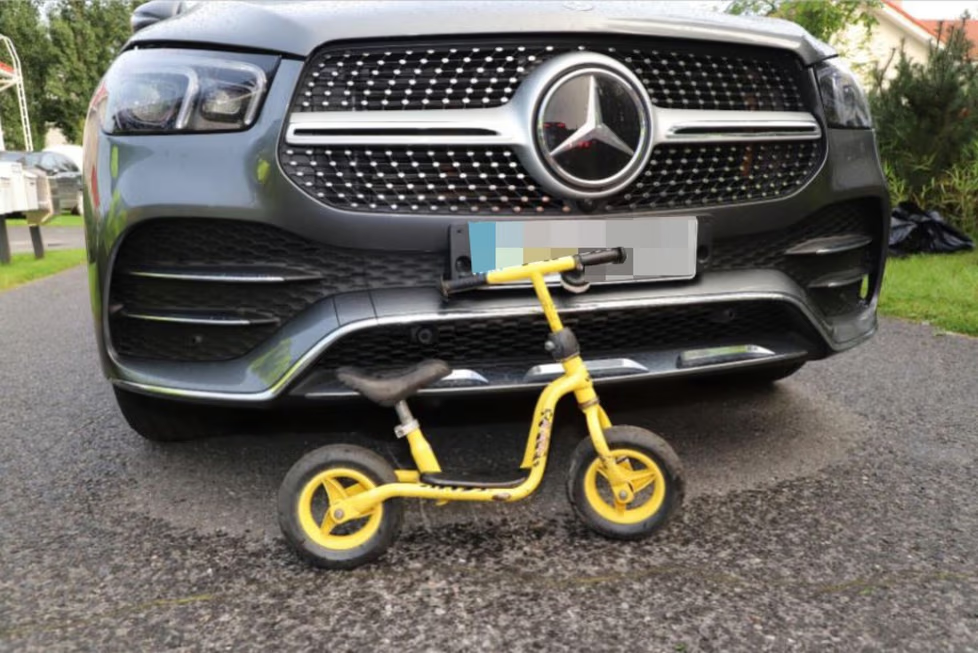
    I hope large cars will get good safety systems. Powerful image of a very tragic case from 2023 (Actually European car in Europe):

    https://images.sanoma-sndp.fi/98ad49728452bf5d3e1c9d1d90d899...

    • bombcar an hour ago

      Images like that evoke feelings but you have to evaluate each on what would have occurred with other vehicles - even a bike hitting a child at speed is likely to be tragic.

      • fzeroracer an hour ago

        No, because we're talking about the physical laws of nature here. A vehicle of that size hitting a child even at a low speed is going to impart much more force than a bike hitting a child at even high speeds. And that's before you get into the other physical design issues of modern cars pulling people under the vehicle in collisions.

fzeroracer 2 hours ago

I'm an American that doesn't drive. I've lived across multiple states across multiple coasts, so I can speak a bit to the issues here as someone that is primarily a pedestrian. There's a bunch of different things that add up into an absolute mess.

The first thing and the most obvious is that for 99% of people, you need a car to live. I've been able to work around that issue, but you simply cannot exist anywhere without a car. Our public transit networks are terrible, our roads are terrible and our commutes are even worse. Half-hour to an hour commutes are normalized among a lot of people. I don't see a need to hammer this point any further as I'm sure almost everyone who has tangential knowledge of the US knows.

The more insidious problem is that Americans are also incredibly afraid and incredibly self-serving, and our law system is set up to benefit that. Drivers can very easily get away with vehicular manslaughter because our system is tilted in favor of drivers. This is why we see larger and larger cars, because people want to protect themselves at the cost of everyone else. And if they do hit a kid or murder a pedestrian it was an accident and not their fault. This is also why Americans drive like absolute maniacs. Our police also rarely enforce traffic laws and drivers have only gotten worse as a result.

So we have a bunch of people that should not be allowed to drive on the road because they have to drive, where they rarely get punished for breaking the law and where the law is set up to benefit them when they do break it. This has been a universal constant across every state I've lived in, though notably Virginia was worse than both Texas and Washington in terms of drivers.

lconnell962 2 hours ago

The answer you get will depend on how much a person has to travel or has traveled in the US. If someone lives, works, and never travels outside (for example) a 100 KM radius then what they do every day will play a big part. Frequent road travel for work, family, or other reasons probably will look towards the smallest or most efficiant car that can fit their need.

The average weather pattern of the region a person lives in plays a part, the amount of public transportation avaliable plays a part, how densely packed cities near you are plays a part. What car is avaliable is obviously a big part. All that stuff will be probably be considered before the "overall safety" of the car you want (and can afford) to get.

The people who can afford to think about safety will most likely be considering "passanger safety" rather than at the societial level. The more big cars around them the more someone concerned about safety will feel the need to own and drive in a big car. Sometimes you need the bigger car for the larger range a bigger gas tank allows. There are still places where you can find around 400 km between gas stations, especially if you are driving outside normal buisness hours.

One topic for the American car market has been how the "mid-sized" or "mid-range value" car space has been vanishing. That the options are increasingly moving towards either minimal passanger/storage Eco-Cars or the larger Trucks and SUVs. That plays a part, the used car market plays a part, and other world events play a part.

So at least from one point of view here all that leads to a lot of topics like this where there are people who have only lived in the US (and often not even moved around to other parts of the US) pushing their world view on others. You also have people who "have been to the US" claiming qualified expertiese based off their point(s) of reference, valid or not. The "US needs better public transportation" crowd will usually come out as well with sometimes more militant views against car use and ownership.

But all this circles back to the idea that the "normal American" has time to think about this or try to act on any of this. Some do, some don't, most won't really think about this unless a headline prompts something from their brain. The hard thing for the "normal European" to understand is the economics of distance and scale at play in the US given just how much space between cities and towns there can be.

People can blame the "American Dream" or the auto-industry, or whatever else you might want to imagine has contributed to the damage done in the last century of road construction and sprawl. The end result is that most Americans don't have a choice but to own a car, and may be far too tired to be trusted at the wheel of a vehicle. Multiple people driving less than a few miles to work may be involved in an accident with someone who had driven hundreds. Miles driven in a year is part of insurance calculations for a reason.

This was much more comment than I intended to give.

echelon 5 hours ago

Americans want big cars.

American regulations created a dichotomy where there's no middle ground. Big car or sour cream dollop with no space and no power.

Americans want big because big means "safety". An SUV feels safer next to the semi than a Smart car. They also want big to haul the occasional furniture between moves, go on the occasional road trip, bring all the gear when camping, or bring back a massive shopping haul.

American housing is way less dense outside the cities. There's no reason for a compact car if you live in the burbs apart from gas mileage.

At the same time, more and more people want to build bike lanes and people infra near roads. "Strong Towns" movement, etc.

We're putting more bicyclists on the roads next to big cars now.

  • MarkMarine 5 hours ago

    That is not the only reason for a big car. You have to find special forward facing child seats to put 3 wide in a Tesla model 3 rear row, then do yoga to try to insert the children into them. To run the child seats facing backwards as long as possible, you need to be something like 5’4” or less to be comfortable with 2 seats in the back. That’s pretty standard in the “normal” sized car market, having a SUV or a minivan makes sense considering that.

    I know. Sold my Tesla, now drive a Land Cruiser. A small car is just an exercise in pain when you have kids and need a car to get everywhere. If I had safe bike lanes to get the kids to school and practice and the grocery store, I’d just have an urban arrow… but I’m not contending with the aforementioned kindercrushers that aren’t looking for cyclists and risking my kids with the way our streets are designed. I would happily support changes that fix this, but this is the world we’re in as parents.

    • bombcar an hour ago

      There’s a reason minivans are “mom wagons” and it’s mainly on kid access.

      And even a minivan is quite large (usually SUV size without the height).

    • CalRobert 5 hours ago

      I once had a Volvo wagon with a rear-facing third row, but I don't think anything like that has been made for over 30 years.

      You're right though, if we hadn't moved to the Netherlands, we'd have bought something like that too, to make sure we'd win in any crash. Luckily we do, indeed, use an Urban Arrow instead.

      Ironically I can hold more kids on the Urban Arrow than I could in my last car - 4 small kids can ride on the bike (3 in bucket, one on a seat on the back), plus the rider of course.