Kids Rarely Read Whole Books Anymore. Even in English Class
(nytimes.com)97 points by signa11 2 days ago
97 points by signa11 2 days ago
I can infere all the facts and logic perfectly well! But thank you.
> I live in a rural Red State, a place you'd expect less reading
I would not assume this, given that the states with the highest literacy rates are mostly rural and at least half red (NH, MN, ND, VT, SD, NE).
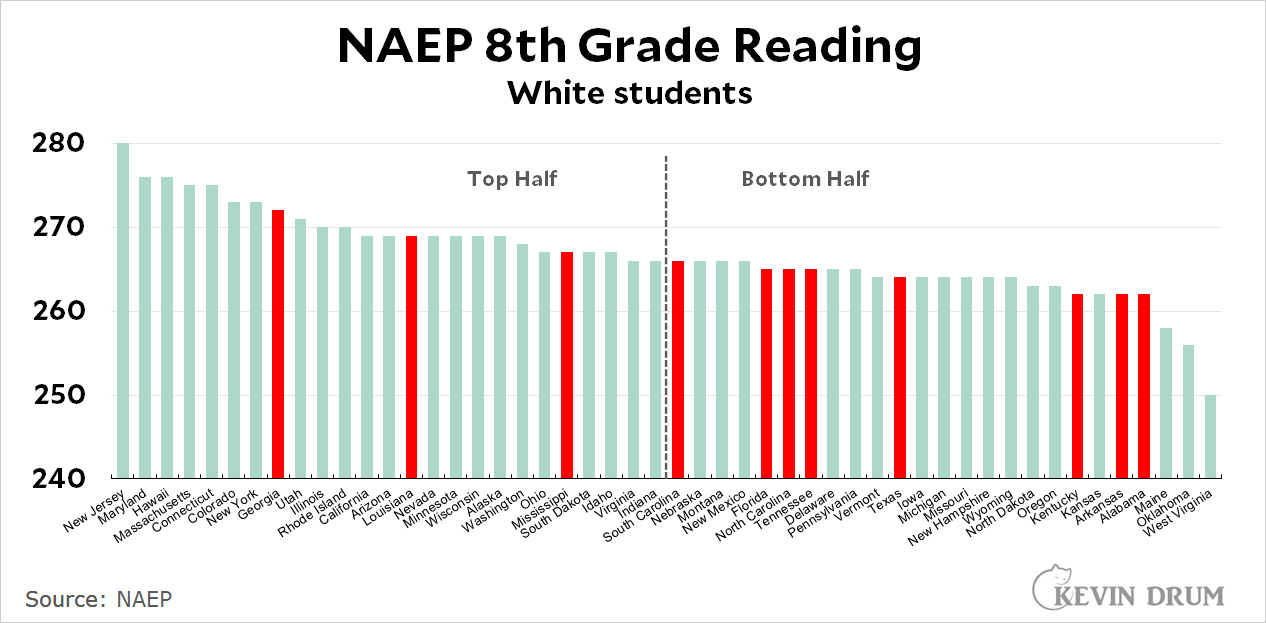
Yeah, reading scores are about how well you teach reading. In terms of NAEP 8th grade reading scores, New York, Georgia, Utah, Illinois, Rhode Island, and California cluster together in the top half, in that order: https://jabberwocking.com/wp-content/uploads/2023/04/blog_na...
> Break that down further and you'll see it's blue cities in those red states that have the highest illiteracy rates.
Not true; in both red and blue states, its rural (usually relatively redder for the state) areas that have the highest illiteracy rates.
> Same with crime.
OTOH, with crime its true that higher population density areas (which also tend to be bluer) tend to have higher aggregate crime rates (though some important categories of crime, notably firearms homicides, reverse this.) But the fact that general crime rates do that has been recognized not merely longer than the current ideological divide between the US major parties, but longer than the existence of electoral democracy; the driving factor being density => opportunity => crime. Opportunity scales with dyadic interactions which scale asymptotically with n² (n=density). It's also worth noting that areas within states don't have the kind of Constitutional sovereignty against states that states do against the federal government; with no equivalent of the 10th Amendment protection that states have against federal encroachment. They don't generally have the power define serious crimes, or define punishment for serious crimes (they may have the power to define and punish infractions and misdemeanors), define correctional and rehabilitation policies that apply to serious offenders, etc. All those things are done at the state level. They also have very limited (because of state law) control of public health (mental and physical) policy, taxation levels and distribution, etc. So even if it was policy and not population density driving the difference in crime rates, the local areas aren't the ones in control of most of the potentially-relevant polices, the states are.
The parent repeats precisely the disinformation of a political party. That shows reading comprehension and some communication skills. If this was an English class, it might get a B if the assignment was about disinformation techniques.
But this is social science and we need to apply other cognitive skills, such as understanding empirical evidence, controls, and causal inference. Using those we could generate other hypotheses from factors more strongly correlated than the leading political party, such as funding, generations of systemic discrimination, government violence, or other causes.
Regarding political party, generally the better educated someone is, the more likely they are to be in the Blue party. The most highly educated institutions, including those of science, education, arts, etc., tend to be overwhelmingly Blue.
> I live in a rural Red State, a place you'd expect less reading, and my kids, and many of their friends, read full books all the time and have since they were quite young.
> The curriculum in our public school regularly requires kids to read full books for class, and the kids you'd expect from the homes you'd expect read plenty.
Reading the expected books for school is very different from reading a lot privately at home.
I know quite many fellow pupils who read a lot privately, but detested reading the required books for school (they at best got some summaries somewhere, which in my opinion actually prepared you better for the tests since the people who write summaries typically know quite well which parts/topics of the books teachers consider to be important, and thus do quite some explanations on these).
On the other hand, I know fellow pupils who barely read anything in their free time (they had different interests), but for some reason actually liked (and liked reading) the books that you had to read for some classes.
I do not live in the US, but this was my experience as well. Actually having read the book made my grades worse, because I now disagreed with the claims the teacher wanted to hear. I was always like: no, I have also read the book and no the author doesn't say that.
In Clark County high schools in NV, they do not read a single whole book in English classes even in honors.
Is it an aversion to assigning homework?
I remember teachers assigning “read chapters 4-6 by Thursday” and then giving a quiz to make sure people read and remembered the details.
It's an aversion to giving bad grades to the inevitable bulk of students who just won't read it.
Those quizzes are part of the problem. It was so dispiriting to read, even enjoy, the assignment and then get dinged because you couldn’t remember whether the protagonist put on an otherwise irrelevant blue sweater or red jacket.
It’s the assigned district curriculum. They have a text book with excerpts.
Okay, now what's the literacy rate in your county? What does the data actually say?
Pretty funny if it's Mississippi and they're just correct.
A quick Google search says 67% of elementary school kids scored at or above reading proficiency in my county. 73% for high school.
It’s probably because you are in a rural red state that isn’t concerned with equity and feelings
Comments here are very strange, “Reading books should go the way of cursive! Education is more like childcare anyways.”
It’s bizarre stuff to say. What would you have the education system do? Put iPads in front of kids all day?
> What would you have the education system do? Put iPads in front of kids all day?
A clear majority of parents that I know actually would have the education system do that. Hence the oftentimes poor results.
A private school I looked at in 2025 required iPads (and nothing else) because their entire management of students was don by an iPad application (that worked on nothing but iPads).
The school admin/marketer/consultant/whatever I spoke to during the sales call literally did not understand what I meant when I said "If your management is so incompetent at decision-making that they got shangaied into buying into this deficient ecosystem when almost any other decision would have worked for both major mobile platforms, why on earth would I think that the other decisions they make would be any good".[1]
------------------------------
[1] Management who make obviously incompetent decisions like "Our study material only works on iPads" are obviously incompetent or otherwise disconnected from reality.
Society grows great when people plant trees whose shade they will never sit in. The problem is that we aren’t raising all of the kids right. It’s a societal problem in as much as it is a personal problem for folks unwilling and often unable to work with their kids on this stuff.
We aren’t a nation of nerds, I doubt we ever were, but nerds really ought to create a support system for each other. I understand why people care so much about which school district they are in. It’s as much about a culture of curiosity as test scores.
I’m a nerd, but we were never a nation of nerds and things turned out pretty well. The reality is that, even for smart people, the world is pretty hard to navigate with book learning. I’m reminded of the last president of Afghanistan, Ashraf Ghani, a professor at Hopkins with a PhD from Columbia who wrote a book called “Fixing Failed States.” Yet he was spectacularly unsuccessful at fixing the problems that were squarely within the field of his expertise.
Given the limits academia’s predictive power with respect to complex issues, I think it’s more important to select for and socialize pro-adaptive “gut feelings.” I went to the Iowa Caucuses back in 2019. These were democrats, but not highly educated ones. Mostly farm and farm adjacent people. But watching them ask questions and deliberate, there was a degree of level-headedness, practicality, prudence, skepticism, and caution that was just remarkable to watch. These are folks who don’t have much book learning but come from generations of people who managed to plan and organize their lives well enough to survive Iowa’s brutally harsh winters and short planting window (about 14 days—either side of that and you and your whole family die). You need smart people to do smart people things, but those conscientious normies are the backbone of a healthy society.
> The reality is that, even for smart people, the world is pretty hard to navigate with book learning. I’m reminded of the last president of Afghanistan, Ashraf Ghani, a professor at Hopkins with a PhD from Columbia who wrote a book called “Fixing Failed States.” Yet he was spectacularly unsuccessful at fixing the problems that were squarely within the field of his expertise.
Outliers.
You cannot come to conclusions based on examining outliers only. The better conclusion is from taking a sample of the population, and checking the correlation between test scores and success.
> Given the limits academia’s predictive power with respect to complex issues, I think it’s more important to select for and socialize pro-adaptive “gut feelings.”
There's plenty of studies that determine the correlation between academic performance and success. Have you possibly even considered that the basic "gut-feeling" only gets better (i.e. more predictive successes) with better academic scores?
IOW, the more you know, the more you learn, the better your heuristic is when making snap conclusions.
> It’s a societal problem in as much as it is a personal problem for folks unwilling and often unable to work with their kids on this stuff.
Even that is multi-dimensional. Another big problem we have in the US is that there are groups of people who don't want their children to learn certain things that most well-educated people take for granted.
For example, it's pretty common to this day for some school districts around the country to skip over teaching evolution. It's also common to misrepresent the causes behind the civil war and gloss over the genocide of native populations.
Others could probably come up with additional examples.
> For example, it's pretty common to this day for some school districts around the country to skip over teaching evolution.
Is this actually common? The argument is quite common, but I expected that the actual number of schools who do this is a very very tiny number.
My daughter, at her very expensive deep-blue private school, learned that the Constitution was inspired by the Iroquois—who didn’t have written language—but didn’t learn about the English civil war where the ideas behind the constitution actually had their genesis.
In terms of being a citizen in America, it’s far more important to understand the English civil war, British history, etc. Those are the instruction manual for the actual society we have inherited. Even in my deep red state public school system, we spent way more time than was warranted on native Americans and other things that people feel guilty about. If you’re born in a multi-generational colony ship, you need to know how the CO2 scrubbers work. It doesn’t actually help you to know that some indigenous population was decimated by the mining of the uranium that power’s the ship’s reactors.
They've rebranded knowledge they don't like as "woke".
> Comments here are very strange, “Reading books should go the way of cursive! Education is more like childcare anyways.”
That's pretty on-brand for HN though. This place enforces a very peculiar version of anti-intellectualism centered on empty-headed contrarianism.
They want to play devil's advocate but they aren't smart enough so all you get are dumb hot takes.
... Prepare shorter or lighter materials for them to read, as this article suggests? Why has reading whole books become the holy grail of education system?
The said education system expected this:
> As a high school student less than a decade ago, he was assigned many whole books and plays to read, among them, “The Immortal Life of Henrietta Lacks,” “The Crucible” and “Their Eyes Were Watching God.”
Yeah, sounds like a very great way to filter out perhaps 20% of good readers and make sure the rest 80% will hate reading for the rest of their lives.
You can say it’s like childcare, sure. But learning has to come from somewhere. Parents seem to be doing less and less out of the classroom. Does that mean we’re just giving up then?
Maybe literature is just a terrible medium for culture except for the relatively brief period in human history when they were extraordinarily cheap to produce and disseminate compared to other cultural products.
Edit: but insofar as media criticism in education is bound to the book rather than the dominant forms of the day, I think children are being done a disservice.
It's still by far the best medium that requires you to be active and imaginative while packing the best information density and usability. Plus it works offline, without power, you can carry it around, &c.
Books forge you in a way short "content" we consume all day long today will never be able to, there are a few long form podcasts here and there that could be comparable but that's not the bulk of the media kids "consume"
Slight problem with that if you would like to live in a functioning, thriving democracy: democracy in the sense of "one person, one vote" requires or at least greatly benefits from a broadly educated population. It's not sufficient, but very likely necessary.
I think you're going to attract downvotes from people who just read your first sentence and assume that's the actual gist of your post.
>Let the market solve it. If the market requires educated adults the market will create that environment or something, answer is probably private schools. I assume they’d say something like that.
I don't pretend to speak for anyone else, but I am more than my economic inputs and outputs, and while it was in a somewhat different context, Heinlein's prose applies in spades WRT your assertion:
“I had to perform an act of faith. I had to prove to myself that I was a man. Not just a producing-consuming economic animal…but a man.” ― Robert A. Heinlein[0][1]
[0] https://www.goodreads.com/quotes/11588525-i-had-to-perform-a...
[1] From Starship Troopers[2]
They're axing honors classes in our high schools so they can mix all the kids together for equity. But because some of the students can't read very well (even in 10th grade), they have to read the books aloud during class, since it would be inequitable to require the kids to read on their own at home.
Not surprisingly, when you're rate-limited by read-aloud speed, you can't get through that many books and excerpts are a natural response.
Probably has to do with the method for teaching reading being terrible for several years, depending on if the school dropped phonics.
I saw some stuff about literacy dropping because they went from teaching to sound out words, to, as I understand it, basically just showing the word and teaching how it's said, hoping kids would naturally pick up the rules. This did not have good outcomes, and last I checked, there was a movement of schools going back to phonics.
> I saw some stuff about literacy dropping because they went from teaching to sound out words, to, as I understand it, basically just showing the word and teaching how it's said, hoping kids would naturally pick up the rules.
I've read a lot on this; it's "phonetics" vs "look-see".
For a really depressing read, read "Why Johnny can't read", then the sequel "Why Johnny still can't read", and then look at the dates of those two essays.
We already knew decades ago that some methods never worked in the past, and don't work now, but we still hope that they will work in the future, so we keep them around because there are powerful and mostly invisible (to the parents) interests in keeping these discredited methods around.
I don’t know if this matters much. When I was in school it was rare to actually read a book assignment anyways, and I’m sure with LLMs now it’s less.
I’ve started to have a positive association with reading only in the last few years, I wish schools didn’t force books onto children and make them think they hate reading for their whole lives.
It’s odd, I read ravenously as a kid/teen, as did my siblings. You need to read what you enjoy, and for it to not be forced. (For example, summer reading at the library gave out prizes kids cared about for reading books.) Plus, we didn’t have access to much digital media like TV/video games (though it was the early 2010s) because my parents were strict, so books were a solid source of entertainment.
I read a lot of books that fit my tastes as a kid, usually adventure/fantasy genre stuff.
Never enjoyed the stuff that got assigned in school though. I’d probably like it now.
It is not just it being homework. It is not like I hated evything in school - I actually discovered quite a few intersting things there.
It is that books everyone here is said that kids dont read anymore or brags they read ... are just not interesting books for a kid.
That was my problem too. Not in the US but in Europe. The stuff we had to read was all by 'highly acclaimed: authors who have carved out this niche of 'literature art ' between them.
However their books were dusty, tough, whiny and horrible to get through. Yuck. I never read fiction in my own language ever again just in spite.
I'm older than you (graduated high school in 1975). I read tons of sci-fi as a kid. I also don't remember reading any whole novels for English class. Maybe we did, but if so I have successfully blocked them out.
I have been amazed at the number of houses I've been in over the years which didn't appear to contain a single book.
I graduated high school in '92 (S.F. Bay Area) and can recall several assigned books we read for class in either junior high or high school. I think there were more, but these are the ones I can recall easily today.
Pride and Prejudice. Last of the Mohicans. A Separate Peace. Tom Jones. Beowulf. Grendel. Crime and Punishment. Waiting for Godot. Tale of Two Cities.
Also, several Shakespeare plays, though I am no longer sure which were read when.
We also had other reading assignments where we chose our own books. The above were assigned to everyone.
interesting. Assuming you're talking about high school I had a totally different experience, we were assigned maybe 6 books/semester for the year I spent in mainstream classes (and about double that when I did the IB program but I expected that to be uncommon)
It doesn’t happen anymore because of phones and the internet. Most people in the past read because they had nothing to do and they were willing to invest the time into a good book. You sacrifice a lot of energy in order to get enjoyment from a book.
Now with the internet there’s an unlimited stream of zero investment snippets of entertainment. People naturally dive into that because it’s more rational in the short term to do that.
Schools stopped reading but it’s as a result of the way students behave. The causal driver is student behavior.
Good point. I am old enough to have lived in a pre smartphone time. Hour long train rides would mean folks opened up a book or newspaper.
> I wish schools didn’t force books onto children and make them think they hate reading for their whole lives
The problem is that if you don't force them, they never actually become literate enough to discover that reading is fun later in life.
The kids don't hate classroom reading because of the reading; they hate it because of the associated curriculum. “Why were the curtains blue?” is a skill wasted on children. I only gained an appreciation for such meta-reading during a weeks-long TV Tropes bender during a spat of unemployment after getting fired from my first big-boy job.
The blue curtains has become an almost deranged meme at this point, completely disconnected from either curricula or evaluation. Students are not asked why singular descriptive details are chosen as such.
Being able to perform critical analysis of text is an essential skill today. It might be more essential now than any other moment in history. Understanding how narrative writing uses symbols translates cleanly into understanding how political messaging or any persuasive writing uses symbols.
If the purpose is reading then we let kids read books that they like.
I can read a 1000 page history book but after 50 pages of Dutch literature I want to throw it in the garbage bin. High school KILLS reading. Few survive.
Now that creating written works is trivial, the new skill to have would be figuring out if what you are reading has an ulterior motive, such as advertising.
Or even figuring out if it was created with the intent to have any utility at all for the reader.
Other than avoiding any written works made after 2020, I am not sure what to tell my kids. Even trusting the claim that something was written after 2020 seems difficult, unless you have a physical print showing its age.
My experience was a self-admitted outlier but it started by being read to frequently as a small child, before school started. I could technically read for as long as I could remember but reading by myself was boring compared to being read to due to having a very short attention span then.
Start literacy young and the discovery of reading for fun will be easy and natural.
> I wish schools didn’t force books onto children and make them think they hate reading for their whole lives.
It's a tough position to be in, although I'd imagine it could be remedied by having the kids pick whatever book they want. So they can read whatever they want, but they do have to actually read it. Form a learning/teaching point of view, this is probably ideal, but I'd imagine it's not really possible from a logistical point of view, since the teacher would likely have to familiarise themselves with as many books as they have pupils, which isn't viable unless the class is fairly small.
I don't understand this. If kids are reading for enjoyment already, is assigning a book in school going to kill their love of reading? Or are we taking about kids who never read until school forced them to?
From what I understand, if parents read to kids when they are little, they become readers who enjoy it.
> If kids are reading for enjoyment already, is assigning a book in school going to kill their love of reading?
I nearly did to me, or atleast the continual assignments did. It took a long time for me to pick up a fiction book again. School never assigned me technical writing and encyclopedias, so I continued to enjoy those, thankfully.
> If kids are reading for enjoyment already, is assigning a book in school going to kill their love of reading?
Yes. (n=1)
Yes, because it amounts to several hours long homework. Kids are more slower then adults at reading, so this can easily amount to 10 hours of additional homework which you do on top of usual homework.
So yes, if you spent 10 hours reading a book you don't care about this week, you don't feel like reading something else. You feel like you spent awful lot of time reading already and feel like reading is something like vacuum cleaning - duty but not something you do for fun.
I think school ruined fiction books for me. I had to read long boring books about stories that didn't interest me, with useless sentences describing what the scene looked like or what someone had for dinner. Most of the stories and themes were outdated and didn't have enough context to make them understandable. Some books even used outdated words and phrases.
Maybe if I wasn't forced to read a book in an outdated language about some Christian farmer 300 years ago while I was not in school, and if I could access a succinct version 1/10th of the length of the book, I'd read it.
Maybe if I wasn't asked to describe minor details to prove I read the book, I'd actually focus on the story and not on every irrelevant detail.
Maybe if my teacher didn't force their religious holier-than-thou attitude and allowed us to form our own opinions, I'd be more engaged.
What school taught me was how to get away with not reading the books. I skimmed books by skipping tens of pages at a time or asked friends for the TL;DR or just got an F.
Now I have a feeling of uneasiness and dread when I try to read fiction for fun. So I don't.
Most 300 page fiction books I had to read could've easily been condensed to 30 pages without any loss of information.
Being forced to read and memorize poetry was the absolute shit. A lot of people won't care about poetry no matter how hard you try to force them to like it. And half of it was propaganda - how $nation survived $struggle, how $nation is so great or beautiful or how $hero did $ethical_thing.
As a native US English speaker, I enjoyed Shakespeare and even when we read Beowulf and some Chaucer in mildly transcribed and annotated Middle English. More than any history lesson, it developed in me a feeling for how, in spite of lots of technological and other societal change, the basic human condition is the same.
I imagine it would be interesting to read early texts in other proto languages too. Sadly, I'm not a polyglot and can't really access that experience first-hand.
I graduated from public school a long time ago. I hated Shakespeare. The phrasing and Englishness of it was a complete turn off. And I read a lot. I believe I read almost a fourth of the books in my little public library in my rural town in Texas. As far as writing, I admire the writing in the King James Bible more than Shakespeare although I am Catholic. I would say most of the books I read were crap and written poorly.
>I would say most of the books I read were crap and written poorly.
So you've encountered Sturgeon's Law[0] in the wild. It applies to pretty much everything, so perhaps you might broaden your focus when considering that.
Were you aware that this is actually a thing?
> Most of the stories and themes were outdated and didn't have enough context to make them understandable. Some books even used outdated words and phrases.
no cap Mr Darcy ur parties are bussin fr fr
I should've used "archaic" instead of "outdated". As in, "incomprehensible to someone speaking proper modern $language". Without a dictionary, a normal student couldn't understand what was being said in many sentences throughout the book. Some books actually had a dictionary in the end, but not for all the archaic words and phrases.
So you cut off your nose to spite your face.
Good job!
Do you smash your windows when it's cloudy outside too?
You're blaming others for your lack of interest and failings.
I'm glad I don't know you.
It is interesting how everyone parrots that art is important when the vast majority of the population will never actually engage with it.
Opera? Ballet? Literature? Poetry? Classical music? Modern art?
Do the numbers it seems most people can do without them and still be functional.
Avengers end game is also art. I engage with this type of art. I don’t consider opera the art of our modern culture. It is unfortunately a niche.
> Being forced to read and memorize poetry was the absolute shit.
Yes and no. I used to start reading at 4 years old, but I forcedly used to memorize some rhymes at 3 years old. Most folk don't believe it is possible to read so early (though Eliezer Yudkowsky has reported about similar age). But my point is - how would I learn reading so early without that poetry?
I don't really like poetry exactly as rest of the fiction genre. And I am still sure it is not shit even for those who are struggling of doing that. I consider poetry exercises as sport exercises: today you claim that some specific muscle is not important for you, but tomorrow you get some injury which happened because of some weak muscle.
But you have also said one important word - propaganda. This is what really shitting any education and propaganda seems like the monster from the Nitzsche's quote "Whoever fights monsters should see to it that in the process he does not become a monster".
I also learned to read at 3. I actually remember the switch from illiterate to literate, as I remember realizing that just by looking at road signs I would automatically read them. I told my sister, who couldn't read yet, that there was a downside, as you could never look at language without reading it ever again!
I think 4 IS early, but not that uncommon. 5-6 is typically without it being forced.
Nobody believes this, but I have VHS evidence of myself reading at 2
I read non-fiction all the time. HN and reddit comments, news articles, Wikipedia articles, books, research papers. My ADHD doesn't help, but doesn't prevent me from finishing 300-page books that are actually interesting. I have yet to find a fiction book that's not full of fluff.
I've read a couple of scripts for movies and TV, and they're, by far, much better than fiction books for me. Just more condensed, more to-the-point.
That's not to say that I admit I can't finish (or even start) a fiction book now. They're ruined for me. But I don't care.
Im seeing the same in Germany. Here’s an incomplete list of all books that I read as mandatory high school assignments, which I can recall from memory.
* Die Vorstadtkrokodile
* Faust I
* Die verlorene Ehre der Katharina Blum
* Antigone
* Die Verwandlung
* Bahnwärter Thiel
* Der Sandmann
* Die Räuber
* Hamlet
* Der Besuch der alten Dame
* Im Westen nichts Neues
* Unterm Rad
* Woyzeck
Im probably missing 5 books or something like that. Many of these books have had a profound impact on my views on the world, more than I would have guessed at the time.
I graduated high school less than a decade ago and I had to read about 90% of those books. And those are just the German ones, there were at least half as many English and French ones too. I have younger cousins who are in the school system now and I am fairly certain that it is still the same. Actually I think it is probably mandated by the curriculum.
There's still plenty of mandatory reading. It's not unusual for high schoolers to have to read at least two books per semester. Here's the problem though: It's just too easy to... you know... not do it. Teachers have no way of reliably telling the difference between those students who complete their reading assignments honestly and those who make due with summaries and AI assistance. Don't ask me how I know ;-)
What i found is that there is an aversion to knowledge, there is a ever increasing group of people (not only kids) that refuses everything that involves reading, learning or reasoning.
You present them a game that involves a bit of investigation and they just don't try, you think well they want to shutdown their brains at the moment of relax, but no they just never use their brains. They can't follow a manual to assemble anything no matter if they only have to connect two pieces clearly marked as put them together.
And they reach adult stage in this condition, they can't do anything else that following verbal very precise instructions, and some of them are not stupid, i found very capable people that just reject trying to read anything but have incredible reasoning skills, they just never notice because they never exercised.
I’ve noticed some of these kids can’t tell time on analog clocks nor read cursive handwriting.
Analog clocks are interesting in that they exercise your brain when you read them. You have to do calculation (what is the number system for each hand), spatial reasoning (where is each hand) and categorization (what is each hand).
There’s a program called Arrowsmith that has a summer program called the Cognitive Intensive Program. It’s basically 3-4 hours a day of speed reading analog clock for 7 weeks. You start out at 2 handed and work up to 8 handed.
Changed my son’s life. He was a completely different student afterwards, for the better.
> Analog clocks are interesting in that they exercise your brain when you read them. You have to do calculation
Interesting, for me it is the opposite. With a digital clock I need to do a division/comparison to know how much part of the day/hour has already passed. With an analog clock I can read a proportion directly.
I kinda rabbit holed on this and it seems to be a very lucrative scam
Just $6k to change your life by speed reading clocks for 3 hours a day for two months...
Needless to say this trips my crank/cult smell meter.
Hours, minutes, seconds, degrees, arcminutes, arcseconds... I could try to read 6, but honestly I doubt I'd even be able to see the arcseconds hand, it would be moving so quickly.
This is hilarious, I don’t even want to know if it’s legit.
I can read analogue clocks only because I was taught in school, and prefer digital ones for all use cases I have myself (other than maybe decorative?), and even when I do read an analogue clock face, I convert that to digital time in my head before I can properly parse it, so I have a hard time blaming them. There aren't many analogue clock faces I need to read in my life, and there are probably even less in theirs. The last time I strictly needed to be able to read one was, funnily enough, teaching kids how to read one.
Not to other people I've talked to.
I'm the wrong person to ask this about, since I prefer digital time, so time is just a number to me. But Technology Connections made a video atleast talking about it,[1] so hopefully that get part of the point across. To him and plenty of other analogue-first people, time is a progress bar, or a chart, or something along those lines, and that's the natural way to perceive time, and converting it to a number is meaningless beyond expressing it as digital time.
Aside from signatures, which don't need to be read, I don't remember the last time I've seen cursive outside of an elementary school.
Something really cool about reading the Declaration of Independence.
you don't write. people don't write in cursive around you?
Why would you write in cursive? If you care about WPM key board toasts it.
If you care about handwritten your receiver cares they got your letter at all not that it's cursive or not.
Cursive is an outdated skill for when it was the fastest way to get words written to paper.
This sort of thing is some of the weirdest pseudointellectualism I've seen. Most adults and seniors also can't tell where they are by the position of the stars, or write with a fountain pen, or use a sliderule, or read a sundial. Because now we have Google Maps, ballpoint pens, calculators, and analog clocks.
> Most adults and seniors also can't tell where they are by the position of the stars, or write with a fountain pen, or use a sliderule, or read a sundial.
I maybe give you the stars, but all the others demand a "Citation needed".
Plausibly some kids might still be reading entire novels worth of text online on the regular. Think of all the massive fanfic archives (Including original fics) Lots of fanfic authors have fans of their own, and those have got to be coming from somewhere.
It doesn't need to be in dead tree format. It doesn't need to be famous authors. Just so long as they read!
For long form original see eg:
* The last angel https://forums.spacebattles.com/threads/the-last-angel.24420...
* The wandering inn https://wanderinginn.com/2017/03/03/rw1-00/
* Or eg https://en.wikipedia.org/wiki/The_Martian_(Weir_novel) which made its way off the net and into print, possibly to the detriment of both. :-P Original location (afaict) (no longer available there) : https://www.galactanet.com/writing.html
> "massive fanfic archives"
Ye gods, that's like saying that youth may not be willing to consume a nutritious, balanced diet but we should rejoice that they are at least consuming vast quantities of sugar and fat. With vanishingly rare exceptions, fanfic is crap in textual form, laden to bursting with literary sins both venal and mortal.
People said that comic books and pulp novels were morally harmful and caused juvenile delinquency, which is indeed nonsense. However that has nothing to do with the quality and depth of the writing so your post is irrelevant.
The usefulness of reading books is not about what factual information you can glean from them. They're about engaging the imagination and making you take hypothetical situations seriously. In that sense traditionally published works aren't going to offer all that much more than fanfiction.
> They're about engaging the imagination and making you take hypothetical situations seriously.
- that nudges readers in interesting (to society) or new (to the reader) directions. Or at least in not in actively harmful ways. Otherwise, OF, livestreaming, or whatever latest social media BS, etc. are king: purposefully designed to create parasocial relationships that trick you thinking you have chance to be noticed.
My main beef with most fan fiction is that in my experience, it unconsciously locks readers into an extremely rigid way of thinking. Of course, this varies from fandom to fandom but woe upon the budding writer who ships the wrong pair or violates the canon.
It mirrors religious dogma, but somehow even worse when compared to all the disputes in Christianity throughout the centuries. (Plus, there's at least a connection between Christianity to modern democracy.)
Beyond a basic level of literacy, I'm not sure it's clear that reading pulp is better for any defined outcome than reading nothing. And I'm not sure why it would be. Once you are able to fully grasp a level of literacy, reading more of that level or below probably isn't really doing anything for you.
Oh, are you responding to my examples?
* Last angel: A web serial, sure it's chunked into chapters/updates, but paper novels have chapters too.
* The Wandering inn, same as above, it's at 2 million+ words and counting. People read it.
* The Martian: Actually the shortest text of the bunch. Now available as a traditional paper novel.
I am not responding to the examples, and I am not challenging the claim that famous vs not famous author does not matter, or that dead tree vs screen does not matter; I am raising the question whether it's just a quantity issue ("Just so long as they read", "entire novels worth of text").
Is it? I am not sure either way. Do you lose something by only reading chapters of a novel but never the whole story from the beginning to the end, even if you're still reading the same amount?
The writing quality and complexity of amateur content, even long-form is only around the level of a YA novel, truth be told alot of the stuff I was reading back in junior high in my school library had more depth than this.
It's good that you can get people reading, but reading the equivalent of pulp is very different from real novel that isn't so bounded by tropes or genre limits.
90% of everything is crap.
--Sturgeon's law.
(ps. and once you get people reading, they tend to keep doing it and develop taste over time. if it's even just a few who wouldn't have done it before. That's good, right?)
(pps. For example: at 2M words, I think pirateaba might exceed the "first 1M words are practice" threshold)
How can I forget Harry Potter And The Methods Of Rationality [1].
HPMOR is written by Eliezer Yudkowsky to promote rationalist concepts, and is somewhat influential in startup and AI circles.
Directly: Emmet Shear {co-founder of Twitch (YC S07)} is apparently superfan and gets a cameo.
So for once I get to post something that's almost on-topic for yc. :-P
[2] https://techcrunch.com/2023/11/21/what-does-a-harry-potter-f...
> How can I forget Harry Potter And The Methods Of Rationality
If you find out, let me know. I wish I could.
I've never read such self absorbed drivel in my life. To be fair, I've not read any Ayn Rand, so I might be judging harshly.
Maybe not the best thing for kids to be reading!
https://www.thecut.com/article/milo-youngblut-max-snyder-ziv...
Even without the, you know, murder stuff, I think we can do better for kids than another generation of "rationalists", considering the track record here.
Who cares? If people enjoy it, let them enjoy it. I've read a few YA novels as an adult that I enjoyed, even though I regularly read more complex stuff.
Most people, for most of history, have only ever enjoyed what might be considered "low quality" entertainment - pulp fiction, shitty plays, etc.
> real novel that isn't so bounded by tropes or genre limits.
Interestingly, even discounting YA and other stuff like that, you are only describing a very small subset of novels.
Jane Austen was considered pulp. So was Charles Dickens. And Conan Doyle.
Nobody considered those high literature back in the day!
>Who cares?
I do? Why would I want my kids to be consuming crap when they could be engaging with great works and high art?
Fanfic reading is not like novel reading in that you don't need to really understand new, unfamiliar characters though.
Thus it can tend to become limiting; and I say this as someone who actually does enjoy fanfiction.
> Fanfic reading is not like novel reading in that you don't need to really understand new, unfamiliar characters though.
So the Lord of the Rings series counts as one book? I'd believe diminishing returns, but not one and done.
Also, I thought that Yudkowsky's HPMOR fanfic had more interesting ideas than the whole Rowling series, which I like a lot.
>Also, I thought that Yudkowsky's HPMOR fanfic had more interesting ideas than the whole Rowling series, which I like a lot.
Then you do not understand writing. If Yudkowski really had more interesting ideas, then he would have been able to do HPMOR as original fiction.
Rowling is actually really good, inventing very charming things, very fun sentences, and there's nothing even close in HPMOR (I have read it myself, and enjoyed it to some degree), but you really underestimate how good Rowling is.
Yeah I thought it was such a funny example yo pick out bc, yes it is!
Most online text is shit and doesn't count IMO. Why would you want to waste your time reading the thoughts of average people (including this one)?
How about us, the adults?
In the latest "War on the rocks" podcast [1], Ryan Evans asked his guest, Swedish Defense Minister Pål Jonson, what books he has read lately (he often, maybe always, asks that question). The guest answered basically that, as a politician, he does not have time to read books anymore, because he is very busy with other things.
I think most listeners of the podcast are absolutely ok with this. Pål Jonson is an important guy, who has a job to do. That job is to keep Sweden safe, and, as Sweden is now part of NATO, by extension to keep NATO safe as well. If he does his job well, then Sweden and NATO together might be able to deter aggression by Russia. If taking time to read books means he has less time to do his job well, then he should not read books.
But if you replace Pål Jonson with somebody else, who are we to say that their job is less important? And if we take a kid, the way the kid understands their jobs is that they need to get ready for life,for their actual, paid, job when the time will come. And if in doing that, they are more efficient by using ChatGPT, then why should they read entire books?
[1] https://warontherocks.com/2025/12/getting-faster-stronger-re...
Modern society has gotten so “efficient” and expectations so insane that yeah, anyone at that level of a professional career - especially with a family - I would in no way expect to have time to read anything. Every last inch of their life is going to be hyperscheduled to oblivion.
We have systematically removed any chance for “unproductive” downtime for any high performers if they want to continue to be seen as a high performer.
Not surprising in the least to me, and society as a whole is worse off because of it. Good luck when this person needs to make a hugely impactful and thoughtful decision for society while in their position of power.
Literature is like classical music. One can argue Beethovens 9th symphony is one of the greatest pieces of music of all time, but that doesn’t mean we all have time to sit through 70 minutes a day listening to it.
I bet important people don’t even have time to sit and watch a full movie.
Any. Even if you're doing a blue collar job, understanding the fundamentals (or at least the specifics about a particular subfield) makes you "the guy" and adds some job security. As a programmer I often got ahead just because I'd read all of the C standard library, the Windows API docs, etc.
When I started high school in the early '90s, there was a compulsory summer reading list of 10–12 books, each ranging from 300–800 pages. Then we had to write essays about them. This was just our summer homework before the new school year started. I didn't enjoy it at all; at the same time, I read lots of easy fiction, sometimes several hundred pages a day.
My six year old (who is still in kindergarten) reads about 70–100 pages per week of books aimed at eight to nine year olds.
The headline should have been ...especially in English Class.
Even in the 90s most people got book summaries to get through the curriculums. I would say, the highest performing language students and teachers pets at school did exactly that.
School unfortunately is largely about reciting of the teachers knowledge, so there is no need to read the source and think for yourself.
Maybe I would've had something intelligent to say about this article, had I been allowed to read it.
I’m in my 30s but the UK English reading choices weren’t very inspiring when I studied and you could pass the exams without ever reading full texts so of course that’s what schools encouraged.
I remember doing sections of Romeo and Juliet and Macbeth but we never did the whole thing. We did read Of Mice and Men and An Inspector Calls but that was it for books/plays. Poetry we had a book called Anthology where we had to read and re-read many poems for analysis.
You should be thankful. I had to read the whole canon of Shakespeare and hated it. I learned about the great vowel shift and more about English trivia than I cared to know.
https://internetshakespeare.uvic.ca/Library/SLT/literature/l...
People rarely read whole books anymore. I know very few adults in my life who read books, lots of people are put off by reading in school and never give it a try in their adult life.
I think the biggest offender is summer reading assignments. I never knew a single person that actually read their book, and being expected to spend time during break reading for a school assignment definitely creates a negative association.
I loved reading as a child, up until high school. Once I graduated, it took years before I enjoyed it again.
The same thing happened to me.
Required reading in school killed my interest in reading. When I graduated I was very happy that I wouldn't have to read books ever again.
It took me about 5 years or so until anime and manga got me to try another fiction book. That eventually led to reading more books. But when school was done I really did think that I wasn't going to touch a (fiction) book again.
---
It makes me wonder if kids in the future will have "required reading" where they have to play certain old video games. Will that make them hate video games?
In our local highschool (near Copenhagen, Denmark) they have scheduled reading time for all pupils while in school - weekly as part of their normal schoolday. That is, instead of normal class everyone needs to bring a book of their own choosing and read in it. No phones allowed during this time, so they can either read or stare out the window. The local library helps them find books of their own interest.
The idea is to get them find genres and books they like and find joy reading it, while not taking time out of their free time.
Ironically this wouldn't work for me because I do almost all of my reading on my phone these days. It has become the main use of my phone at this point.
It is a good idea though, as long as they can find things they want to read. I've been sucked into the "bleeding edge" of reading (web novels), so it can be a bit more challenging to find things I really want to read. They are still out there though. Eg The Martian and Project Hail Mary (the former actually started as a web novel) .
If by summer reading assignments, are you referring to Scholastic summer reading programs? I quite enjoyed those as the available options for reading were very wide and I could always get some new Goosebumps books from the book fairs. But those are parent initiated, not something the school assigns. They can't really assign anything over the summer as they have no authority to do so outside of some IEP designed to get a particular student back on track.
I did my PhD, and so I am not averse to reading. But its nowadays rare to find books that have value in being read completely. Most of the time, I would rather read a blog post or a paper, books are often outdated by the time they are published. Books are limited to scenarios where looking at a complete scene of something frozen in time is still instructive.
The article seems to be centered around reading assignments. I was reading entire books often when I was in school, yet did my best to avoid reading assignments because they were so dull.
I don't know how they sourced respondents, anecdotally all my kids a reading books as I type that. They read much more than I did at their age; and their friends read as well. They'd probably spend all their time on snapshat or brawlstars, were they to have a say.
Isn't that the characteristic of each generation to feel like education of the next generation is decadent?
We have at least a whole generation of kids that were taught to read using "whole language" methods instead of phonetically. None of this really surprises me.
Pretty much every one in the selective school I went to read for fun.
Even the "troublesome" ones.
Seattle public schools does not read full books in elementary. Just short form publisher slop. Can’t do reading as a group and discussion because not all kids understand and that wouldn’t be inclusive.
When I was in high-school 20 plus years ago excerpt based reading assignments were fairly common in non-honors/advanced placement classes. Except there were whole textbooks full of excerpt based assignments instead of computer software for this purpose. Anecdotally I took honors and AP English and those classes destroyed my desire to read for years. I only read a few of the assigned books cover to cover because they were either dreadfully boring or the expectations for how quickly we should read them were more than I, a very average student, could manage. Usually some combination of both. Rather than relying on cliffnotes and sparknotes alone I would typically read the first chapter, the last chapter, and then some chapter in the middle so I was prepared for tests and discussions.
At the end of the day the AP exams didn't test you on your knowledge of The Scarlet Letter or The Great Gatsby. The exam tested you on your ability to read an excerpt and answer questions about it as well as your ability to write a multi-paragraph essay from a prompt while a proctor wearing the most hideous smelling blackberry perfume bathed you in an olfactory assault every time they walked by. In-classroom writing assignments were the most effective way to prepare and we did them frequently. As a reward for doing well you got to skip a couple of 100 level English credits in college.
Sure there are lots of brainrot distractions available to kids today, but it feels like the education system never takes a moment to look inward and acknowledge that The Scarlet Letter and My Antonia are dreadfully boring reads. It took me three tries to finish 1984 because the beginning is such a slog. It is strange to say kids aren't interested in reading (from the article) when a lot of the subject matter is objectively dull. Four of the six books in the article header are books I don't even want to think about let alone read.
> Sure there are lots of brainrot distractions available to kids today
Take apart the distractions per se, how is it possible to read book for a kid in 2025 at all? Reading thick books requires having some device with no distructions. In my young ages all computers and all smartphones used to have no distructions, but now all computers (except some Linux distros) used to be bombarded with distructions in such a way that I can not read a book on any proprietary OS without getting some notification about anti-virus software or some updates or a need to restart, or just some events happening on the Internets.
My point is not just that distractions distract people, but distructions have become inevitable on almost any modern device able to render PDF with formulas.
Paper books are too hard to sell after you have read it.
Ereaders can not render PDF/DJVU with formulas. My reading list has nothing able to be read from that kind of devices.
Installing some more proprietary code will not lead to "deshittifying" some existing proprietary code. You just add 1 guy more of your dependances. You even can not do this once for whole life of the device. So many time perfect for reading goes inte nowhere with Woedows OS.
I agree wholeheartedly with this.
While "the classics" may have some educational and cultural value, many of them came off as dry and pretentious.
There are countless anecdotes online of people who loved to read books as a kid but thoroughly hated reading by the end of high school or college, which is a terrible outcome.
I think that English classes in general are far too prescriptive and narrow in what they assign students to read, particularly when it comes to fiction. They seem to adopt the attitude of "These books are well-written classics. You have to read them, and if you don't enjoy them then there's something wrong with you."
Forcing students to read specific boring material might make sense in other classes like History or Science where there are very specific facts that they need to remember, but the required reading portion of English classes doesn't need to be handled in such a rigid way.
I suspect that we would end up with far better results if we gave students a curated list of popular books and had them pick out their favorites to read rather than just telling them to go read Ethan Frome and write an essay on loneliness afterwards.
> it makes sense to me that kids would not want to read them
That's why the 2026 remake of Animal Farm in animated form includes a twerking pig[1]. Education with brainrot is the future!
I never understand where these anecdotes come from.
I live in a rural Red State, a place you'd expect less reading, and my kids, and many of their friends, read full books all the time and have since they were quite young.
The curriculum in our public school regularly requires kids to read full books for class, and the kids you'd expect from the homes you'd expect read plenty.
So whatever the problem is, if there even is one, is less to do with school curriculums, english classes, screen time, or the availability of books, and more to do with the culture of many homes not prioritizing reading.