Comment by spicyusername

Comment by spicyusername 2 days ago

45 replies

I never understand where these anecdotes come from.

I live in a rural Red State, a place you'd expect less reading, and my kids, and many of their friends, read full books all the time and have since they were quite young.

The curriculum in our public school regularly requires kids to read full books for class, and the kids you'd expect from the homes you'd expect read plenty.

So whatever the problem is, if there even is one, is less to do with school curriculums, english classes, screen time, or the availability of books, and more to do with the culture of many homes not prioritizing reading.
mmooss a day ago

You doubt there's a problem because you don't know of it happening in your rural town? In addition to teaching kids to read books, we apparently need to teach adults research and inference fundamentals.

  • [removed] 11 hours ago
    [deleted]
  • throwawayqqq11 a day ago

    I can infere all the facts and logic perfectly well! But thank you.

    • whattheheckheck 21 hours ago

      Evidently not when you cite one anecdotal counter example and over generalize?

apparent 2 days ago

> I live in a rural Red State, a place you'd expect less reading

I would not assume this, given that the states with the highest literacy rates are mostly rural and at least half red (NH, MN, ND, VT, SD, NE).

  • rayiner a day ago

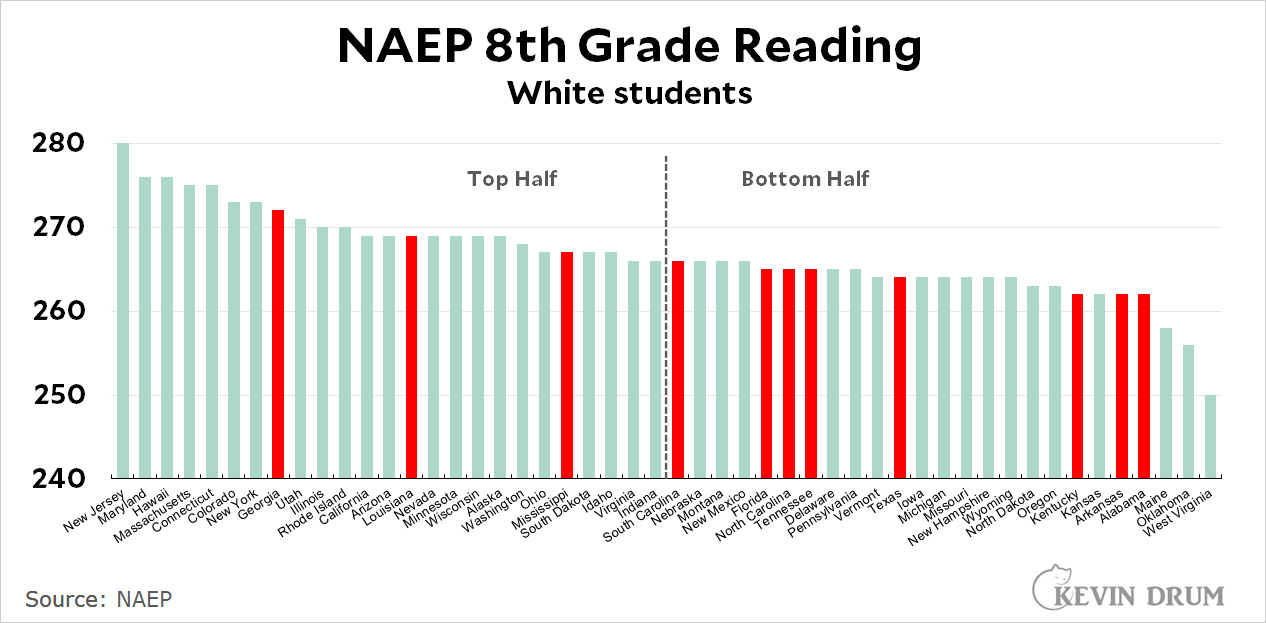
    Yeah, reading scores are about how well you teach reading. In terms of NAEP 8th grade reading scores, New York, Georgia, Utah, Illinois, Rhode Island, and California cluster together in the top half, in that order: https://jabberwocking.com/wp-content/uploads/2023/04/blog_na...

    • apparent a day ago

      The linked chart says it's for "white students". How does it look when all students are included? ChatGPT shows different results (though these could of course be incorrect).

      • j_w a day ago

        Much worse for the blue states with heavy immigrant/English second language populations, which is to be expected.

        "White students" is likely just the cleanest set of "almost certainly English native and parents are English native speakers."

  • theultdev 2 days ago

    Break that down further and you'll see it's blue cities in those red states that have the highest illiteracy rates. Same with crime. Kind of goes hand in hand. Education in blue cities needs to be fixed.

    • dragonwriter a day ago

      > Break that down further and you'll see it's blue cities in those red states that have the highest illiteracy rates.

      Not true; in both red and blue states, its rural (usually relatively redder for the state) areas that have the highest illiteracy rates.

      > Same with crime.

      OTOH, with crime its true that higher population density areas (which also tend to be bluer) tend to have higher aggregate crime rates (though some important categories of crime, notably firearms homicides, reverse this.) But the fact that general crime rates do that has been recognized not merely longer than the current ideological divide between the US major parties, but longer than the existence of electoral democracy; the driving factor being density => opportunity => crime. Opportunity scales with dyadic interactions which scale asymptotically with n² (n=density). It's also worth noting that areas within states don't have the kind of Constitutional sovereignty against states that states do against the federal government; with no equivalent of the 10th Amendment protection that states have against federal encroachment. They don't generally have the power define serious crimes, or define punishment for serious crimes (they may have the power to define and punish infractions and misdemeanors), define correctional and rehabilitation policies that apply to serious offenders, etc. All those things are done at the state level. They also have very limited (because of state law) control of public health (mental and physical) policy, taxation levels and distribution, etc. So even if it was policy and not population density driving the difference in crime rates, the local areas aren't the ones in control of most of the potentially-relevant polices, the states are.

    • bdangubic a day ago

      oh I am sooo stealing this “blue cities is red states” thing - well done mate wherever you picked this up from, well done!!

    • [removed] 2 days ago
      [deleted]
    • mmooss a day ago

      The parent repeats precisely the disinformation of a political party. That shows reading comprehension and some communication skills. If this was an English class, it might get a B if the assignment was about disinformation techniques.

      But this is social science and we need to apply other cognitive skills, such as understanding empirical evidence, controls, and causal inference. Using those we could generate other hypotheses from factors more strongly correlated than the leading political party, such as funding, generations of systemic discrimination, government violence, or other causes.

      Regarding political party, generally the better educated someone is, the more likely they are to be in the Blue party. The most highly educated institutions, including those of science, education, arts, etc., tend to be overwhelmingly Blue.

aleph_minus_one 2 days ago

> I live in a rural Red State, a place you'd expect less reading, and my kids, and many of their friends, read full books all the time and have since they were quite young.

> The curriculum in our public school regularly requires kids to read full books for class, and the kids you'd expect from the homes you'd expect read plenty.

Reading the expected books for school is very different from reading a lot privately at home.

I know quite many fellow pupils who read a lot privately, but detested reading the required books for school (they at best got some summaries somewhere, which in my opinion actually prepared you better for the tests since the people who write summaries typically know quite well which parts/topics of the books teachers consider to be important, and thus do quite some explanations on these).

On the other hand, I know fellow pupils who barely read anything in their free time (they had different interests), but for some reason actually liked (and liked reading) the books that you had to read for some classes.

  • 1718627440 a day ago

    I do not live in the US, but this was my experience as well. Actually having read the book made my grades worse, because I now disagreed with the claims the teacher wanted to hear. I was always like: no, I have also read the book and no the author doesn't say that.

  • nomdep a day ago

    Yeah, that was totally me.

    The only book I ever read for school was by accident. I was already deep into it on my own when the teacher assigned it to us

idontwantthis 2 days ago

In Clark County high schools in NV, they do not read a single whole book in English classes even in honors.

  • smelendez 2 days ago

    Is it an aversion to assigning homework?

    I remember teachers assigning “read chapters 4-6 by Thursday” and then giving a quiz to make sure people read and remembered the details.

    • eudamoniac 2 days ago

      It's an aversion to giving bad grades to the inevitable bulk of students who just won't read it.

      • serf 2 days ago

        something still changed; i've been in classes where the bulk of the students got bad grades and that never stopped the instructor from handing them out.

        if we use grades as a yardstick for elementary progress and efficacy then you'd think it would be a bigger deal if a single cog in the system decided to systematically add inaccuracy to the measure simply because a failing student irks them.

        • eudamoniac a day ago

          You have the principal actors reversed. Teachers would generally love to fail more students. It is the administration that prevents or disincentivizes it.

          Grades are a yardstick merely for which district gets more prestige and funding. There is absolutely no incentive for anyone with authority to fail bad students. Reprimands or terminations result from a teacher giving consistently below average grades.

      • watwut 19 hours ago

        There is no real way for teacher to check whether I read the book or not. People who read books regularly fail trivia tests and people who did not read them can quick read "about the book" analysis off web and call it a day.

        And crutially, my inclination to finish assigned book and my willingness to read books in general are unrelated. A kid that reads a lot wont neceasary enjoy and finish assigned books - I know I skipped quite a lot of them.

        • eudamoniac 13 hours ago

          If your premise is that there is no way to test knowledge, then I can see how you might not want to assign books to be read, but I think there are ways to test knowledge and that reading a book should result in knowledge of the book.

    • mattkrause 2 days ago

      Those quizzes are part of the problem. It was so dispiriting to read, even enjoy, the assignment and then get dinged because you couldn’t remember whether the protagonist put on an otherwise irrelevant blue sweater or red jacket.

      • JumpCrisscross 2 days ago

        > get dinged because you couldn’t remember whether the protagonist put on an otherwise irrelevant blue sweater or red jacket

        This sounds like a bad quiz, unless the story was set in e.g. the American revolution.

      • lelanthran a day ago

        > It was so dispiriting to read, even enjoy, the assignment and then get dinged because you couldn’t remember whether the protagonist put on an otherwise irrelevant blue sweater or red jacket.

        Maybe things have really changed a lot since I was in school, but that was certainly not the type of questions that were asked of set works.

        The questions were asked such that, the more the student got into the book, the higher the mark they were able to get.

        Easy questions (everyone gets this correct if they read the book): Did his friends and family consider $protagonist to be miserly or generous.

        Hard questions (only those slightly interested got these correct): Examine the tone of the conversation between $A and $B in $chapter, first from the PoV of $A and then from the PoV of $B. List the differences, if any, in the tone that $A intended his instructions to be received and the tone that $B actually understood it as.

        Very hard questions (for those who got +90% on their English grades): In the story arc for $A it can be claimed that the author intended to mirror the arc for Cordelia from King Lear. Make an argument for or against this claim.

        That last one is the real deal; answerable only by students who like to read and have read a lot - it involves having read similar characters from similar stories, then knowing about the role of Cordelia, and at least a basic analysis of her character/integrity, maybe having read more works by this same author (they'll know if the mirroring is accidental or intentional), etc.

        We were never asked "what color shirt did $A wear to the outing" types of questions (unless, of course, that was integral to the plot - $A was a double-agent, and a red shirt meant one thing to his handler while a blue shirt meant something else).

        Did I like the set works? Mostly not, but I had enough fiction under my belt in my final two years of high-school that I could sail through the very difficult questions, pulling in analogies and character arcs, tone, etc from a multitude of Shakespeare plays, social issue fictional books ("Cry, The Beloved Country", "To Kill a Man's Pride", "To Kill a Mockingbird", etc), thrillers (Frederick Forsythe, et al), SciFi (Frederick Pohl, Isaac Asimov, Philip K. Dick), Horror-ish (Stephen Kind, Dean R Koontz) and more.

        With my teenager now, second-final year of high-school, I keep repeating the mantra of "To get high English marks, you need to demonstrate critical thinking, not usage of fancy words", but alas, he never reads anything that can be considered a book, so his marks never get anywhere near the 90% grade that I regularly averaged :-(

        The only books he's ever read are those he's been forced to read in school.

    • idontwantthis 2 days ago

      It’s the assigned district curriculum. They have a text book with excerpts.

    • qball 2 days ago

      No, it's an aversion to having (and enforcing) basic standards.

fzeroracer 2 days ago

Okay, now what's the literacy rate in your county? What does the data actually say?

  • spicyusername a day ago

    A quick Google search says 67% of elementary school kids scored at or above reading proficiency in my county. 73% for high school.

ruszki a day ago

> The curriculum in our public school regularly requires kids to read full books for class

That doesn’t mean that kids really need to read any single of those books any time in history.

nothercastle 20 hours ago

It’s probably because you are in a rural red state that isn’t concerned with equity and feelings