Amazon faces FAA probe after delivery drone snaps internet cable in Texas
(cnbc.com)149 points by jonathanzufi 7 days ago
149 points by jonathanzufi 7 days ago
> Traditional stereo won't help you localize them [...] and LIDAR sacrifices resolution for weight and power consumption
I wonder if a more mechanical solution wouldn't help:
Whiskers, like on a cat. A long enough set of thin lightweight whiskers could touch the wire before the propellers do, giving time for the drone to stop and change course. Essentially, giving the drone a sense of touch.
As an undergrad I worked with a professor who was doing precisely that! https://sense-lab.github.io/pubs/pdf/solomon_nature_2006.pdf
I hadn't thought about this in a long time. Looks like her lab is still going strong doing research at the intersection of biology and robotics on whisker-based sensing:
Thin lightweight whiskers are going to be challenging to manage on a propeller-driven vehicle. They'll get blown all over the place. Having them extend out past the propellers will likely get them tangled in the propellers.
Sure, they'll move around in the prop wash.
But that's fine, isn't it? If they're intended to detect fixed objects, then noticing that one or more of them have ceased to be blown around in that way may be a good way to detect unanticipated contact with a fixed object: When the signal becomes less noisy, then maybe something is in the way.
And the whiskers don't have to be all floppy like a wet noodle. I myself am thinking that something rigid or semi-rigid might be good. Perhaps something akin to armature wire, or thin spring steel. Maybe even literal bamboo chopsticks.
They can also be constrained so that they don't get sent into the props.
My little brain thinks that the drone-end of the whiskers can be attached to potentiometers, with light return springs to bring them back towards center, like the mechanism used by an analog stick on a PS3 controller.
A cage around the drone, there are kids toys like this, and also commercial products for inspection. Prevents contact with other objects, contact can be sensed and reacted to. https://www.flyability.com/elios-3
Doesn't protect against everything, like Spanish Moss which dangles from trees, but that is a lot bigger than a long thin wire.
Sorry, not profitable enough, not a "team player". Please enjoy these weekly 1:1s with your manager and HR.
> horizontal wires were the hardest common object to avoid... Traditional stereo won't help you localize them
This makes a lot of sense. I wonder if it wouldn't be better for autonomous vision to use three cameras instead of two for better spatial reasoning.. maybe in a triangle pattern?
We experimented with a rig with more cameras on it (four, in a square) but the baseline of the cameras on the drones we were using could be measured in centimeters, so the vertical stereo pairs didn't provide much better results. Further, more cameras means more power, more weight, and much more expensive on-board processing (which also will require more power).
Cables don't move often. Why not simply have a map of all of them?
Google sell maps of things like this from street view data.
OpenStreetMap supports annotating poles and theirs cables. It's common for power lines (local and long distance). There are also annotations for communication lines (https://wiki.openstreetmap.org/wiki/Tag:communication%3Dline).
There are also public and proprietary "aviation obstacle" databases across the world.
Any one particular cable might not move often, but if a telco owns N bucket trucks it's a safe bet that about N cables move every workday.
Telcos are notoriously secretive about the location of their fiber. They even got most state legislatures to exempt it from state-level FOIA laws.
All cables? Everywhere in the entire country? Accurate to the centimeter level and updated on the hour?
Edit: This was flippant, but the real issues are: any map you get will be incomplete and obsolete almost immediately and cables move and sway in the breeze.
> Traditional stereo won't help you localize them
Wouldn't making a quick circuit around the house before landing allow wires to be observed from multiple angles be enough?
Yes but tradeoffs with delivery speed, and thin wires are still hard to detect with limits on vision processing.
It’s really hard for people too. The advice I got for landing in a field was to assume that every pole you saw had wires going to every other pole. Which is reasonable enough for that scenario, but not workable for continual low altitude flying in a built up area.
It's very simple: don't fly there
there are very little aerial lines few meters highers and ones that exist can be probably spotted from satellite images and planned around.
Especially if delivery area is limited, they could just map them out of the routes.
Video: https://www.youtube.com/shorts/089CBuGTkcY (it's also in the article; my ad blocker must have gotten me on this one). Amazon are not having a good run with these lately.
The double crane cable incident ( https://www.cnn.com/2025/10/02/us/arizona-amazon-drones-cras... ) and the LIDAR failsafe issue ( https://www.bloomberg.com/news/articles/2025-05-16/amazon-re... ) were both rather surprising from a process and management standpoint. This issue seems more like a run of the mill "problem with drone delivery conceptually" that Amazon will have to deal with.
I half expected the shared clip to be this scene from Pluribus: https://youtu.be/r3D3dg23tyA?t=129
> not sure why it's not linked that I can find in the article from the same source?
the point is not news, its to keep you on their sites as long as possible with no escape
Link with playback controls: https://youtube.com/watch?v=089CBuGTkcY
This comes after the incident where multiple drones crashed into a crane.
Given that prior incident and now this the FAA will likely not be too kind to Amazon. The permission on drone tech is predicated on very strong “see and avoid” technology. Given two pretty bad screw-ups now in as many months the FAA won’t be amused at the failures in the tech on these drones.
And that crane cable was much thicker! And it was two drones in a short period of time!
A commenter here notes that detecting power lines is a really hard problem. However surely there is a set of simpler solutions to the problem than actually trying to spot power lines.
This sort of thing is a largely solved problem for bigger aircraft and a similar approach with quite a lot of international regulation and agreement seems to be needed.
Drones could be given a cross section of airspace to work within that is say a horizontal slice about 50m to 100m above ground level, with various rules on resolution (ie what constitutes ground level at any point on the planet). The minimum height should clear most obstacles that are hard to spot. There would be flight corridors defined between take off and landing zones. There would be exclusion zones around areas such as air fields and military locations etc.
Drones could even be allowed to use commercial airspace provided they follow the existing rules and are detectable and contactable etc.
The tricky bit is working out take off and landing zones and rules for them. At the moment, aircraft try to avoid flying over habitation zones. I live near to a helicopter factory and used to work there so I have some idea of the issues involved.
There are lots more rules that could be added for safety. For example, requiring height when flying in a non corridor depend on direction. However, I'm only allowing a 50m zone here but then a drone is only about 1m "tall". Even something as simple as divide the compass up into say 16 zones for wind Beaufort 0-2, eight zones for 3-4, four zones for 5-6 and ban flight at 7+. Those wind designations might depend on gust speeds or constant and could be transmitted. The idea is that things get a bit random as the wind speed increases. Divide the allowable height by the number of zones and set your height accordingly. So flying directly north will be at say 50m and directly south at 100m. The wind speed should also indicate the density of drones allowed per horizontal area. That will need some experimentation and legislation to determine what is "acceptable".
It's an ethernet cable, looks like? That's pretty cool that a drone has enough power to break an ethernet cable. It just got tangled in a single cable, looks like it was run across someone's back yard. That's not a bad failure mode, imo - gives them a little exercise in problem solving, figuring out how to prevent ethernet/cable collisions and snags, and maybe results in sensor upgrades, or they figure out good detangling maneuvers or something.
One cable getting damaged is inconvenient, but I'd have to laugh it off if it were my service. 5G would be a good enough backup in the meantime, and how often are you going to get to see these types of accidents (hopefully almost never) so it'd be cool to have a story.
"I ordered some flaming hot cheetos from a drone, and it broke my internet cable!"
It would be great that the drone had some kind of tactile sensibility.
Go slowly in the opposite direction of said contact first, then if that is not working try to rotate on one of the horizontal axis while going in the opposite direction to see if it make a difference, and if it doesn't then something is stuck on your skin, and you should be able to notice that your weight is not the same as before; if that's not the case, then maybe your sensor is just broken, but then maybe you could be able to notice some difference in the power consumption of the tactile components array, and if that's not the case ... well, maybe that sensor is off too ? Wait ... what are you doing in Madrid ?
That would be okay if you were flying forward at a snail's pace so that initial contact doesn't take out the drone. i'm thinking of all of the times my Roomba has plowed full speed into something and then slowly backed away. If drone behaved that way, it wouldn't be very good. i'm also thinking of all of the times my drones acted that way when i was learning to fly and getting cocky. it wasn't good for them
It is a standard outdoor coaxial cable. Perhaps it looks thin because you are mentally scaling to the size of smaller hobby drones.
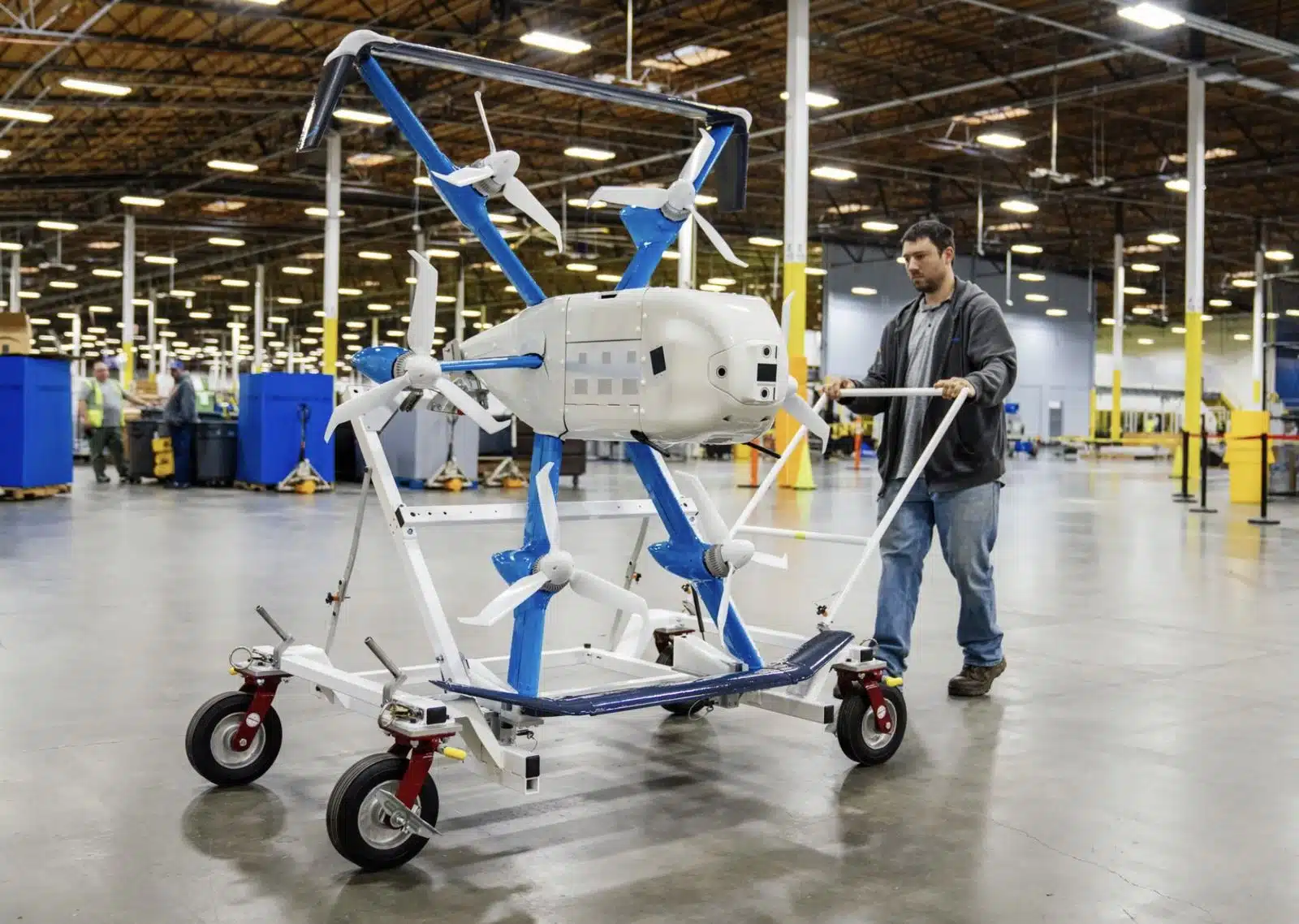
Edit: The MK30 is 78 pounds, and about 6 feet diameter. Here is an image with a human for scale:
https://dronexl.co/wp-content/uploads/2023/10/Amazon-Prime-A...
Shouldn't drones run by trillion-dollar companies not crash into stuff?
Show me the line lmao. You see these rural cowboys stringing 1 - 2 cores over a long distance, I have seen them just going right through or even resting on trees.
The solution is probably a dial before you dig style registry that corresponds to an altitude floor, but I honestly doubt the ability of rural telco to meet that requirement.
Fucking, learn it from the self driving car companies. fly your drones for at least 6 months in the city, make high resolution 3d maps of the area, identify the no fly zones, train models on these. I can't believe their drones are crashing into stationary cranes.
I'm generally pretty gung ho about tech adoption. Nuclear? Yes! LLMs everywhere? Let's try it! Crypto? OK... give it a go! Self driving cars? Heck yeah!
But I really, really don't want drones flying over my house, polluting the already noisy soundscape, etc. This just strikes me as a terrible idea.
My dream is that an increase in drones would lead to a decrease in vehicular deliveries, to the point that there would be a net decrease in noise.
But in my heart of hearts I am certain the convenience of drone delivery -- and an absence of sufficient regulation -- would lead to a drastic net increase in noise instead.
This dream is naive. One truck rumbling (or humming, in the near future) through your neighborhood delivering packages to each of your neighbors over the course of 30 minutes will be replaced with one drone per neighbor.
If they must exist, I hope they're priced/taxed such that they're used sparingly.
Now instead of just one truck for a whole route of deliveries, or one noisy drone per individual delivery, we get multiple particular corners in any given area where the sound is concentrated like a buzzsaw testing facility every day because that's where the Amazon dudes like to park and release the drones.
It'll be awesome when they decide that the parking spot in front of my house -- with no trees or overhead lines -- is an ideal place for drone staging.
(And no, I'm not particularly worried about any of these noise issues. I predict that it'll all sort itself out just fine. Besides, I personally think the spectacle of a swarm of package delivery drones leaping forth from a truck is something that I would never tire of observing.
But it is fun to think about the problems and the solutions. The deeper one dives, the more complex they get.)
Electric trucks are nearly silent. Drones are much louder in my experience. Do I misunderstand your comment?
I am similar to you. Have you seen the startup that is trying to make a more quiet deliver drone? It flies much higher then uses a long wire to drop the package at the location. The demos on YouTube look pretty cool and you don't hear the drone.
There are a lot of solutions to this that involve neither vans nor drones:
1. Properly ticket and reprimand the people breaking traffic laws.
2. Properly reprimand the companies who contract out and run the vans.
3. Build cities that don't necessitate driving everywhere for everything.
4. Buy things in stores.
Solid meh from me. Only thing I really don’t like about it is it’s likely to impact the personal rights to fly drones we enjoy today (which are already being chipped away).
Otherwise, they’re probably not very loud or frequent, don’t really present much of a privacy issue vs. what street view already has, and they maybe make the roads a bit safer. Might take some jobs away from delivery van drivers. Nothing seems worth getting overly concerned for.
Probably half my immediate neighbors get an amazon delivery a day. The truck makes sometimes two or three stops throughout the day and is there for like 15-20 minutes running packages. The thought of that replaced with drone traffic is crazy. It would be like dozens of landings and overflights per hour. It is already bad enough when the realtors fly their drones overhead. I can't imagine the birds and bees aren't getting stressed out if it's managing to piss me off.
Same. Even outside the holiday season, there are 5+ package truck deliveries/day on my little street (12 houses). That's UPS, FedEx, USPS, usually multiple Amazon (which always surprises me), plus a couple unmarked vans. Plus couriers in cars. Plus food delivery, at least 2 a night. Almost all the Amazon vans are now electric Rivians or GMCs.
That's a LOT of drone traffic, given there's near zero ability to double up on a single stop as there is today.
What on earth are people buying that's delivered so frequently? I find the whole concept of frequent deliveries confusing.
Sounds like there’s an opportunity for bigger drones where you are. Lower frequency noise, fewer flights if you can drop more than one package per flight.
I just have a hard time seeing this becoming a major quality of life issue in the real world. It’s gonna be fine.
And birds and bees seem to be fine around waterfalls and airports, I think they’ll survive drone noise.
Annoying drone buzzing when it works, 80lb bricks from heaven when it doesn't. Not really looking forward to that future.
I already get annoyed at police helicopters hovering at night. I can only imagine what dozens of different delivery services would sound like.
Stick some thin strong wire up over your back garden, and order a bunch of stuff from Amazon.
There. Now you have a whole bunch of free drone parts.
no, you're probably not the only one. bring it up at the next concerned citizens action committee meeting
Consider that drones substitute for cars and trucks driving through neighborhoods.
For the same payload delivered, ground vehicles cause significantly more property damage, environmental damage, and injuries/deaths.
A truck travels a greater distance to deliver those 500 packages to the same locations, as it must take roads instead of flying in a straight line. And roads are much more likely to have people on them than a random patch of ground. Also the truck weighs several tons. The weight requires more energy to move stuff around, and has more kinetic energy than an 80lb drone.
It's almost as if .. if noise, property damage, enviro damage, injury and death.. are the problems, then we should regulate everything that do those things equally rather than trying to pick winners among various transport modes. But among other things, this would mean holding people responsible for the incredible damage anyone can do with a car and the people will not stand for being told they cannot go vroom vroom. Additionally since we refuse to regulate until there is a crisis, anything that is new automatically has an advantage over anything that is old, regardless of which causes fewer issues per unit of work (package delivery etc).
"I don't want a noisy neighborhood, but I want to drive my two-ton death trap that you can't see toddlers in front of and I also don't want to see any of my neighbors and also I want any object in the world deliverable within 24 hours."
Maybe we should consider this a chaos monkey test rather than castigating Amazon.
If Amazon can accidentally take down internet in a large area with a cheap commercial drone... what can a genuine bad actor do with a few thousand of these. If this is any indicator, half the country is going to be blind and deaf in the first day of a Taiwan war, it's going to be be over before we even get back online.
the ukrainians destroyed hundred million dollar russian bombers with a drone attack in July. drone warfare is very much on-the-radar
I'm sure this will sound a bit whack to some of the sorts on here but honestly, who cares?
I was at the principal engineers offsite summit in scenic Cle Ellum when they supposedly announced prime Air.
I know, I know, what the f** ever, but there was something very ominous and significant at this unveiling. If this were my demo and my unveiling, I would have had a drone pick up a package at one side of the auditorium and drop it off at the other side of the auditorium.
What we got was a mock package and a mock drone and lots of talky talk from a guy who didn't last long at Amazon. This set the tone for everything going forward. And the engineers of tech, the real engineers of tech, not the toxic empathy talkers who can't do anything (tm), need to put these people in their place or the enshittification will continue unopposed.
I'm mostly out of f**s here having made what I needed to make but it's fun to post here in a position of not caring what people think of me anymore. Make of that what you will.
Edit: Come on PE snowflakes! You want to talk about that thread on the principal engineering list about how long it had been since any of you had actually written a line of code? I do. It explains a lot about you guys.
And don't get me started about that urgent missive about only hiring fungible people. Because fungible equals generalist and that's why both you and Google have the horrible retention rates you have. I can tell I'm not the only one that was in the room for that ridiculous presentation from the downvotes. Keep going and no worries, Amazon will have more than enough money to acquihire the people that actually solve these problems.
In tech, no one is Jesus but many are John the Baptist.
Jesus saves but John makes backups and Moses takes them offsite.
Sadly, Moses was canceled for his anger issues and couldn't attend the off-site as HR ordered mandatory sensitivity training.
because it should be able to detect and avoid any number of obstacles.
what if the next time it hits a clothes line and lands on someone?
the FAA investigates anything that might cause shit to fall out of the sky
I used to work in perception for autonomous aerial vehicles and horizontal wires were the hardest common object to avoid. Traditional stereo won't help you localize them -- wires are thin so even mere detection can be hard, and one portion of a wire looks much like another so feature matching fails resulting in bad or no depth estimates -- and LIDAR sacrifices resolution for weight and power consumption (which both have to be optimizied for drones). It's been years since I've worked in this field, and Amazon has many smart people thinking about it but I'm not surprised it's still a difficult problem.