Comment by yetihehe
Comment by yetihehe 2 days ago
Wow, someone finally made Poland-filter. It all looks exactly like I'm used to.
Comment by yetihehe 2 days ago
Wow, someone finally made Poland-filter. It all looks exactly like I'm used to.
Hard disagree. This is what brutalism looks like in sunny, subtropical Brisbane, Australia: https://commons.wikimedia.org/wiki/File:QPAC_Exterior.jpg
If the straight concrete isn’t your thing, they’re also currently extending it with a glasshouse: https://www.snohetta.com/projects/queensland-performing-arts...
I don't hate brutalism but I'd much rather have the https://en.wikipedia.org/wiki/Royal_Exhibition_Building than QPAC, rain or shine.
To me the issue is that the alternative to brutalism isn't classic, art deco, art nouveau, googie, etc. It's soulless glass and steel designs.
I'd rather have classic, art deco, etc. to brutalism but I'd MUCH rather have brutalism to modern glass and steel.
I never understood the dislike for brutalist architecture. To me, at least it looks like something. It's got soul and expresses an artistic idea even if that idea is "the overbearing power of the state". Personally, I'd take that over the soulless glass and steel buildings that seem to be today's alternative.
Brutalism does make for some sweet Quake maps, however: https://qbj3.slipseer.com/
Apart from some lucky places, most of the world cities looks like this or worse.
That is something I've found over the years with traveling.
You watch a bunch of travel videos and think the place you're visiting is going to be so different but its just the same overcast sky and ocean and washed out color palette as home.
Once you remove all the filters, color correction, and drone shots from influencer travel videos a lot of places look the same IRL.
I cannot relate to this at all. Even just Valparaiso and Venice (two towns) are so different from each other. Even if you make weather dreary it’s a different feeling.
Then you consider Patagonia or Norway and compare it with the California Coast. The world is full of beauty.
Really? I drove from Kansas to the Florida Keys in November, stayed at an ocean front hotel where it was a blissful 83°F, and it felt like our own slice of heaven. We stayed a few extra days over Thanksgiving just to laze in the pool while our kids splashed in the water. Being able to drive away from the snow and the cold into paradise was amazing, and being able to go with my family made me feel richer than a king.
I traveled a little and was also happy to mostly see the nice side of most places. Some of us are lucky, some just always try to see the best in things. Beauty is in the eye of beholder. Also, some people here commented that they like this antirender look. Maybe by contrast. I talked with someone from Ecuador and they said they like when it rains. It was this lat autumn, when we didn't see sun for several weeks and everything was gloomy, looking even worse than in those photos, additionally colored by bad mood of everyone.
Hmm.
I'd say that despite similarities for places built at the same time as each other, there's a huge range of variation in the places I've been.
First trip to the US was California, and the geography of the hills around Central Valley were substantially different in different places just within that region. Southwest, I saw hills that looked like Bryce's default textures which I'd previously assumed were mediocre approximations rather than based in reality; the Redwoods and Yosemite are very different from each other and the aforementioned, and the hills west of Winters and east of Sacremento are different again, and of course all are different to the Valley itself. On another trip I saw the Bonneville Salt Flats, I've yet to see anything else like them. All these are very different from the views around Zürich, or the UK South Downs (which unsurprisingly given the name is similar to New England and Brittany), and all those are different to the west coast of Wales; when I later saw the Spanish Mediterranean coast and the area around Athens, they reminded me of some of the wine areas around Paso Robles (which shouldn't be surprising given wine).
Within cities, Berlin has incredibly wide streets unlike anything I've found elsewhere; Athens is the exact opposite, with at least a few of roads in the tourist core (near the Parthenon) almost too narrow even for the smaller size of car common in Europe and pedestrian paths only a few cm wider than my elbows are apart, and so many ancient ruins you could practically trip and fall over them. The UK and Germany where I've lived, one can quickly learn to spot which era any given house was made in, with a handful of still-standing medieval buildings in the UK (mostly churches), then typical stylings visible for late 18th century (e.g. Bath), then a gap to the late 19th century to early 20th (in both countries but with more Gothic in the UK and more Neo-Classical and Art Nouveau in Berlin), then another gap where little survives to today, then post-war (British housing estates and DDR soviet style Plattenbau); these are very different to Swiss rural styles, to the narrow buildings you can find in Amsterdam. The UK and France also still retain a lot of medieval castles in various states of repair and museum-ification.
Bologna still has a lot of medieval structures around, including two leaning towers. Venice may be famous for the canals, but the famous ones are not the entire set, the ones I remember seeing went right up to the hotel I was in and functioned like roads, with a similar vibe to the roads of Athens (only without the footpaths at all because footpaths were a completely independent system), while the canals in Amsterdam were broad and felt more like the spaces dedicated to the Straßenbahn and U-Bahn in Berlin.
Budapest felt like a decaying museum to itself, or a ruin in which people nevertheless still lived and worked.
NYC deserves the name "urban jungle", it was like walking through canyons where the "mountains" (skyscrapers) were so distant and large as to defy not just the instant parallax between my eyes, but also the time-delayed parallax one normally gets from walking towards or away from a thing.
Cyprus (caveat: I've only been to Larnaca) was a mix of British road furniture, medieval castle, and a Church that pre-dates England (https://en.wikipedia.org/wiki/Church_of_Saint_Lazarus%2C_Lar...), with the half-finished look to many properties where the rebar was still poking out of the uppermost surface of enough buildings to notice and visible water tanks on most of them (https://www.google.com/maps/@34.9108686,33.6190677,3a,15y,41...)
Nairobi mixed a British 50s-60s Brutalist core (presumably because of who was in charge in the 50s-early 60s) with main streets that were variously poorly repaired and unpaved, and minor streets that varied from "this could be any middle class residential area in Europe" to "this has been accidentally cobbled by people treading plastic bottles into the soil as they pass"; there is another easily recognisable style here, best shown rather than described, this kind of wall lack-of-surface-finishing: https://www.google.com/maps/@-1.2844081,36.9005201,3a,30y,35...
Most of Singapore looks like the Soviet Union: https://www.google.com/maps/@1.3756813,103.9459007,3a,90y,26...
Sun/Light has a lot to do with it. The place linked looks fine/tolerable but put that in the northern of Europe/America and you'll looking at the edge of depression (at least for myself).
Funnily enough, I live a couple of minutes walk from this spot, I guess you are nearby? HDBs can look a bit samey, but that photo does a bit of a disservice to Singapore. There are also quite lovely HDBs as well:
https://thehoneycombers.com/singapore/unique-hdb-blocks-desi...
And of course the surrounding area there is pretty amazing, loads of green spaces and wildlife on your doorstep. A large part of this video was filmed just around the corner, for instance:
They are currently building a new HDB estate right on the edge of a coastal park five minutes from that location. Even without the sunlight, it’s a pretty great place to live.
It is a good place to live. I was just comparing how climate can make a place okay/fine versus not okay/depressing. You mentioned greenery: I'm a bit up north (Malaysia) and it's plenty green here too. Though that's more due to the area climate than anything they are doing (i.e., Dubai can't match that no matter how hard they try).
Yes, that's how a lot of Singapore looks like. It's an HDB car park.
But your picture of the Soviet Union is perhaps a bit too rosy.
I'm not sure why you'd be depressed? It's a picture of a construction site in a car park. Sure, I'd love having the car infrastructure being less front and centre, too. But otherwise it's fine.
> I'm not sure why you'd be depressed?
I was saying I'd be depressed or it would be depressing, in Singapore. What I was saying is that if you match that place with a grey sky, in cold climate with slow rain, that will be the definition of depression (at least for me).
Before the dystopian black and gray fad arrived most buildings that went up were sort of OK. And I didn't mind the pastel paint on commie blocks either. But a decade ago someone decided that gray cuboids with asymmetric windows were an improvement...
Even so, I think North American cities are on average uglier than most Polish ones. Overall we're not doing so bad but I want the Slavic city memes to continue lest we get Prague or Amsterdam level tourist invasion.
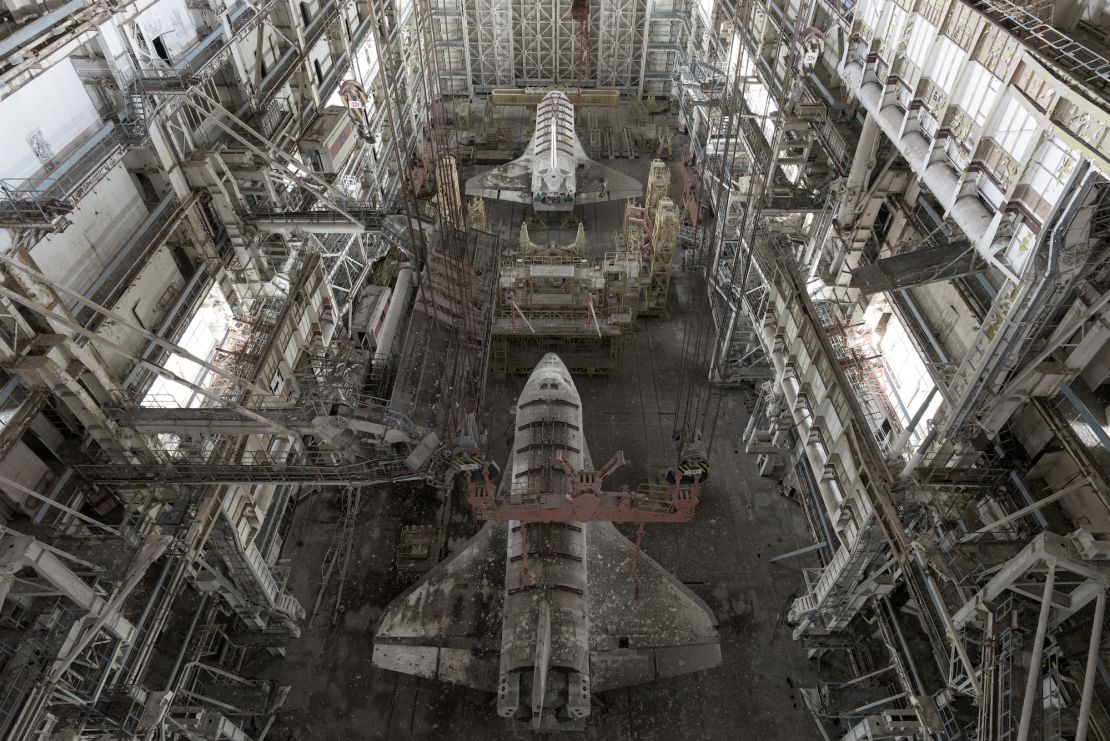
What would happen if you run it on a spacecraft? Blank image comes back?
There are plenty of grungy spacecraft images out there.
Buran in storage: https://edition.cnn.com/style/article/baikonur-buran-soviet-...
Image link: https://media.cnn.com/api/v1/images/stellar/prod/17103111131...

Pretty much any place with brutalist architecture, really. I'll happily take pretty much any revival or classical style over "modern" or brutalist style.
There's nothing more depressing than walking by beautiful historic old buildings only to turn a corner and see a monstrosity of concrete and glass somehow reaching the epitome of bland and uninviting.